
Intonation Balance and Blend
Band Worksheets · Jump to the free PDF
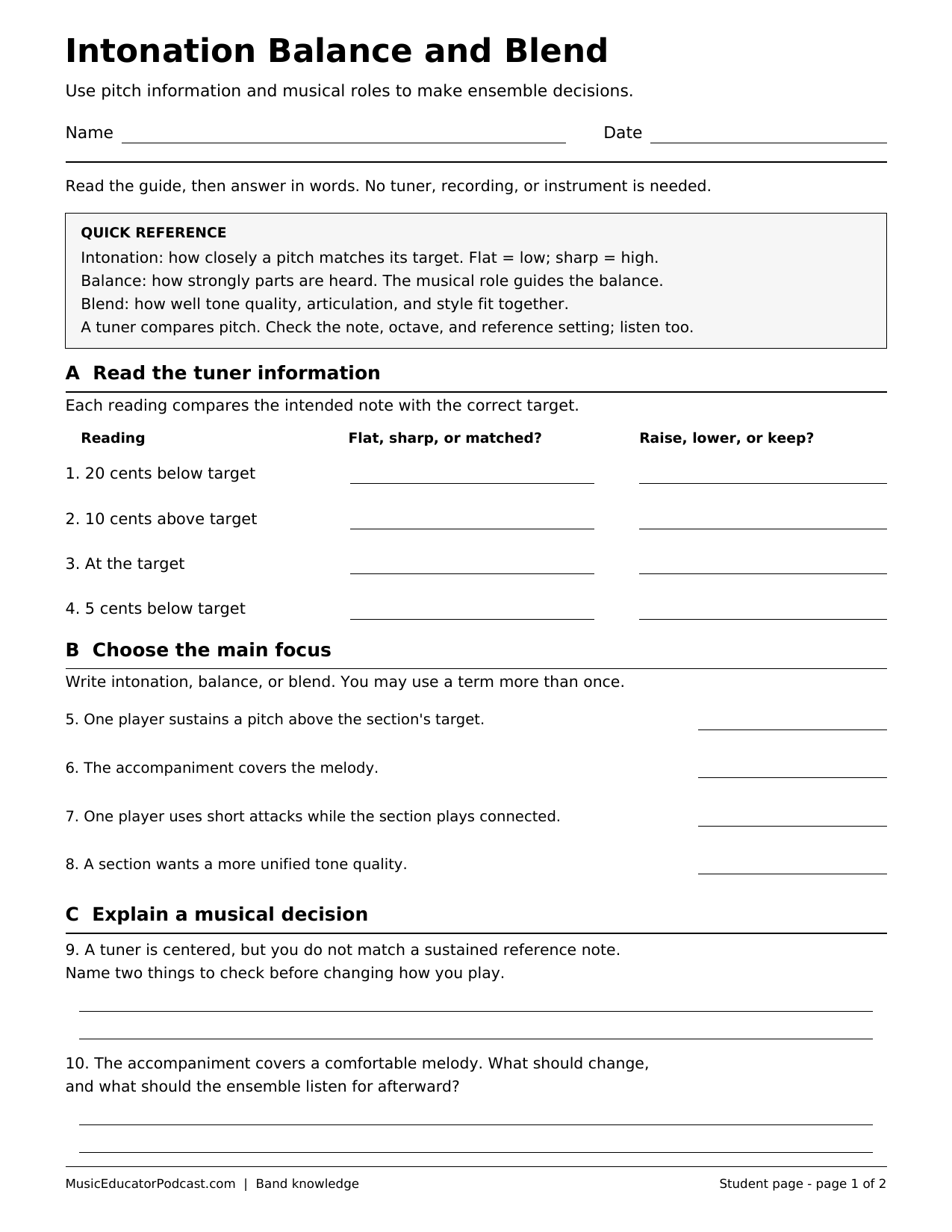
Musicians need different responses to a pitch that is too high, an accompaniment that covers the melody, and a section that lacks a unified sound. Intonation Balance and Blend helps students distinguish those problems through written tuner readings and short ensemble scenarios. No audio or instruments are required.
Download and print
Download worksheet and answer key (2-page PDF)
Print page 1 for students. Page 2 is the matching answer key. The free download requires no account.
One student page with four tuner-information items, four classification scenarios, and two short explanations, followed by a matching key with sample responses. The two-page US Letter PDF prints clearly in black and white.
What students practice
- Describe a pitch as flat, sharp, or matched relative to its target.
- Choose whether a pitch needs to rise, fall, or stay at the target.
- Distinguish intonation, balance, and blend in short musical situations.
- Propose a balance adjustment and describe a listening check.
Classroom use
Use the reference box to establish shared vocabulary, then let students work independently through the scenarios. When instruments are available again, connect one written response to an actual listening example. Treat physical tuning adjustments as instrument-specific instruction rather than a single rule for the whole band.
Common questions
Is a real tuner needed?
No. The worksheet supplies written readings relative to the correct target.
Does a centered tuner guarantee an ensemble match?
No. Students are asked to check the intended note, octave, and reference setting, then listen and compare.
Are the written explanations graded word for word?
No. The key provides sample responses; accept another musically sound explanation that addresses the problem and includes a useful check.