
Parts of the Flute
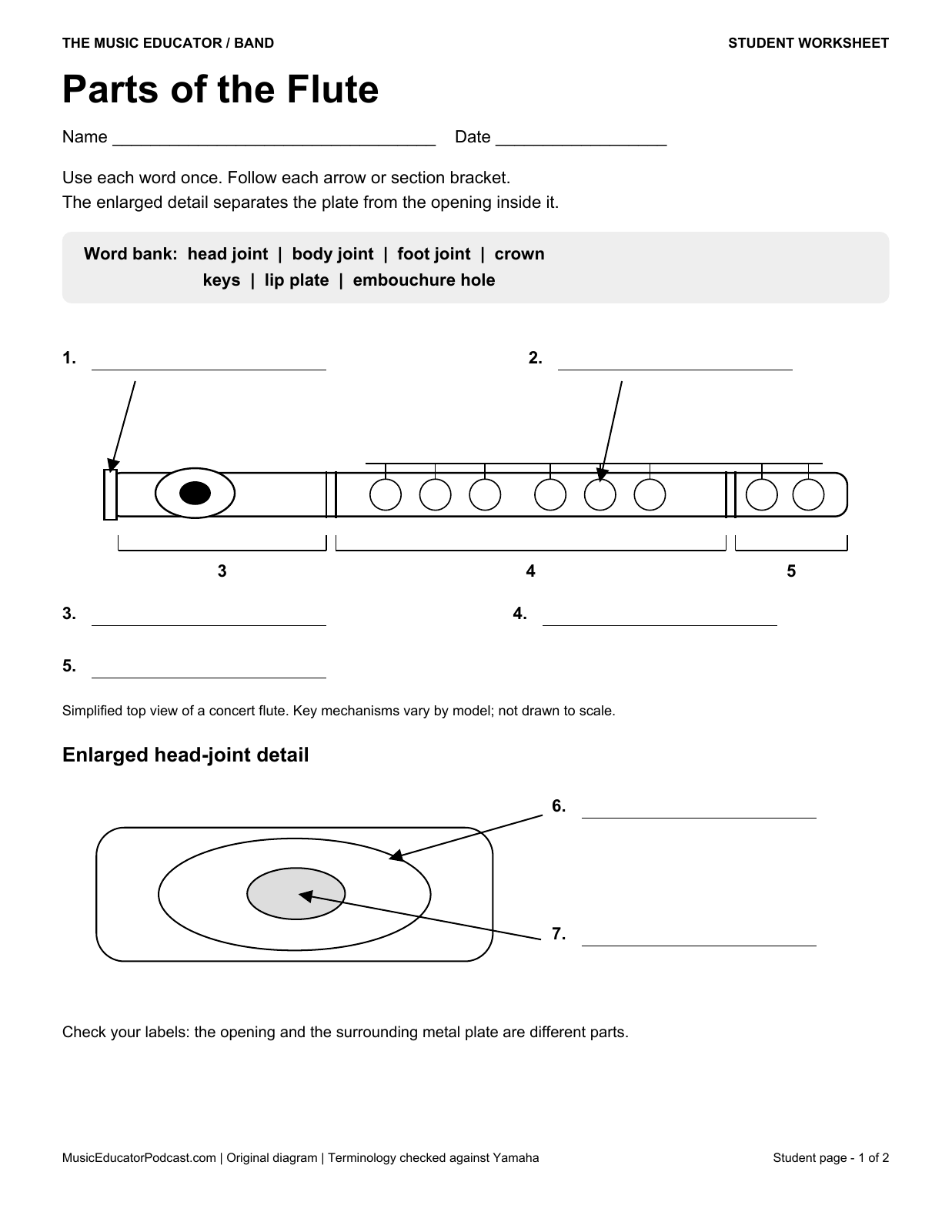
Help beginning players identify seven parts of a concert flute with a clear, simplified diagram and an enlarged view of the lip plate and embouchure hole. Students use the word bank to label the crown, headjoint, bodyjoint, footjoint, keys, lip plate, and embouchure hole.
Download the worksheet and answer key
Download Parts of the Flute with answer key (2-page PDF)
US Letter. Print page 1 for students; page 2 is the matching teacher key.
Learning goals
- Identify the three main sections of a concert flute.
- Distinguish the lip plate from the embouchure hole within it.
- Locate the crown and the key mechanism.
Use it in class
Show the assembled instrument before distributing the worksheet. Point out the joints, then compare the lip plate with its opening. Students should trace each pointer to its endpoint before choosing a word. Brackets indicate whole sections; the inset enlarges the small features near the mouth. The drawing is a teaching model, not a scale diagram.
Use the activity as a short beginning-band review or station. After checking the labels, ask each student to point to the same features on an instrument. Handle instruments according to your classroom procedures and explain that keywork and footjoint designs vary.
Frequently asked questions
Is an answer key included?
Yes. The second page repeats the same diagram and places the correct term beside each numbered label.
Are headjoint and head joint different?
No. These spelling styles refer to the same flute section. The worksheet uses headjoint, bodyjoint, and footjoint consistently.
Why use an enlarged detail?
The lip plate is the surrounding contact surface; the embouchure hole is its opening. The inset makes the two pointer endpoints easier to distinguish.
Terminology checked against Yamaha’s flute structure guide. The diagram is original.