
Guitar Fretboard Note Finder Worksheet
All Free Music Worksheets › Guitar Worksheets
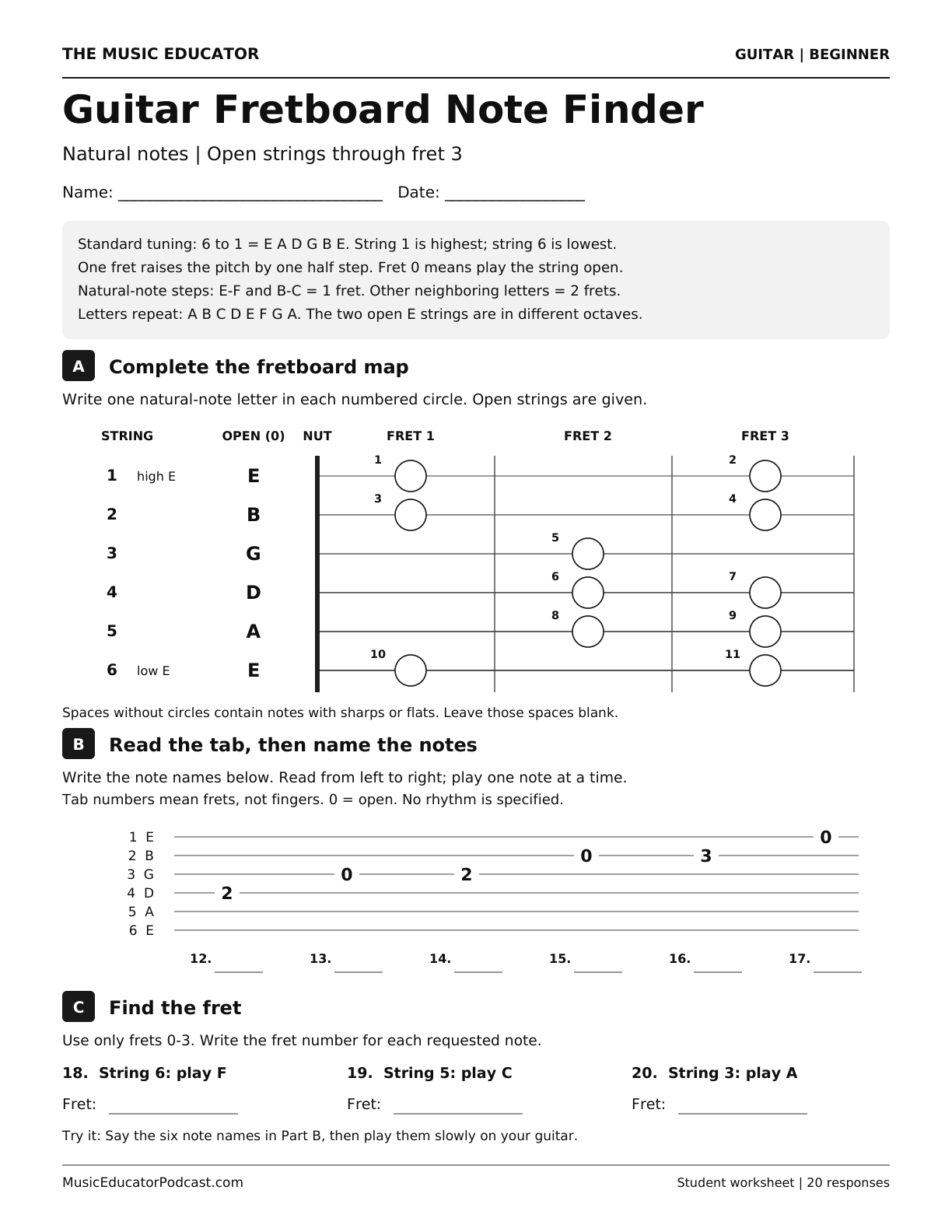
Help beginning guitar students connect string numbers, fret positions, and note names. This free printable uses standard tuning and focuses on natural notes from the open strings through fret 3. Students complete a fretboard map, read a six-note tablature pattern, and work backward from a note name to a fret number.
Level: Beginning guitar Format: One student page + separate answer key Practice: 20 responses
Preview the student worksheet
Download the free PDFs
Print on US Letter paper in black and white. The student and key downloads each contain one page. The combined file puts the student page first and the answer key second.
Download the combined two-page PDF
What students practice
- Locate natural notes on a six-string fretboard map using known open-string pitches.
- Use one-fret and two-fret distances between adjacent natural-note names.
- Read single notes in six-line guitar tablature, including open strings.
- Find a fret number when the string and desired note are given.
Inside the worksheet
Part A: Fill 11 note-name circles on a fretboard map. Part B: Name six notes from tablature. Part C: Find three missing fret numbers. A short reference explains standard tuning, fret steps, and the difference between high and low E. The answer key keeps the same question layout so students and teachers can check each response easily.
Use it in a guitar lesson
Introduce the open strings and show how a fret raises pitch before assigning the page. Model one position, then have students complete the map and use it to check the tab-reading section. Finish by having students say the six notes from Part B and play them slowly, one at a time. The tab gives pitch locations only; it does not specify a rhythm.
Watch for two common mix-ups: reading string 6 as the top line of tablature, and treating every pair of neighboring natural-note letters as one fret apart. Revisit the high-E/low-E labels and the E-F and B-C half steps when checking those errors.
Related guitar worksheets
- Parts of the Guitar Worksheet: connect instrument vocabulary with the guitar students use.
- Chord Grid Reader Worksheet: practice fret positions, open-string symbols, and unplayed strings in chord diagrams.
Frequently asked questions
What level is this worksheet for?
It is for beginning guitar students who have been introduced to string numbers, open-string names, and frets. Students do not need to read staff notation; the page uses a fretboard map and guitar tablature.
Which tuning does it use?
It uses standard six-string tuning: E-A-D-G-B-E from string 6 to string 1. Do not use the answer key for an alternate tuning without adapting the exercise.
Does it include an answer key?
Yes. The answer key is a separate one-page PDF with an answer for every numbered response. A combined PDF places the student worksheet first and the answer key second.
Can it be used without a guitar?
Yes. The written tasks can be completed from the reference and diagrams. Playing the six-note tab pattern afterward is an optional way to connect the written work to the instrument.