
Dynamics Detective: Follow the Volume
Music Theory Worksheets · All Free Music Worksheets
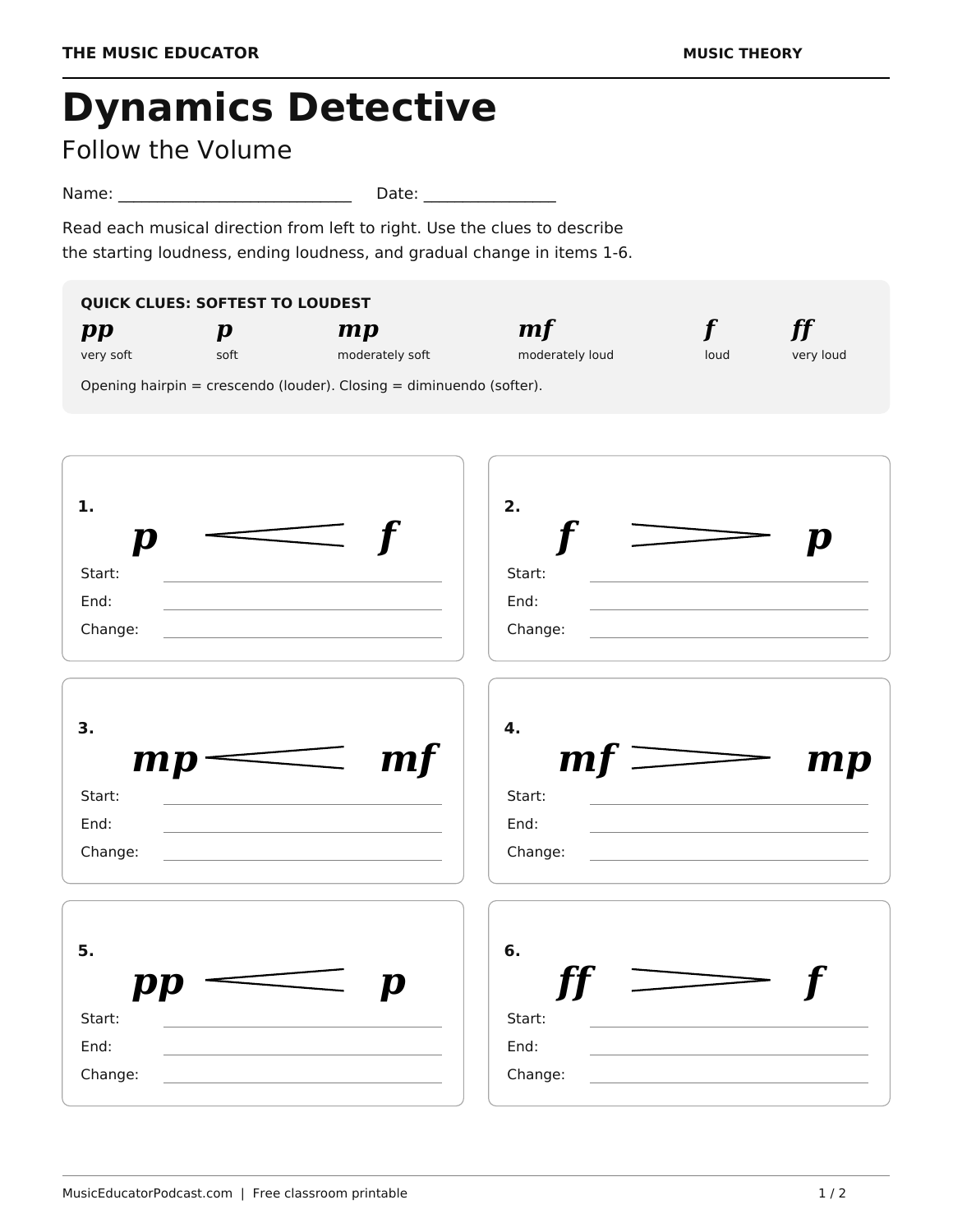
Dynamics Detective helps beginning musicians follow a change in volume from one marking to another. In six short exercises, students name the starting dynamic, name the ending dynamic, and explain whether an opening or closing hairpin means to grow gradually louder or softer.
Download and print
The student-only file is one page. The complete PDF contains the student worksheet followed by the answer key. Both are black-and-white, US Letter printables. If using the complete file, print only page 1 for students. Choose fit-to-page if needed for your printer’s margins.
What students practice
- Interpret pp, p, mp, mf, f, and ff using the printed reference guide.
- Read opening and closing hairpins from left to right.
- Describe the starting volume, ending volume, and gradual change separately.
A short teaching routine
Begin by speaking or playing a short, repeated pattern softly and then loudly. Keep its pace steady so students can concentrate on volume. Model the first exercise by reading the left-hand marking, tracing the opening hairpin, and naming the right-hand marking. Explain that the hairpin describes a gradual change, not an immediate jump.
Let students complete the six examples independently or with a partner. During review, ask them to point to the marking that determines the starting volume and then describe how the sound changes. If a student confuses a closing hairpin with a crescendo, have them trace its wide-to-narrow shape while gradually lowering their voice.
Helpful distinctions
Dynamics describe relative loudness, not a fixed volume setting. For example, p to f and mp to mf both get louder, but they begin and end at different levels. This worksheet uses written endpoints to make each change clear; the hairpin itself does not specify an exact final dynamic.
No note reading or instrument is required. For an optional performance extension, have students speak the same short phrase through one of the printed dynamic changes, without changing its pace.
Related practice
Music Symbols Identification offers broader symbol-recognition practice. Return to Music Theory Worksheets for note reading and rhythm activities.