
Melody Motion: Steps, Skips, and Repeats
Music Theory Worksheets · All Free Music Worksheets
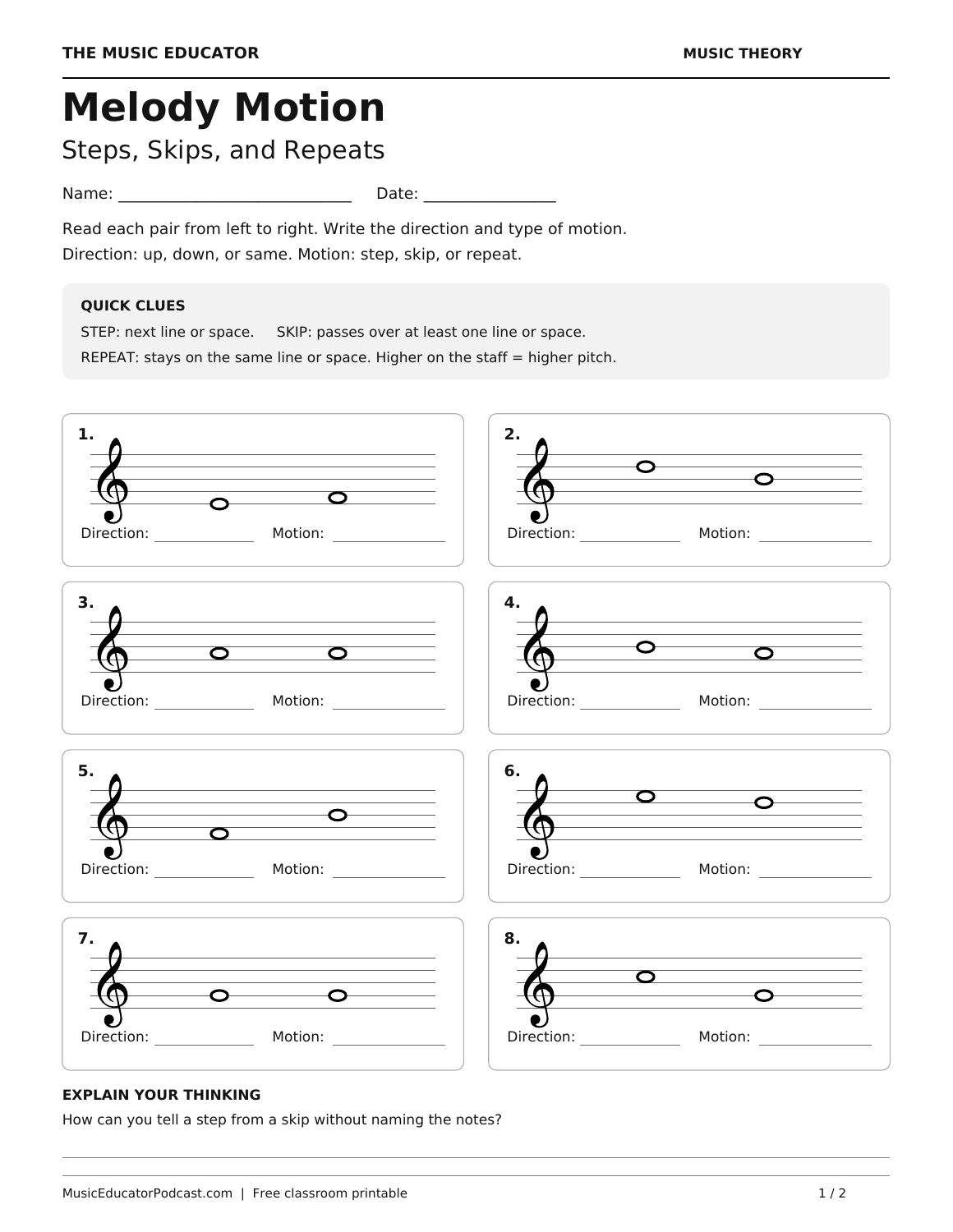
Reading a melody is more than naming isolated notes. Melody Motion asks beginning readers to compare two notes, notice whether the second pitch moves up, down, or stays the same, and identify a step, skip, or repeat. Eight treble-clef examples keep the focus on staff position rather than speed or memorized letter names.
Download and print
The student version is one page. The complete file has the student page first and the answer key second. Both use US Letter paper and black-and-white notation. Print only page 1 for students if using the complete file; choose your printer’s fit-to-page setting if its margins require it.
What students practice
- Read note pairs from left to right and compare their vertical positions.
- Distinguish upward, downward, and repeated pitches.
- Identify a step as the next line or space and a skip as movement past at least one staff position.
- Explain the difference between steps and skips without relying on note names.
A short classroom routine
First, model one pair on the board. Point to each note in reading order, then have students trace the change in height with a finger. Ask for direction before asking for motion: a pair can move down by either a step or a skip. Students then complete the eight pairs independently or with a partner and answer the final reasoning prompt.
During review, ask students to point to the intervening line or space in a skip. If a student calls every upward pair a step, separate the two decisions again: direction describes where the pitch goes; motion describes how far it moves through staff positions. For a short extension, students can draw a new note pair and exchange it with a partner to classify.
Common questions
Do students need to know the note names?
No. This worksheet targets relative position on the staff. Familiarity with lines, spaces, and left-to-right reading is enough to begin. Naming the notes can be an optional follow-up.
Is this a rhythm exercise?
No. All examples use the same note shape so students can concentrate on pitch movement. There is no time signature or beat-counting task.
Can I use this in band, choir, or piano?
Yes, as an introductory notation-reading activity. The printed examples use treble clef. Students working primarily in another clef may still compare direction and staff positions, but this sheet does not assess note naming in their clef.
Related practice
- Treble Clef Space Note Names – connect familiar staff spaces to letter names.
- Note Reading Worksheet 1 – continue practicing written note recognition.