
Rhythm Detective: Repair the Measure
Music Theory Worksheets · All Free Music Worksheets
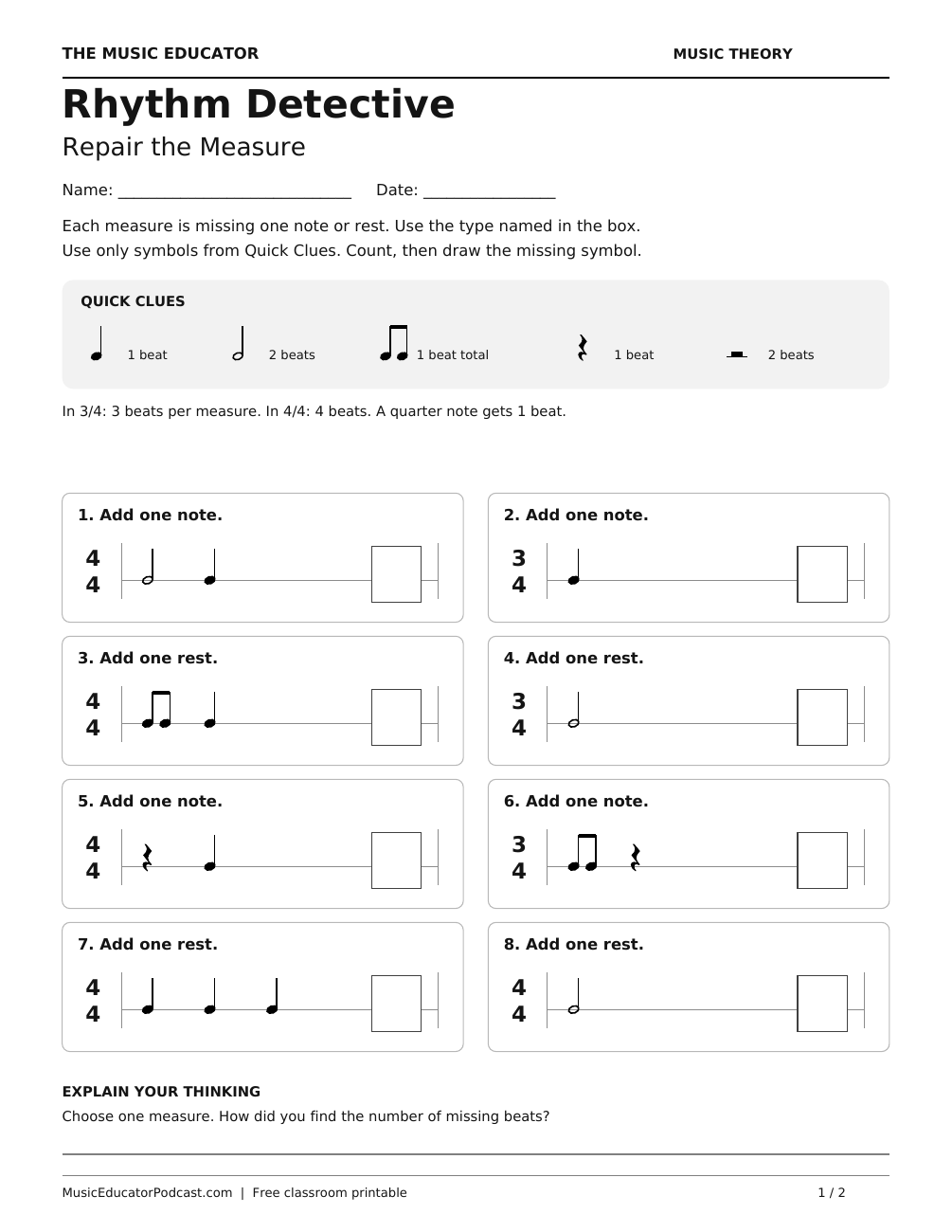
A measure can look almost complete and still be missing a beat. This printable asks beginning musicians to inspect eight short rhythms, count the notes and rests already present, and supply exactly one missing note or rest. Unlike a note-value arithmetic drill, every answer completes a measure in 3/4 or 4/4.
What students practice
- Read the beat total from a 3/4 or 4/4 time signature.
- Count quarter notes, half notes, beamed eighth-note pairs, and quarter rests.
- Choose a quarter or half note or rest to complete a measure.
- Explain a solution using the beats shown and beats still needed.
Download and print
The complete PDF contains one student page followed by its matching answer key. A student-only PDF is also available. Both are US Letter portrait, with black-and-white notation and handwriting space. Print page 1 for students; keep page 2 for checking. Use Actual Size or 100% when printing on US Letter paper.
A short teaching routine
Review the Quick Clues strip first. Model the process aloud: identify the required total, count what is present, and subtract to find what is missing. Students then complete the eight boxes independently or with a partner. Check both the duration and the required type: a note is not interchangeable with a rest, even when both occupy the same number of beats. Finish by having students tap or clap a completed measure, keeping a silent pulse during rests.
The single horizontal line is a rhythm staff, not a pitch-reading exercise. Students do not need to identify treble- or bass-clef pitches.
Common checks
- Two connected eighth notes together occupy one quarter-note beat, not two beats.
- The upper time-signature number gives the beats per measure here; the lower 4 makes the quarter note the beat unit.
- A half rest sits on its short reference line. Check that a student's drawn symbol is distinguishable from a whole rest.
Frequently asked questions
Who is this for?
Beginning music readers who have already met quarter and half notes, eighth-note pairs, and basic rests. The same page can support general music, beginning band, orchestra, or choir rhythm work.
Does the packet include answers?
Yes. Page 2 places the correct notation in the same numbered boxes as the student page. It also models the written explanation for item 1.
Is this a pitch-reading worksheet?
No. The one-line staff isolates rhythm so students can concentrate on duration and meter rather than note names.
How can I extend the activity?
After checking an answer, ask a student to replace a note with a rest of the same duration, perform both versions, and describe what changed and what stayed the same.
Related practice
- Note Value Practice: 10 Worksheets – build fluency with note and rest durations.
- Music Symbols Identification – review the symbols used in written music.