Bow Direction Detective: Four Orchestra Worksheets
Orchestra Worksheets · All Free Music Worksheets
Bow Direction Detective gives beginning string players repeated practice reading down-bow and up-bow symbols, following slurs, and planning changes of bow direction. The four connected worksheets include 40 original exercises, with 10 on each page. Use them in order or choose the practice your ensemble needs.
The rhythm-only examples work for violin, viola, cello, and double bass students without requiring a shared clef. They focus on written bow plans, not note names or an assessment of physical bow technique.
Download the series
All files are US Letter and black-and-white friendly. The student file contains no answers. The complete file has student pages 1–4 followed by their matching keys on pages 5–8. Each individual download below contains one student page followed by its key; print only page 1 for students.
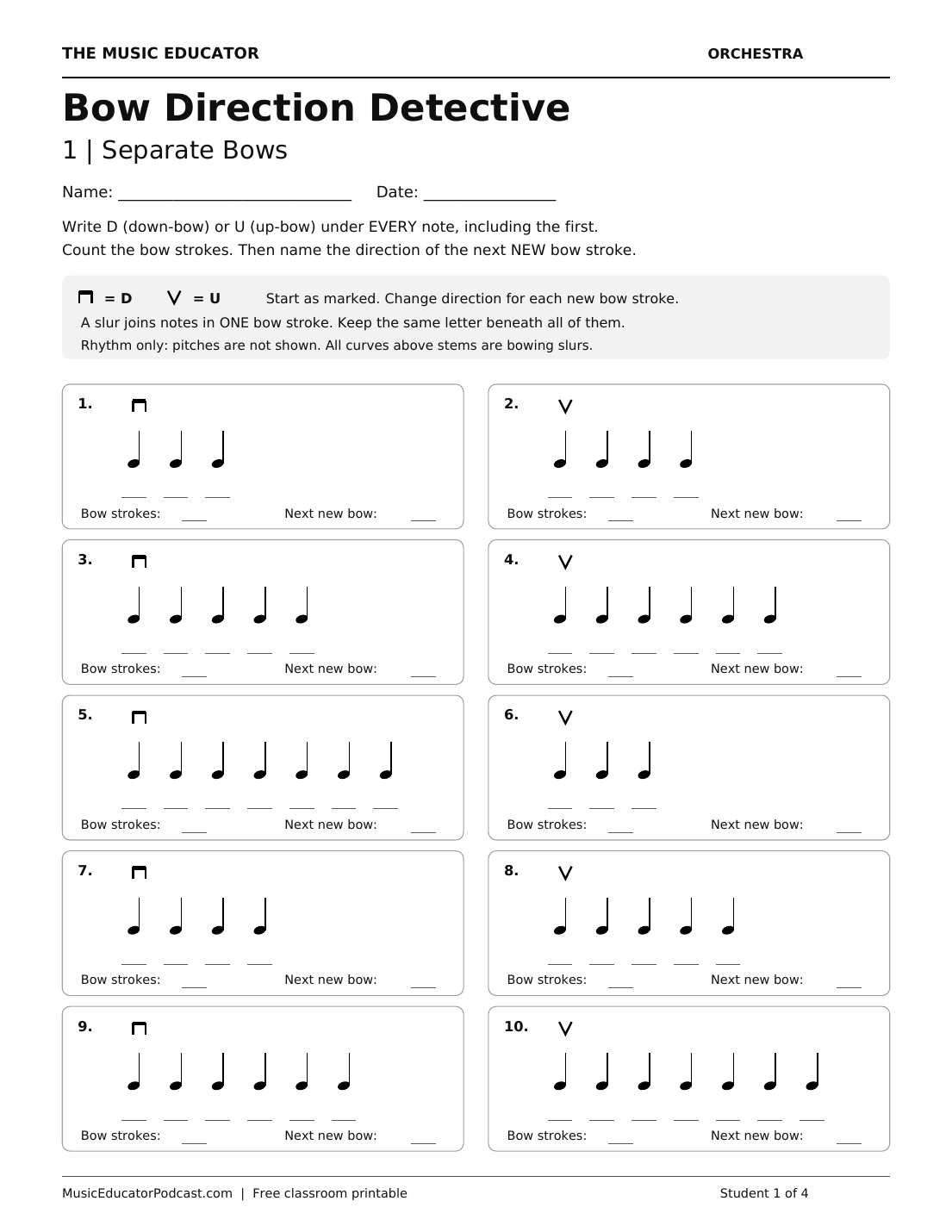
1. Separate Bows
Start with separate quarter notes. Students identify each down-bow or up-bow, count the strokes, and predict the direction of the next new stroke. The starting symbol and number of notes change between examples.
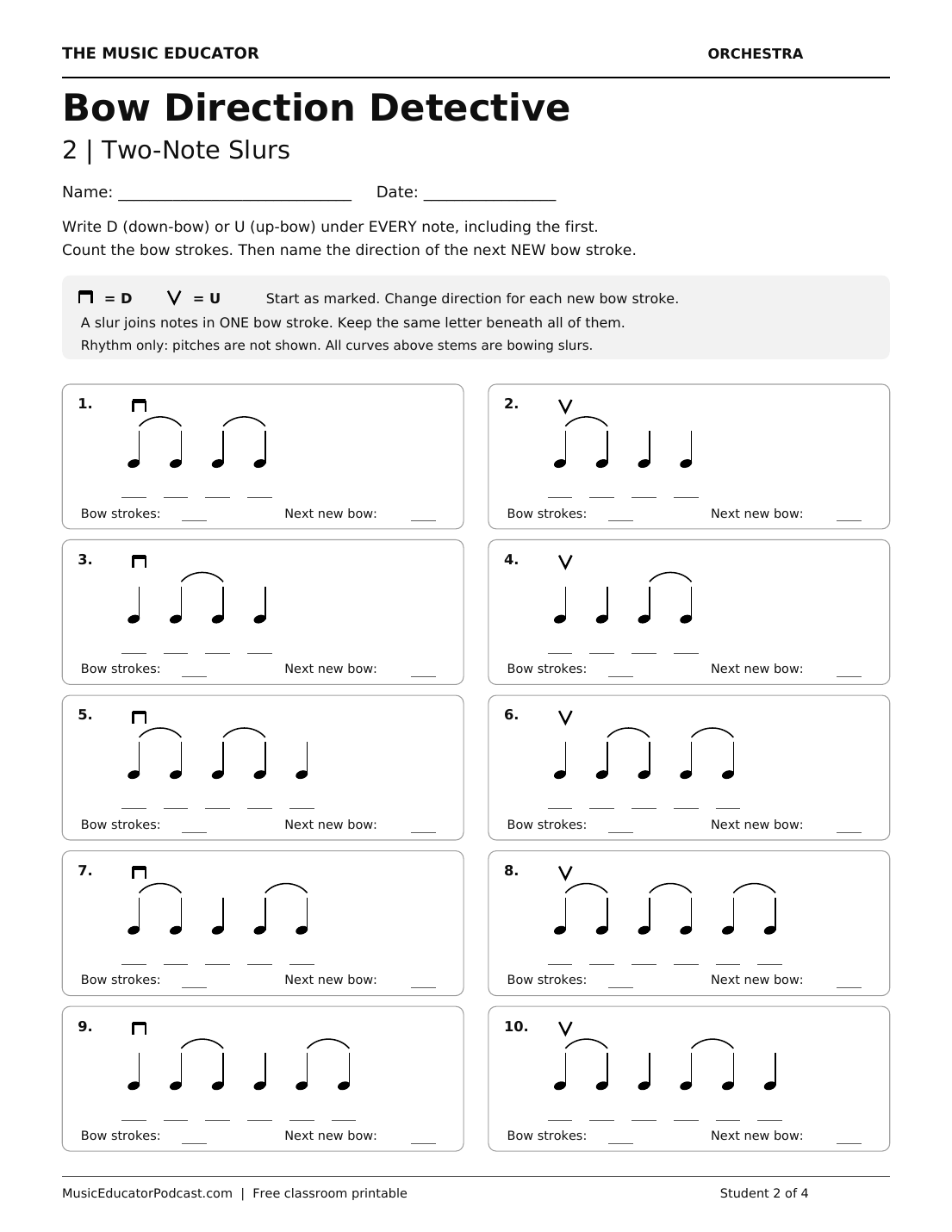
2. Two-Note Slurs
Introduce pairs of notes played in one bow stroke. Students keep the same direction within each slur and alternate direction when a new stroke begins. Separate notes appear between and around the slurs.
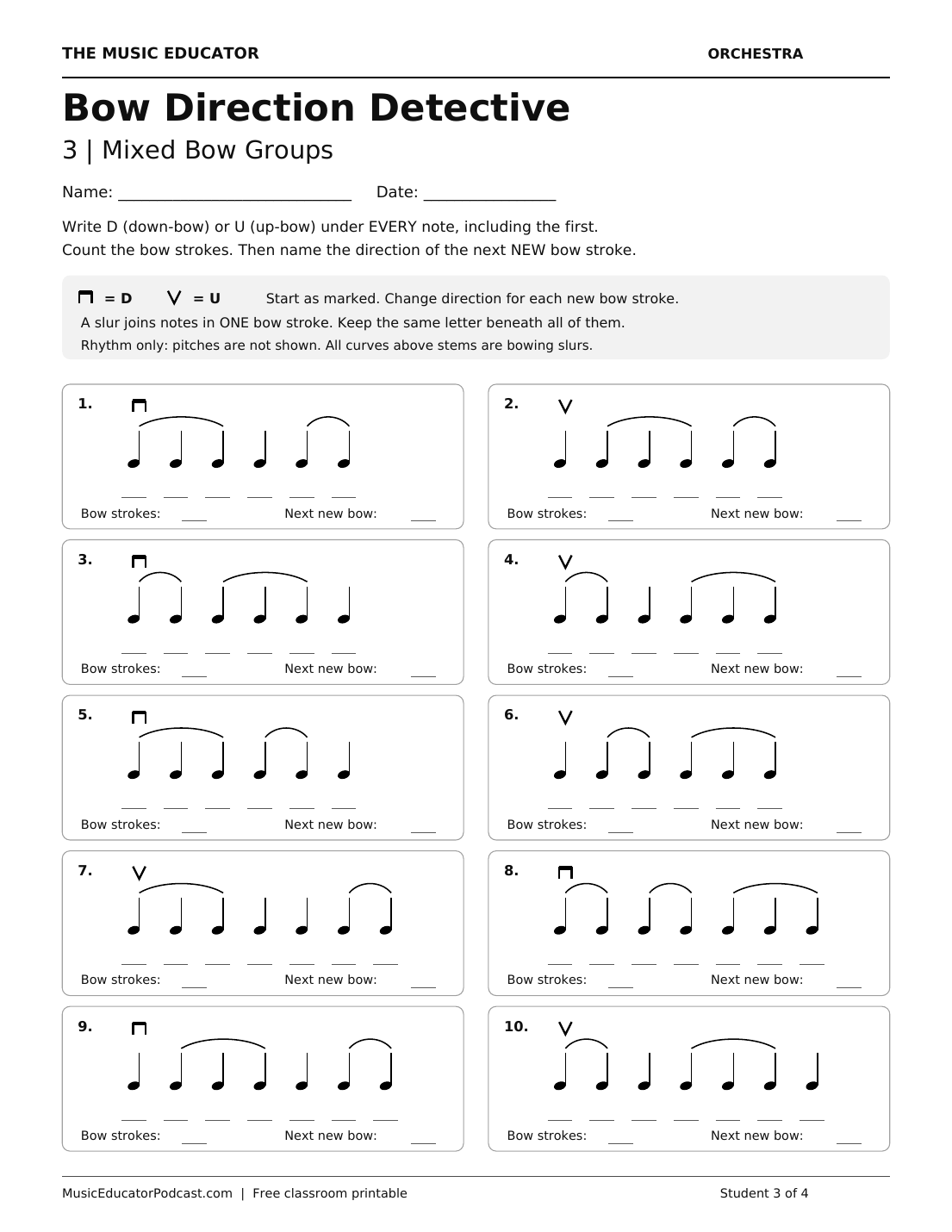
3. Mixed Bow Groups
Combine single notes with two-note and three-note slurs. Students follow changing group lengths rather than alternating letters automatically on every note. Each example asks for the full direction plan, stroke count, and next new bow.
4. Repair the Bow Plan
Apply the same rules as an error detective. Every printed plan contains exactly one wrong letter. Students circle the error and write the complete corrected sequence using the starting bow symbol and slurs.
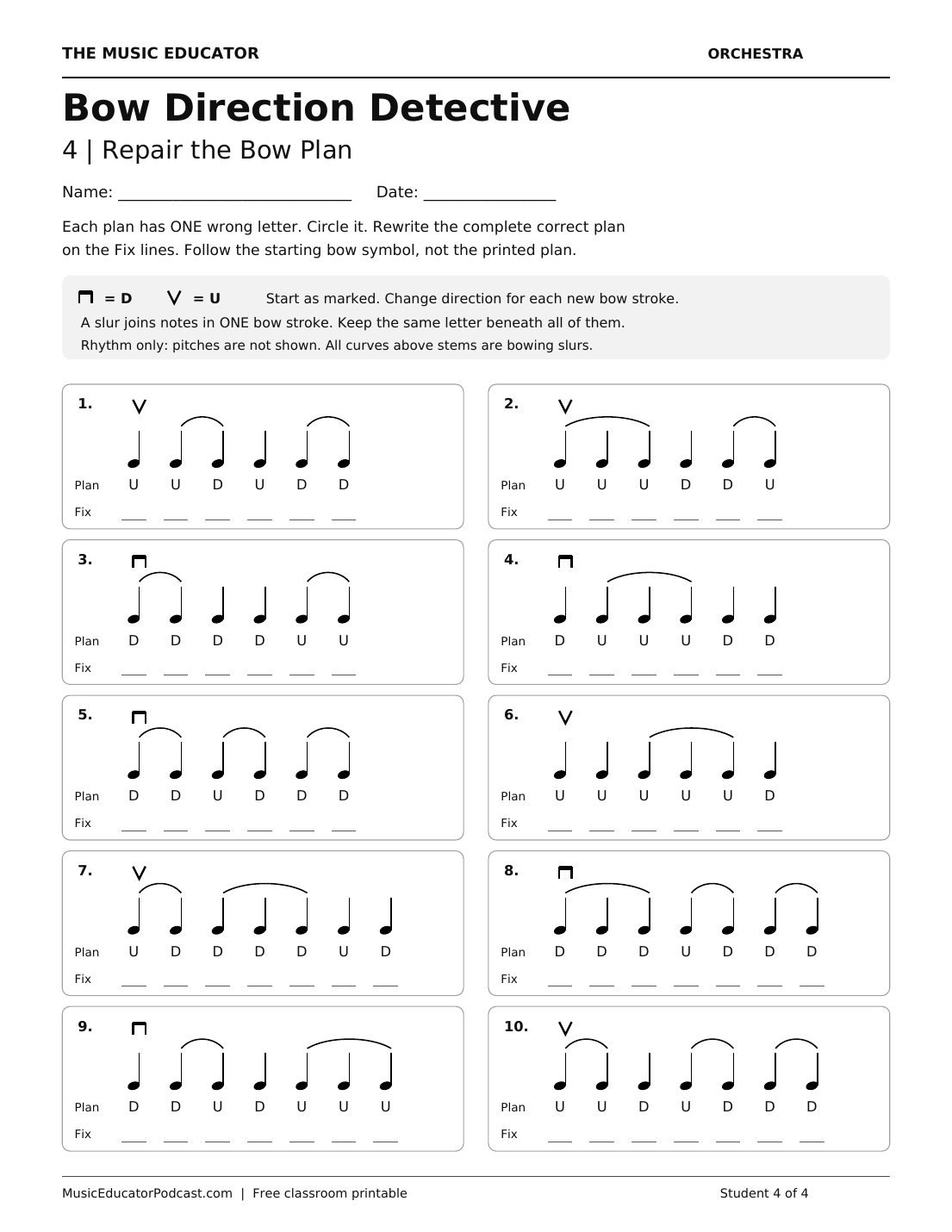
What students practice
- Recognize down-bow and up-bow symbols and record directions as D and U.
- Keep one direction across notes joined by a bowing slur.
- Distinguish the number of notes from the number of bow strokes.
- Predict a new stroke and explain or repair a written bow plan.
A practical teaching sequence
Begin with the symbol legend. Model a short separate-bow sequence aloud, saying “down, up” as you point to each note. Then contrast two separate notes with two notes under one slur: the second example uses one stroke, not two.
Assign one page at a time. During review, ask students to show the exact point where a new bow begins before they give the next letter. If they change direction inside a slur, trace the whole curve together and repeat the same direction beneath its notes. Use the repair page after students can explain their choices on the earlier sheets.
Common questions
Are these pitch-reading worksheets?
No. The examples show rhythm only, without a staff or clef. All curves above stems are explicitly identified as bowing slurs. This lets a mixed string class focus on the same skill.
Do bows always alternate?
These exercises ask students to alternate for each new stroke and maintain the direction within a slur. Other music may include repeated bow directions, retakes, or special articulations. Those exceptions are not included here.
Where are the answer keys?
The “Answer keys only” button opens all four teacher pages. Each individual worksheet PDF also includes its matching key on page 2. The complete eight-page PDF places all four student sheets first and all four keys second.
Related orchestra practice
Parts of the Violin & Viola Bow supports the vocabulary used when discussing a bow. Visit Orchestra Worksheets for the violin/viola, cello, and double-bass anatomy resources.