
Guitar Skills Lab
Give beginning guitar students a clear way to read the information on the page before they play. This six-worksheet set covers standard tuning, tablature, fret distances, E-minor and E-major shapes, strum starts, and chord tones. Original diagrams keep string numbers, fret numbers, and sounding notes distinct.
6 original worksheets · 8 questions per worksheet · 6 matching answer keys
US Letter • black-and-white • no signup required
Download the complete guitar packet (PDF, 12 pages)
Printing: The complete packet puts six student pages first, followed by six keys. Print pages 1–6 for students and keep pages 7–12 for checking. Each individual PDF below contains its student page first and answer key second. Print page 1 only for a student copy.
What students will practice
- Connect string numbers with open-string notes in standard six-string tuning.
- Read string, fret, and event order from simple tablature.
- Measure half-step and whole-step distances on one string.
- Compare chord shapes, identify repeated chord tones, and follow a strum-start grid.
Choose a worksheet
- Guitar Standard Tuning Map
- Guitar Tablature Path Reader
- Guitar Chord Change Map
- Guitar Fret Distance Lab
- Guitar Strum Onset Grid
- Guitar Chord-Tone Detective
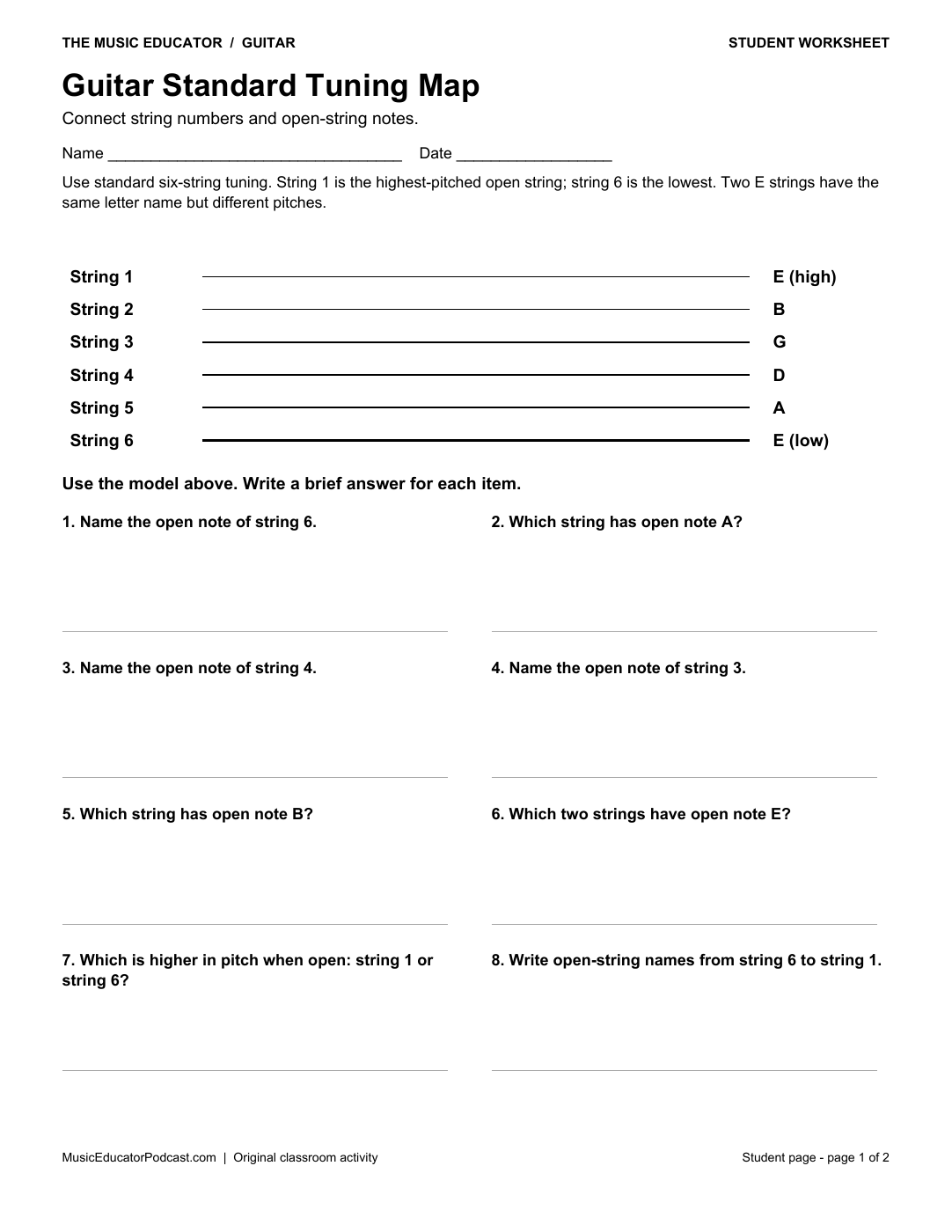
Guitar Standard Tuning Map
Read a six-string tuning map from high E to low E and back. Students distinguish the same letter name from the same pitch.
Download Guitar Standard Tuning Map + answer key (PDF, 2 pages)
Preview the student page: Guitar Standard Tuning Map
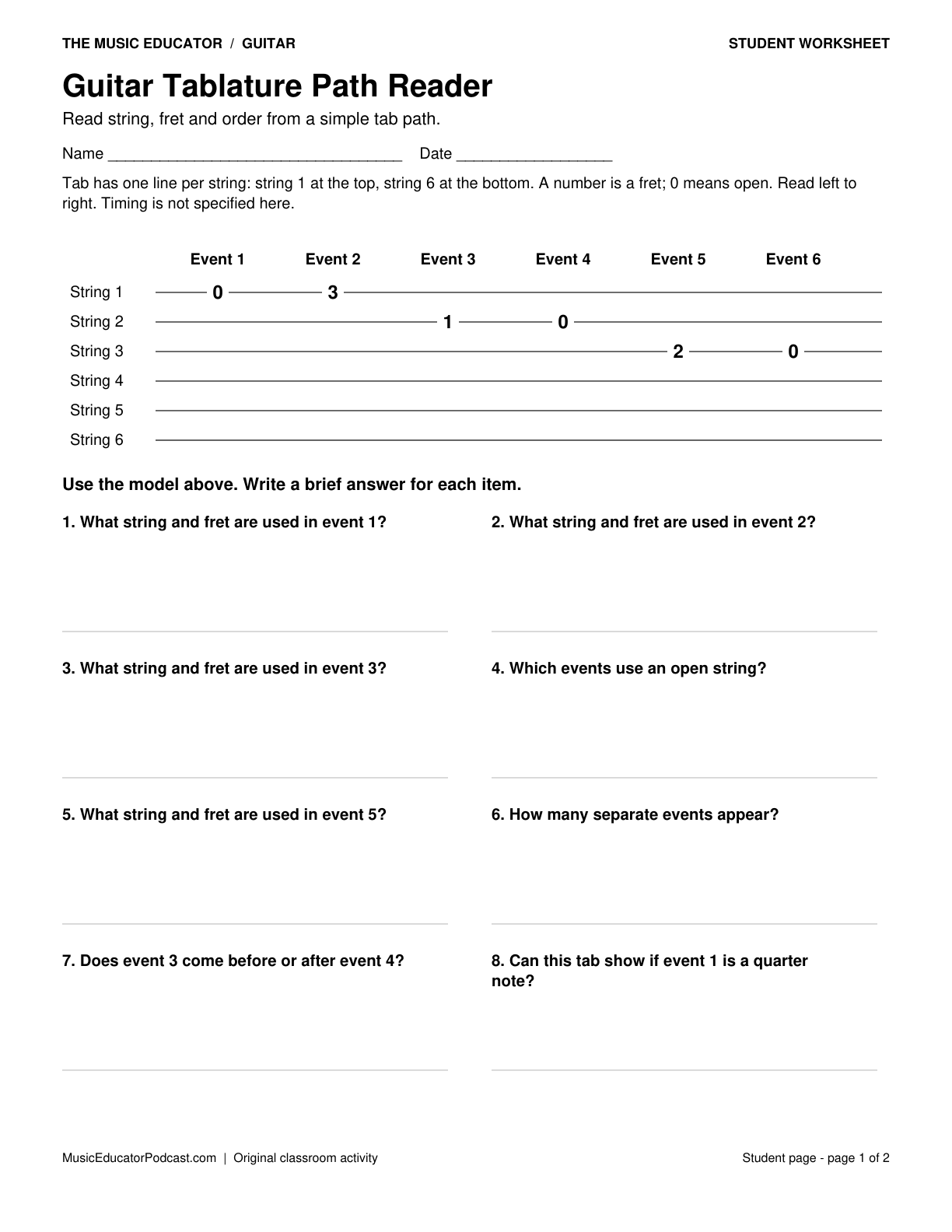
Guitar Tablature Path Reader
Decode six original tab events numbered 1–6. The task checks open strings, fret numbers, reading order, and the limits of tab without rhythmic notation.
Download Guitar Tablature Path Reader + answer key (PDF, 2 pages)
Preview the student page: Guitar Tablature Path Reader
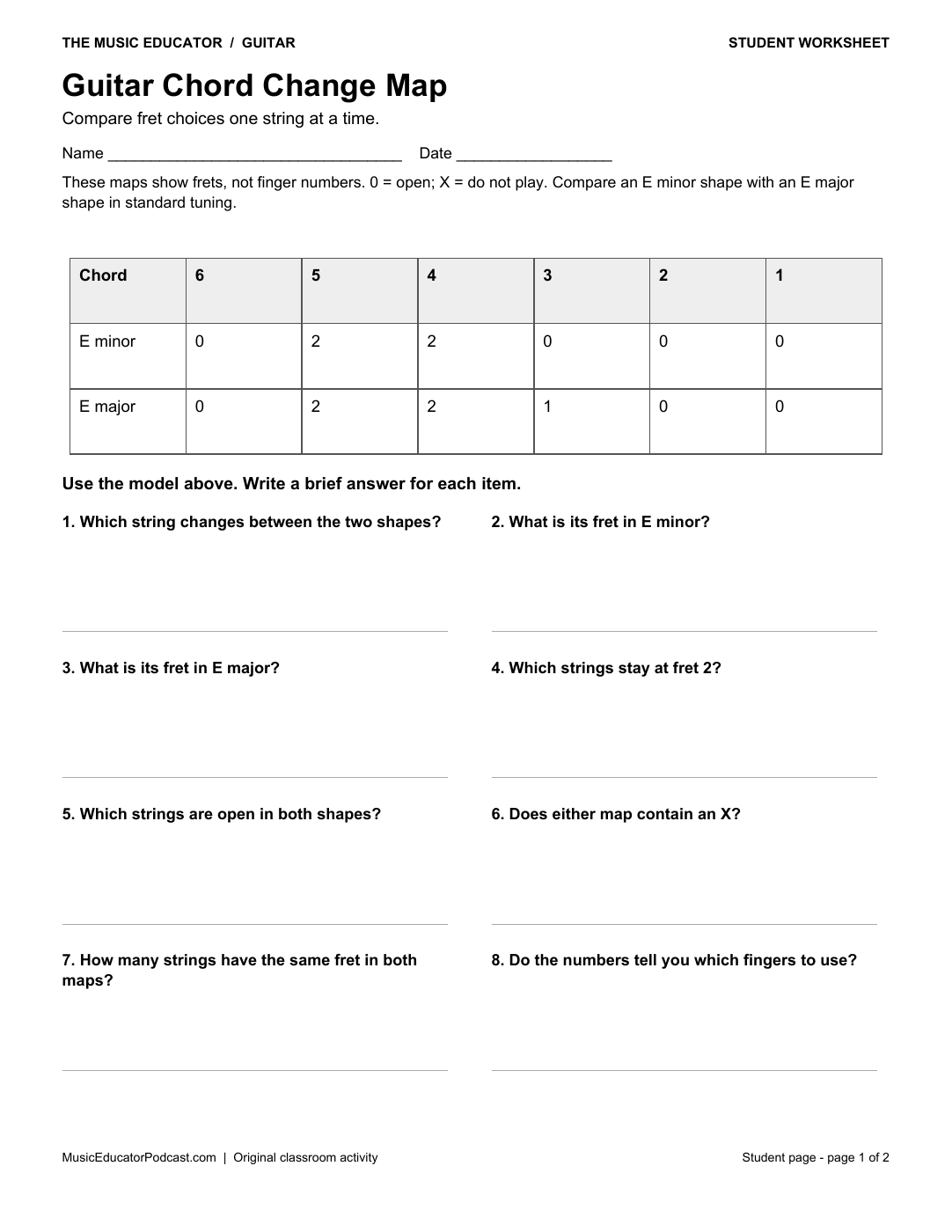
Guitar Chord Change Map
Compare E minor and E major string by string. Students identify the single changed fret and explain why the numbers are not finger numbers.
Download Guitar Chord Change Map + answer key (PDF, 2 pages)
Preview the student page: Guitar Chord Change Map
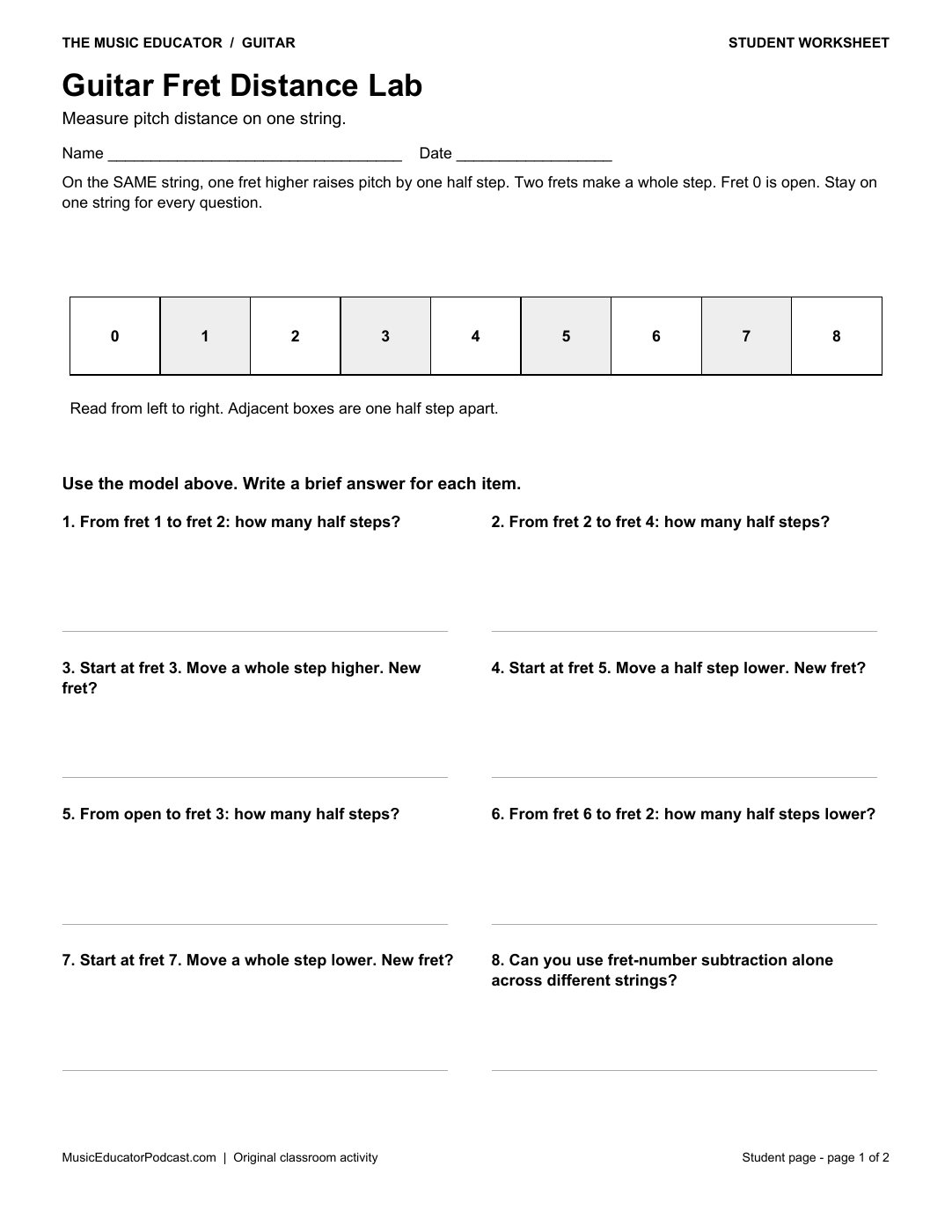
Guitar Fret Distance Lab
Calculate pitch distances on one string using a fret-number strip. The final question explains why crossing strings requires more information.
Download Guitar Fret Distance Lab + answer key (PDF, 2 pages)
Preview the student page: Guitar Fret Distance Lab
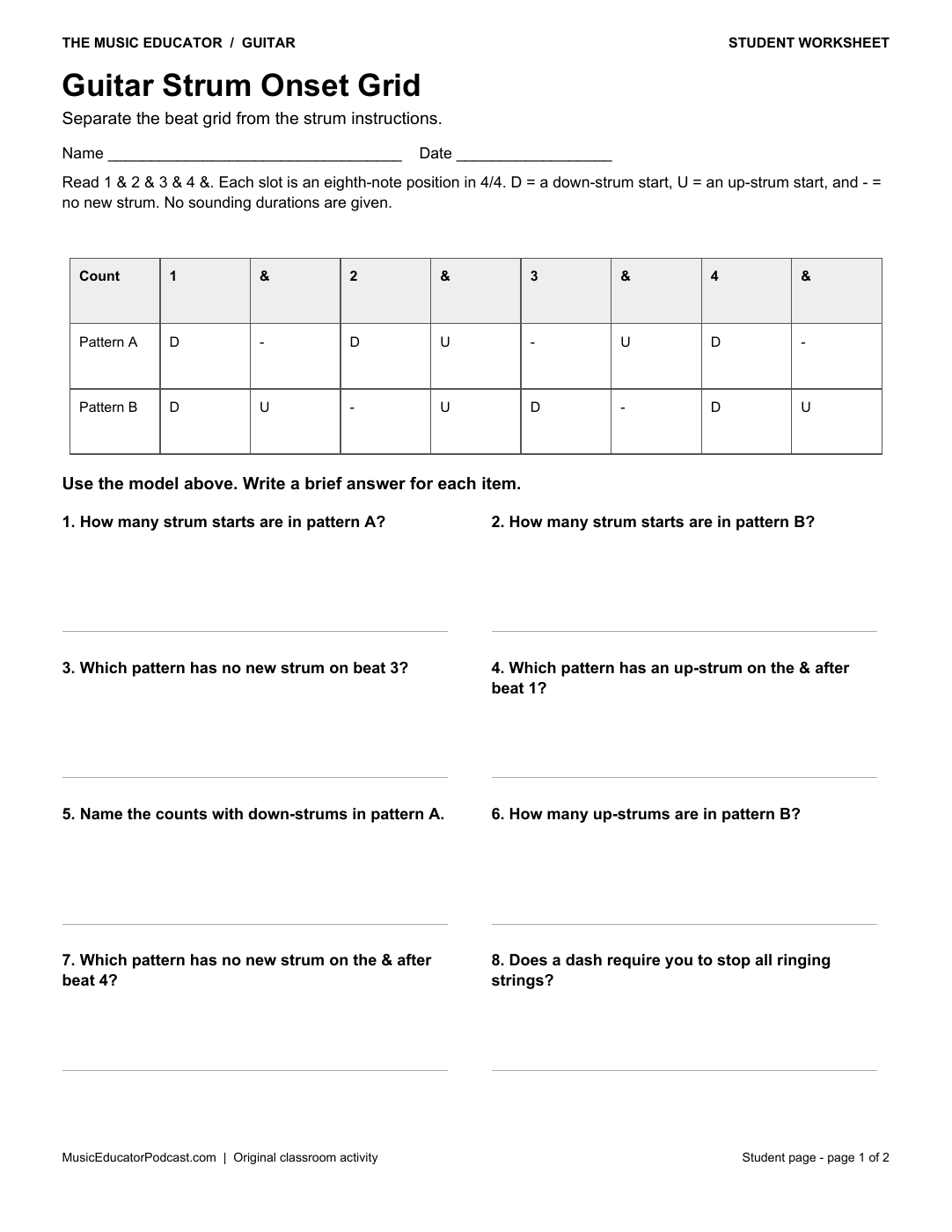
Guitar Strum Onset Grid
Read two patterns on a 1 & 2 & 3 & 4 & grid. Students count starts and locate down-strums, up-strums, and gaps.
Download Guitar Strum Onset Grid + answer key (PDF, 2 pages)
Preview the student page: Guitar Strum Onset Grid
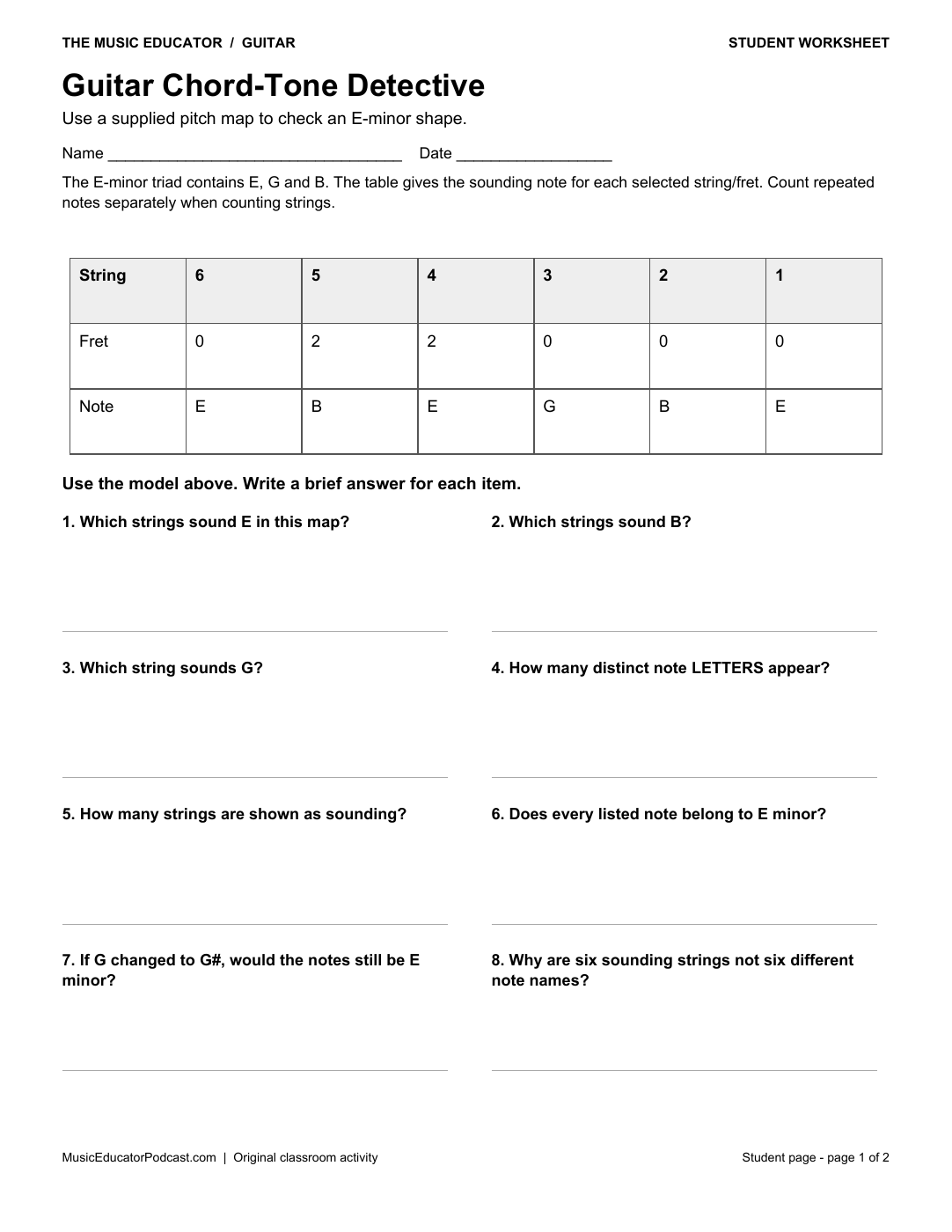
Guitar Chord-Tone Detective
Inspect the supplied E-minor fret-and-note map. Students distinguish six sounding strings from three distinct note names and identify the change to E major.
Download Guitar Chord-Tone Detective + answer key (PDF, 2 pages)
Preview the student page: Guitar Chord-Tone Detective
How to use this set
Use one worksheet as a short lesson starter, station, or substitute activity. After a student identifies an event, ask them to say both the string number and fret number. For chord work, compare the two E shapes one string at a time before playing. On the strum grid, keep a steady spoken count and trace D or U only where shown. A dash means no new strum, not an instruction to damp every ringing string.
Teacher questions
Which tuning do these worksheets use?
Standard six-string tuning: E–A–D–G–B–E from string 6 to string 1. They are not written for alternate tunings or a four-string instrument.
Does the tablature include rhythm?
The tab activity specifies string, fret, and order only. Its answer key explicitly notes that note durations cannot be inferred from this example.
Can students work without a guitar?
Yes. Every written question uses a printed model. Follow with instrument practice when available, checking that students transfer the map to the correct strings.
Are answer keys included?
Yes. All six activities have matching answer keys. Accept equivalent wording when the musical meaning is correct. Use the keys to discuss the reasoning, not only to mark an answer.