
Fades and Smooth Joins
All Music Technology Worksheets
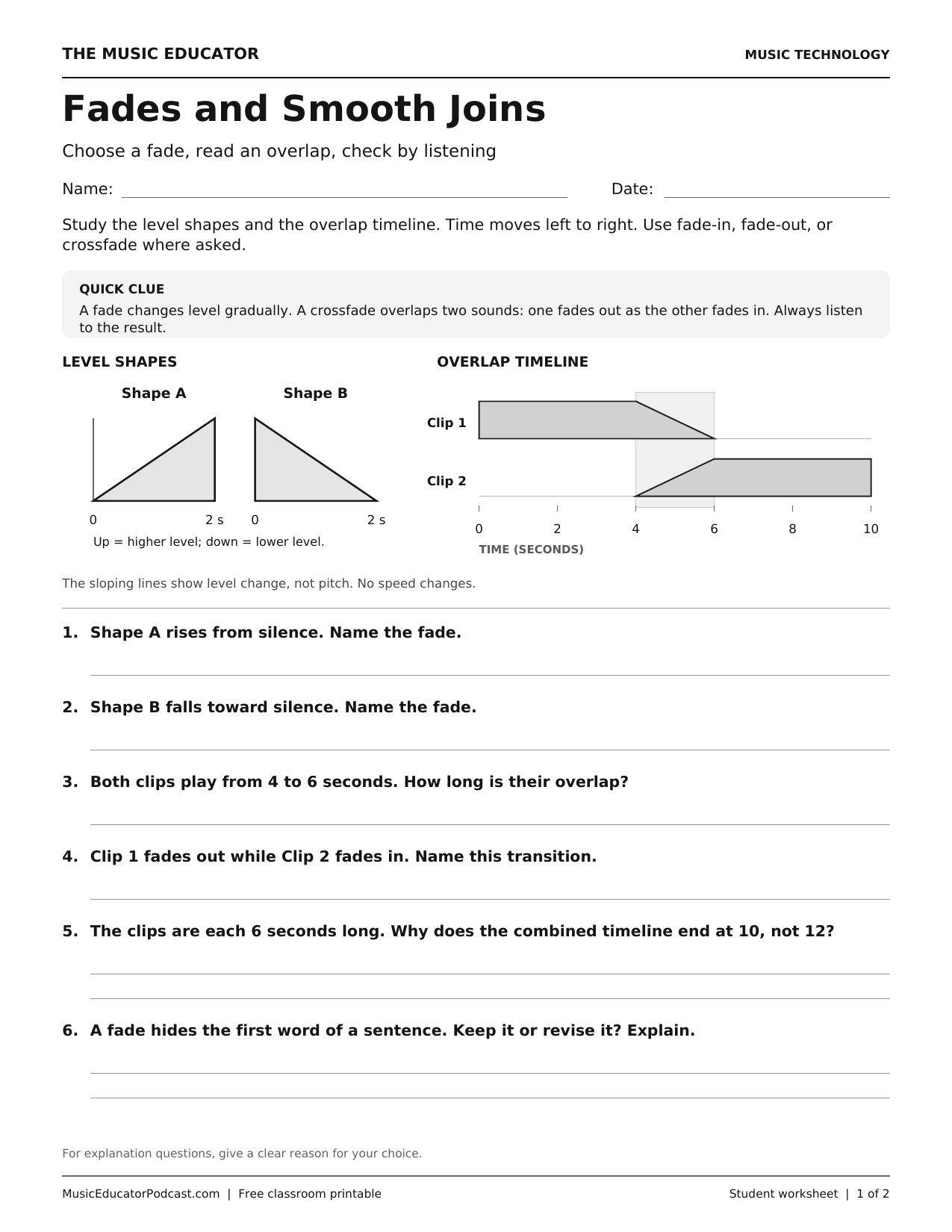
A smooth-looking transition is not automatically a good edit. This worksheet uses simple level shapes and two overlapping clips to teach fade direction, crossfade timing, and the need to protect speech. Students finish by evaluating a fade that masks a word rather than treating every fade as an improvement.
Learning objectives
- Identify fade-in and fade-out level shapes.
- Describe the two simultaneous changes in a crossfade.
- Calculate overlap time and combined clip duration.
- Revise a transition that reduces speech clarity.
How to use this worksheet
Use this after students have practiced selecting and moving clips. Demonstrate the same phrase with no fade, a suitable fade, and an overly long fade. Ask students to explain what they hear rather than choosing by the display alone.
What is included
The free two-page US Letter PDF contains one student worksheet followed by its matching answer key. Print page 1 for students; keep page 2 for discussion or checking. No audio files or software account are required.
Download worksheet and answer key (PDF)
Frequently asked questions
Does a fade change pitch?
Not in this worksheet. The diagrams show a gradual change in audio level.
Is two seconds the correct length for every crossfade?
No. It is the supplied length for this exercise. Suitable timing depends on the sounds and the intended result.
Will a fade fix every click or bad edit?
No. Fades can help some abrupt boundaries, but students still need to listen and revise the edit.