
Piano Skills Lab
Help beginning piano students connect keyboard geography with musical decisions. These six printable activities move from black-key names and interval numbers to triads, inversions, two-hand entrances, and phrase patterns. Each page supplies a clear model so students can explain an answer before trying the idea at a keyboard.
6 original worksheets · 8 questions per worksheet · 6 matching answer keys
US Letter • black-and-white • no signup required
Download the complete piano packet (PDF, 12 pages)
Printing: The complete packet puts six student pages first, followed by six keys. Print pages 1–6 for students and keep pages 7–12 for checking. Each individual PDF below contains its student page first and answer key second. Print page 1 only for a student copy.
What students will practice
- Name black keys using sharp and flat spellings.
- Count interval numbers using letter names, including both endpoints.
- Compare major and minor triads and identify C-major inversions by the lowest note.
- Track hand entrances and recognize repeated phrase patterns.
Choose a worksheet
- Black-Key Name Pairs
- Keyboard Interval Numbers
- Major and Minor Triad Lab
- Triad Inversion Detective
- Two-Hand Rhythm Grid
- Piano Pattern and Form Map
Black-Key Name Pairs
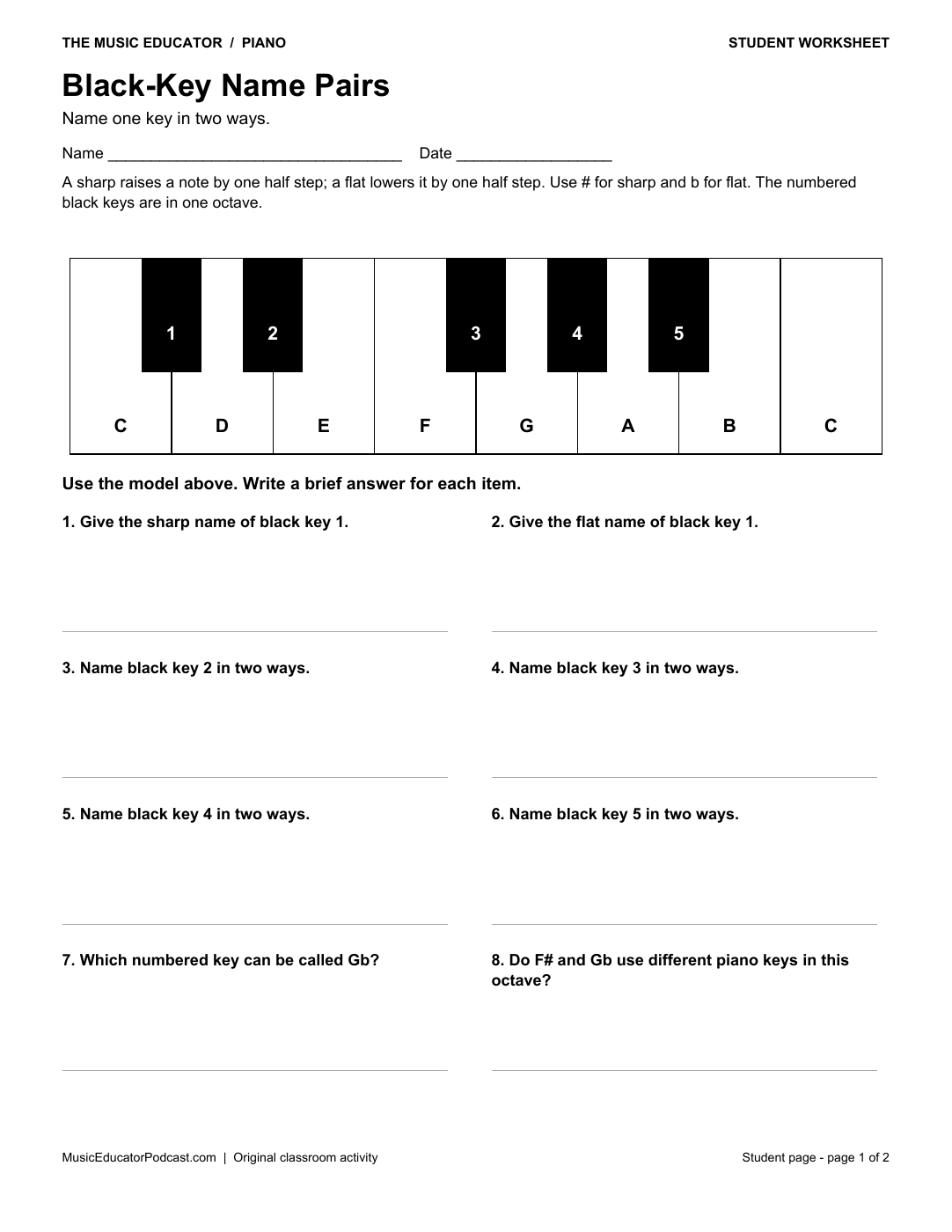
Locate five numbered black keys and give their sharp and flat names. Useful after students can find C, D, E, F, G, A, and B.
Download Black-Key Name Pairs + answer key (PDF, 2 pages)
Preview the student page: Black-Key Name Pairs
Keyboard Interval Numbers
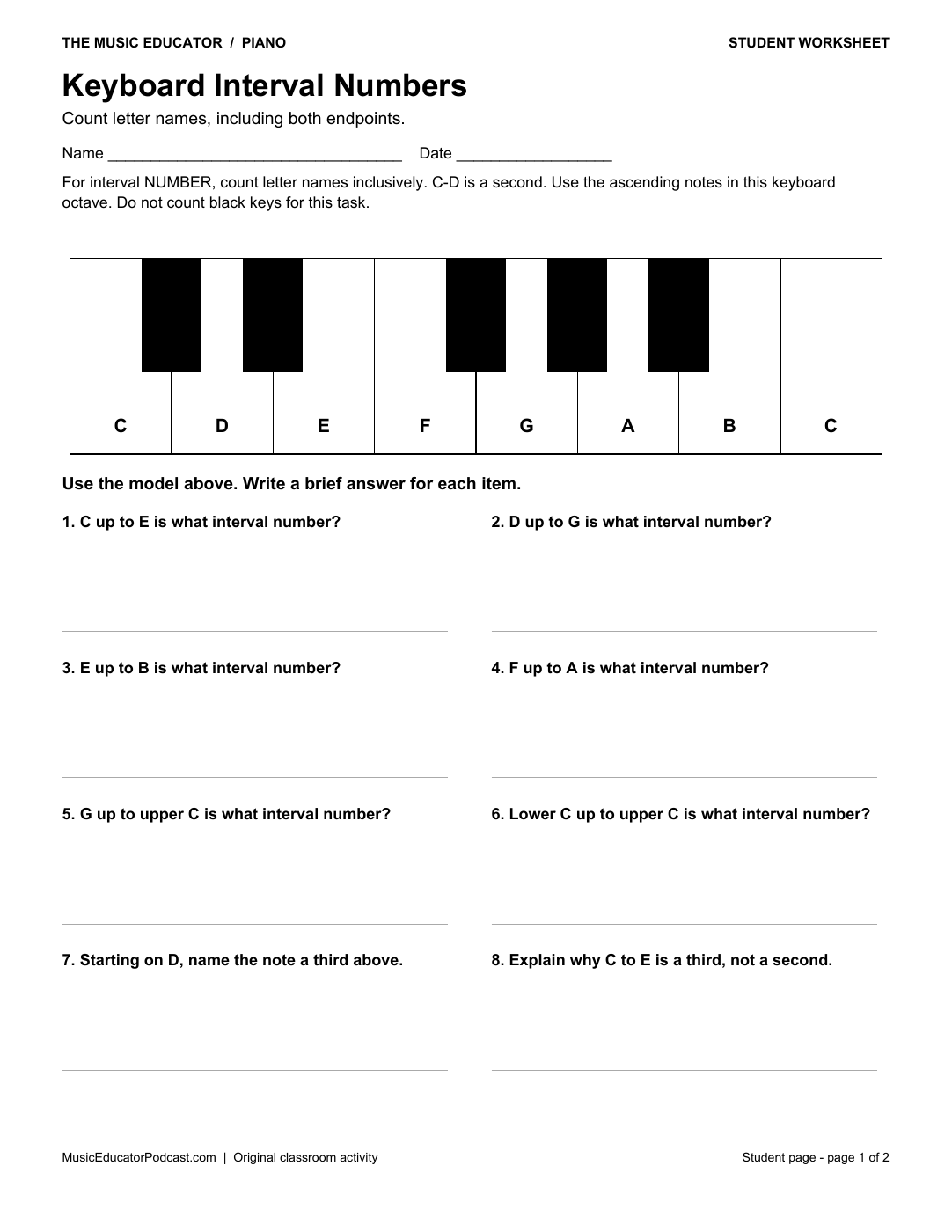
Count ascending letter-name intervals within one octave. Students distinguish the interval number from a count of half steps.
Download Keyboard Interval Numbers + answer key (PDF, 2 pages)
Preview the student page: Keyboard Interval Numbers
Major and Minor Triad Lab
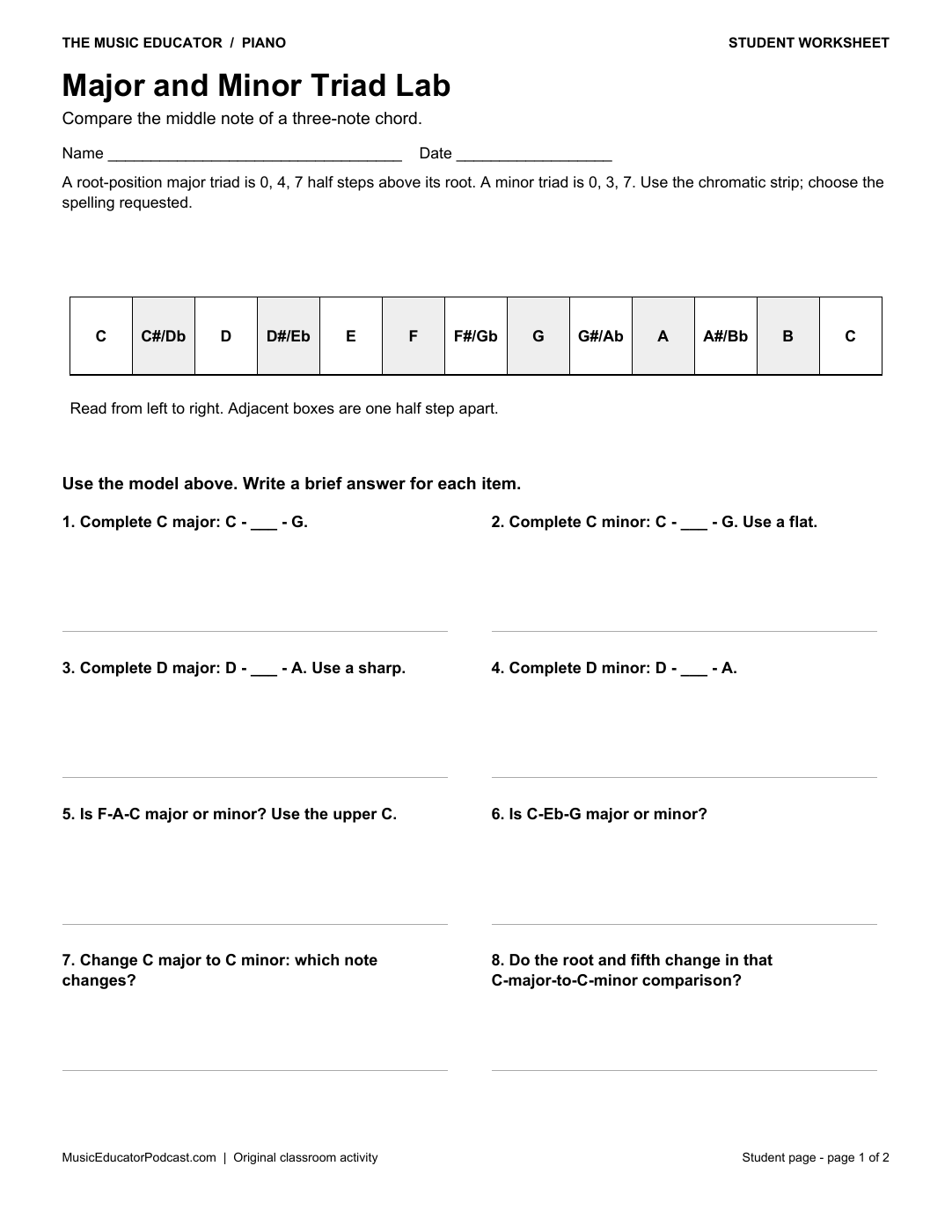
Use a chromatic strip to complete and compare major and minor triads. The activity makes the changing third visible while the root and fifth stay fixed.
Download Major and Minor Triad Lab + answer key (PDF, 2 pages)
Preview the student page: Major and Minor Triad Lab
Triad Inversion Detective
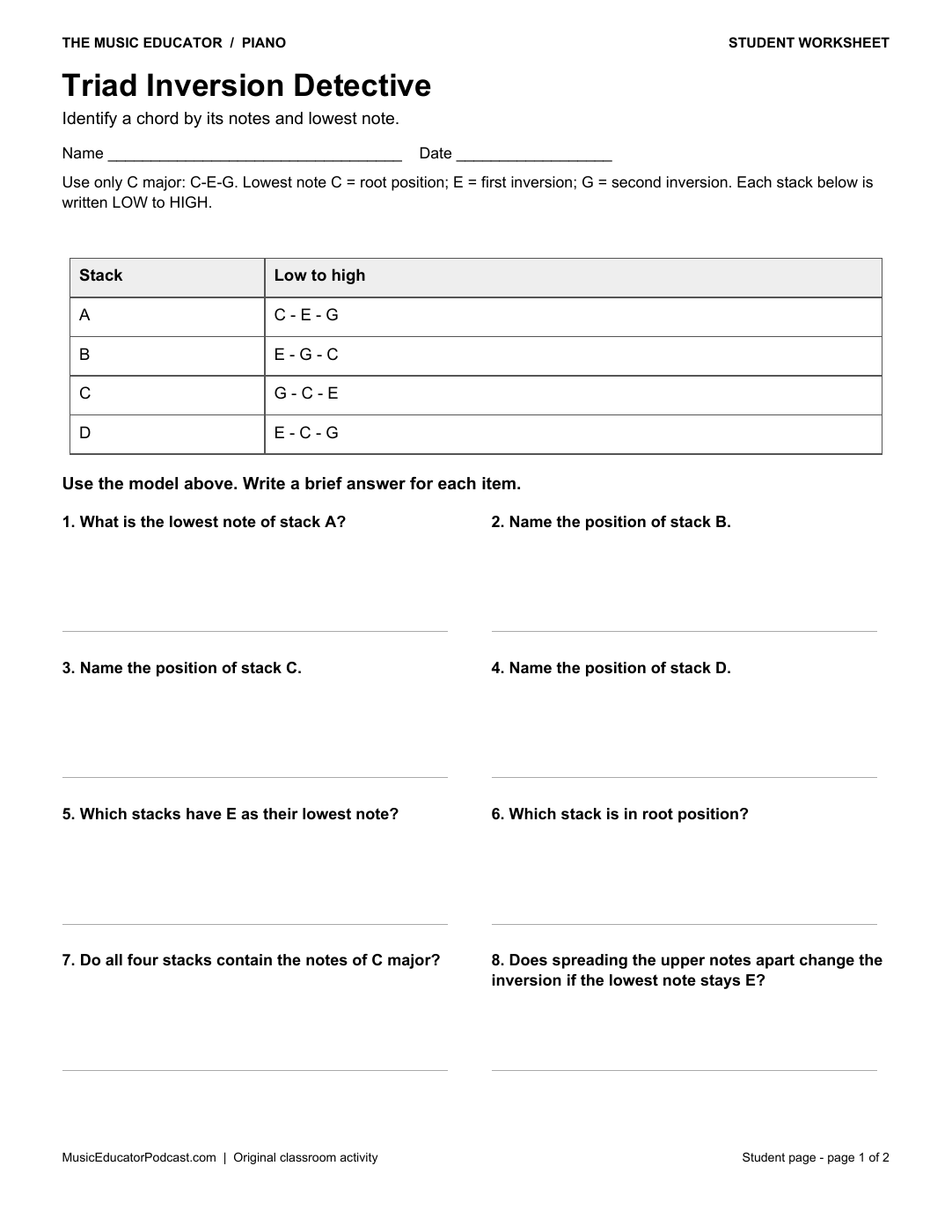
Compare four C-major note stacks, including an open spacing. Students use the lowest note to determine root position, first inversion, or second inversion.
Download Triad Inversion Detective + answer key (PDF, 2 pages)
Preview the student page: Triad Inversion Detective
Two-Hand Rhythm Grid
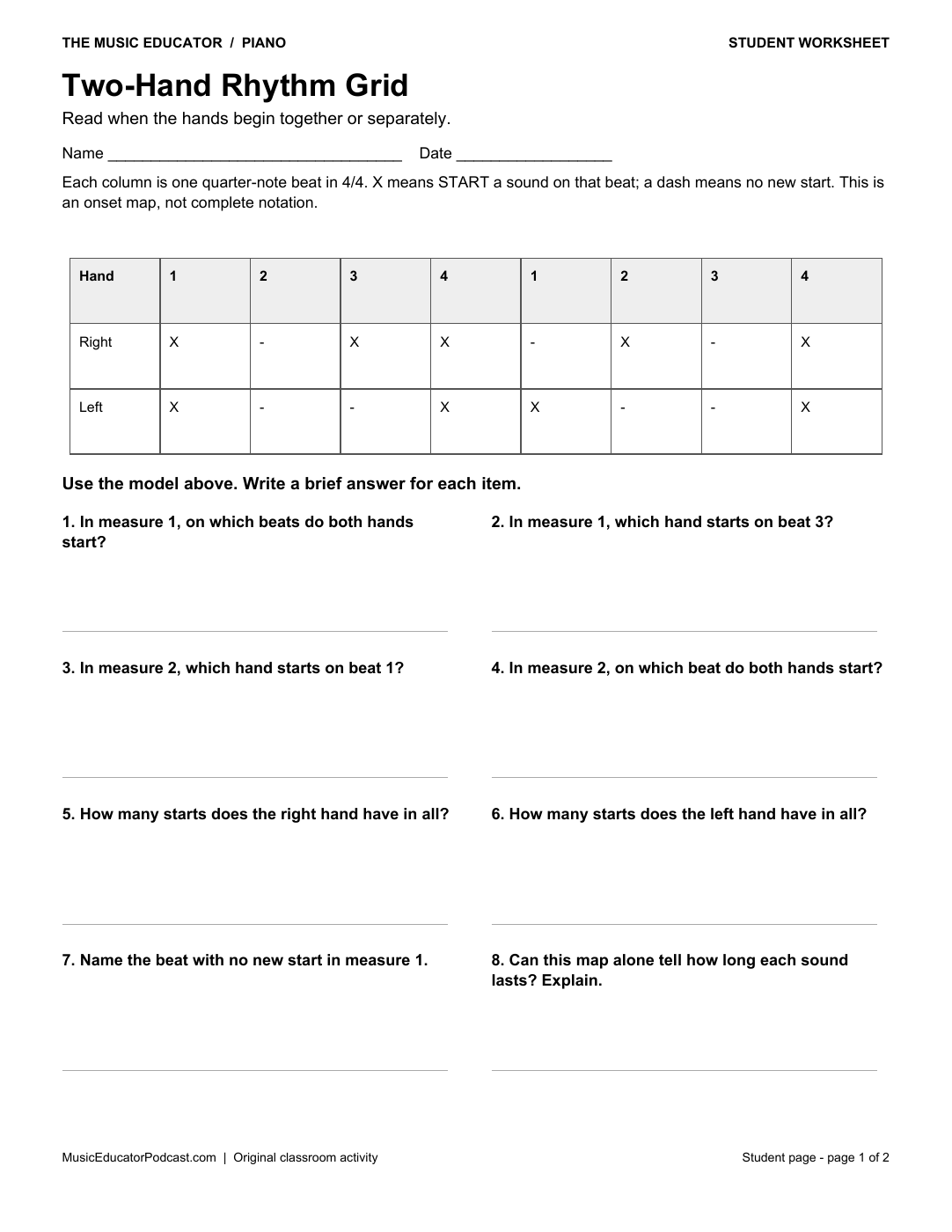
Follow right- and left-hand starts across two measures of 4/4. Students identify simultaneous entrances, separate entrances, and what the grid cannot tell them.
Download Two-Hand Rhythm Grid + answer key (PDF, 2 pages)
Preview the student page: Two-Hand Rhythm Grid
Piano Pattern and Form Map
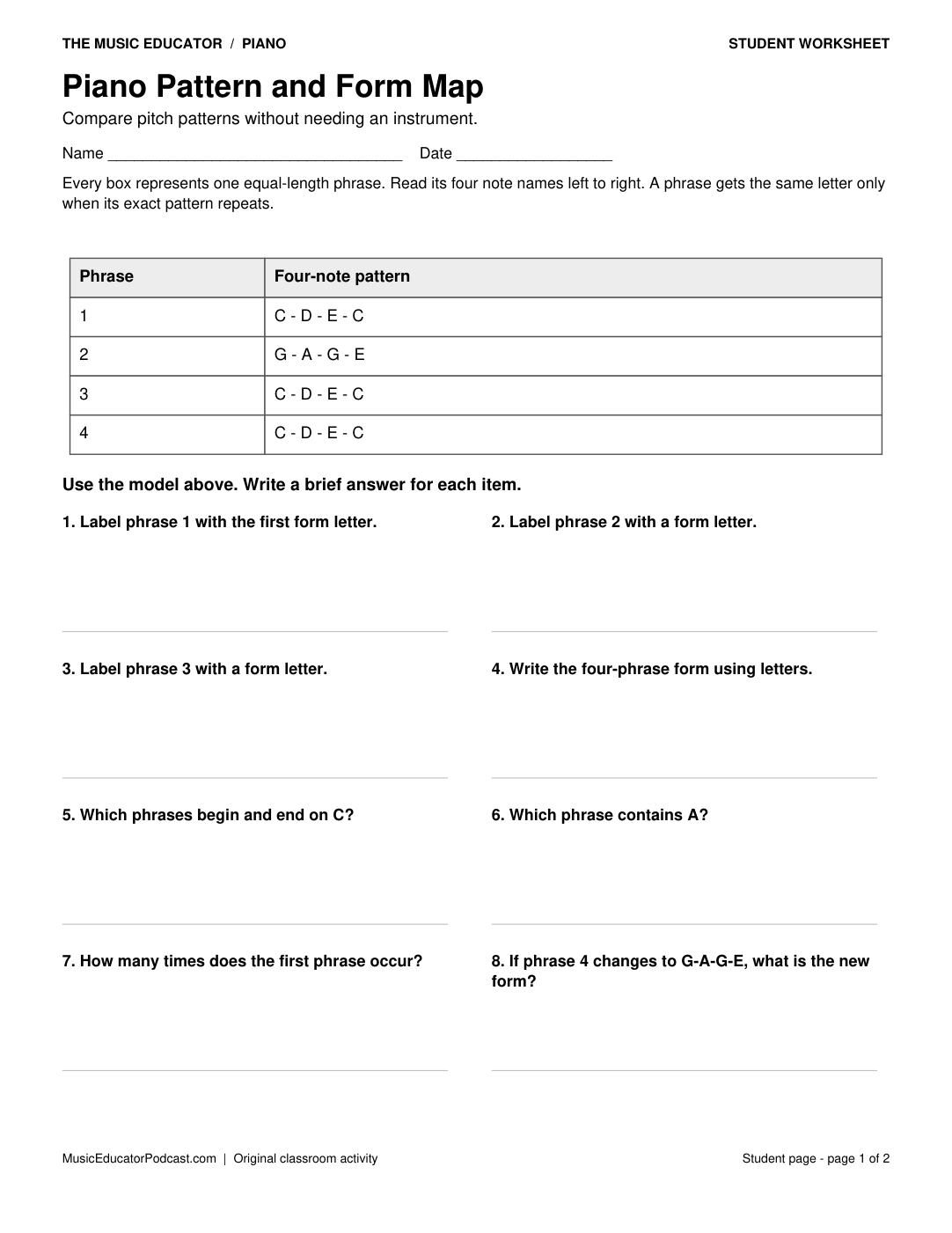
Compare four short pitch patterns and label their form. A final change asks students to revise the form from ABAA to ABAB.
Download Piano Pattern and Form Map + answer key (PDF, 2 pages)
Preview the student page: Piano Pattern and Form Map
How to use this set
Choose one page for a 10–15 minute lesson segment. Model the first item, let students complete the remaining questions, then ask them to point to the evidence for one answer. Transfer the idea to a piano when available: locate two enharmonic names on one key, play a triad, or tap the hand-entry grid on a tabletop. The onset grid shows when sounds begin; it does not supply their full durations.
Teacher questions
Do students need a piano?
No instrument is required for the written work. A piano or keyboard is useful for checking note locations and hearing the triads afterward.
Is this staff-reading practice?
These pages focus on keyboard names, letter-name relationships, and planning grids. They complement staff-reading work; they do not replace it.
What experience level is appropriate?
Use with beginning students who know the musical alphabet. Teach the supplied rule first when introducing triads or inversions. Select individual pages to match readiness.
Are answer keys included?
Yes. All six activities have matching answer keys. Accept equivalent wording when the musical meaning is correct. Use the keys to discuss the reasoning, not only to mark an answer.