
Music Theory Reading Lab
Music Theory Worksheets / Reading Lab
Ten free music theory worksheets help students explain what they see before they sing or play. This collection moves from bass-clef reading and accidentals to meter, minor scales, intervals, triads, and repeat navigation. Each activity has eight questions, an original visual model, and a matching answer key.
Download the complete reading lab
Download all 10 worksheets and keys (20-page PDF)
Print pages 1–10 for students. Pages 11–20 contain the corresponding keys in the same order. Individual downloads below put the student page first and the key second. All pages are US Letter and designed for black-and-white printing. No account is required.
Choose one skill
Start with a topic your students have encountered. The printed reference supports practice; it is not intended as a closed-book test. Use one worksheet at a time or select a short sequence.
- Bass Clef Line and Space Lab
- Ledger-Line Bridge
- Accidental Memory Map
- Ties, Slurs, and Attacks
- Meter Grouping Lab
- Major Key Signature Decisions
- Natural Minor Step Builder
- Interval Number and Quality
- Triad Quality Sort
- Repeat Ending Route
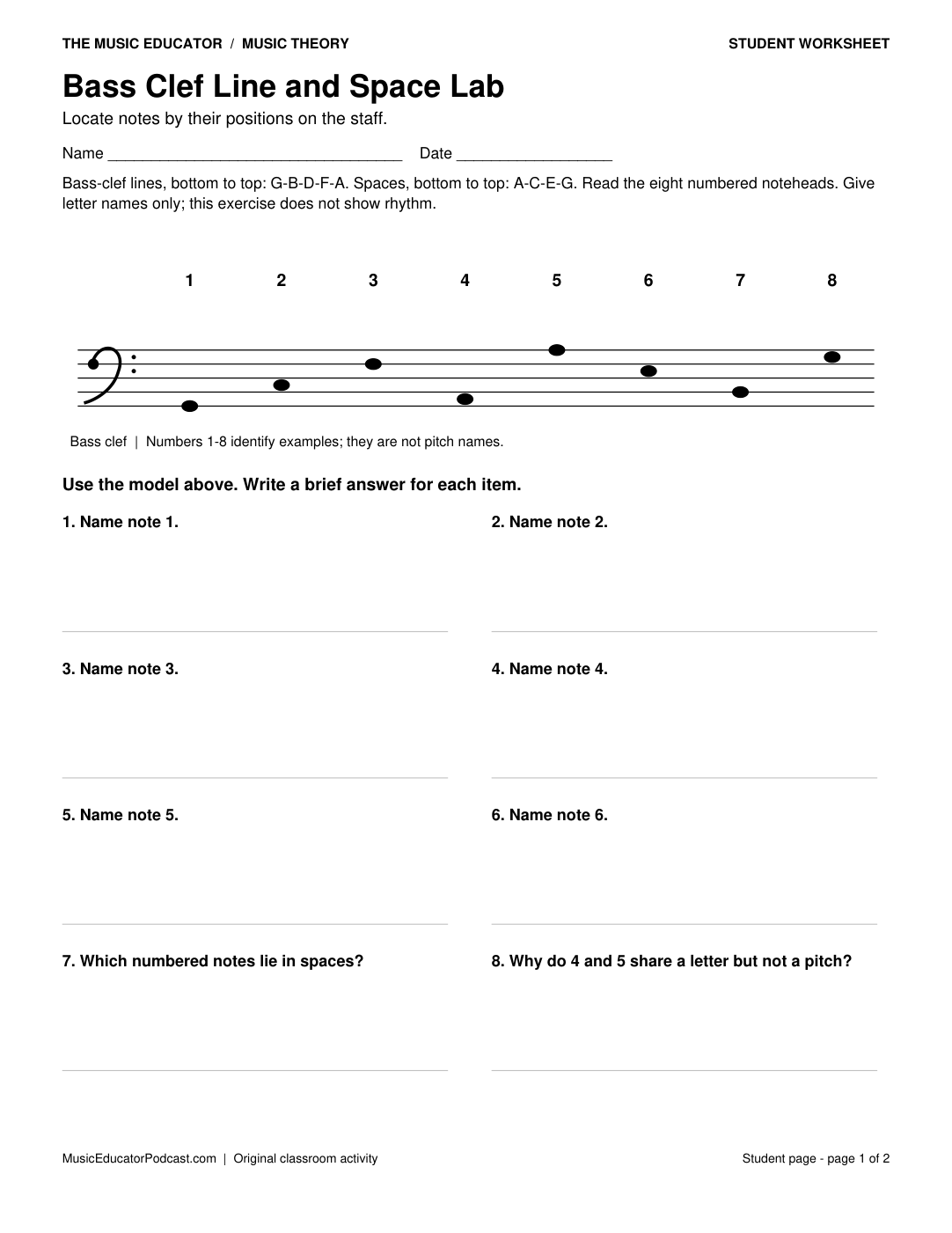
Bass Clef Line and Space Lab
Name notes on bass-clef lines and spaces, then compare octave placement.
Download worksheet and key (2-page PDF)
Preview the student worksheet
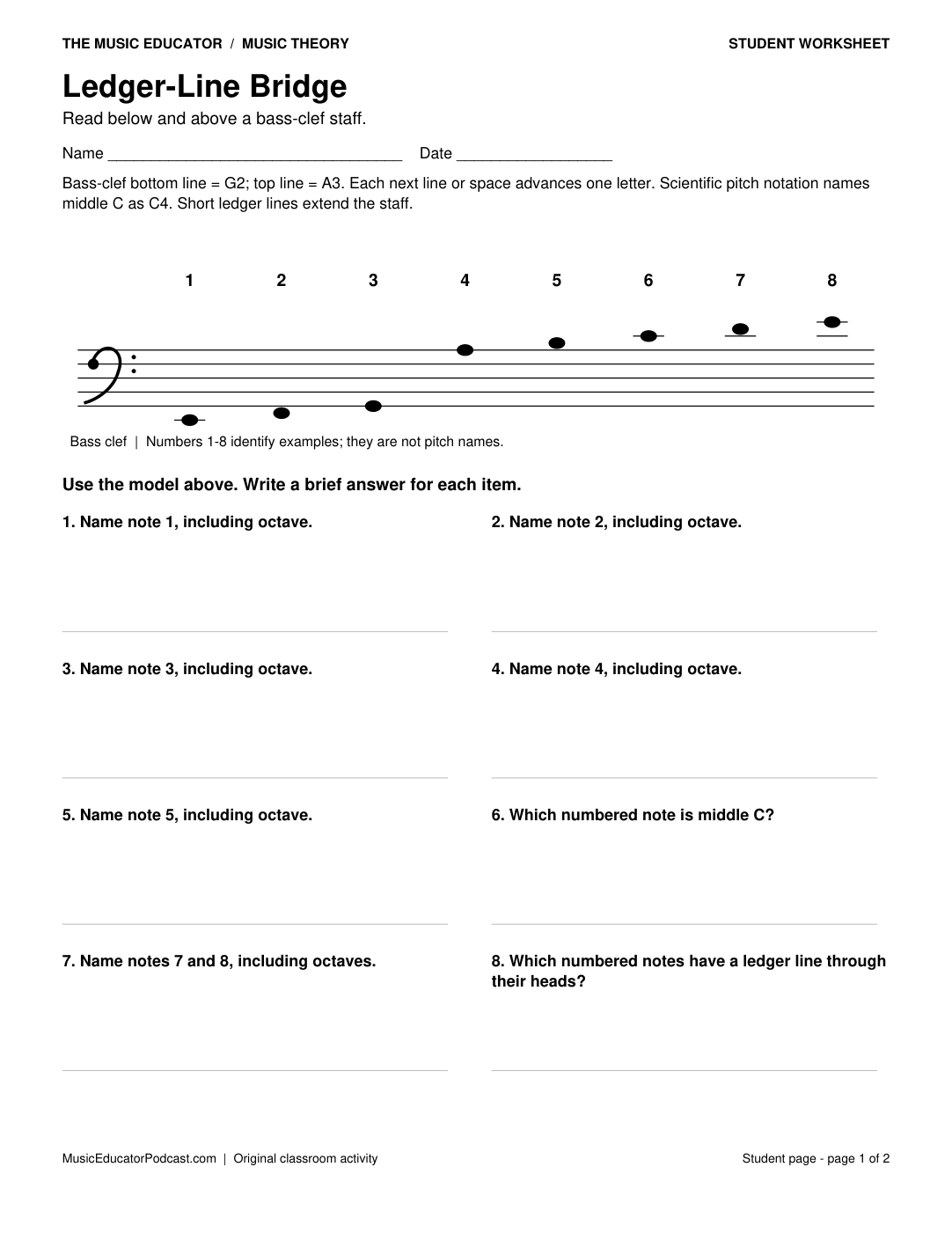
Ledger-Line Bridge
Read bass-clef ledger lines and identify middle C with octave numbers.
Download worksheet and key (2-page PDF)
Preview the student worksheet
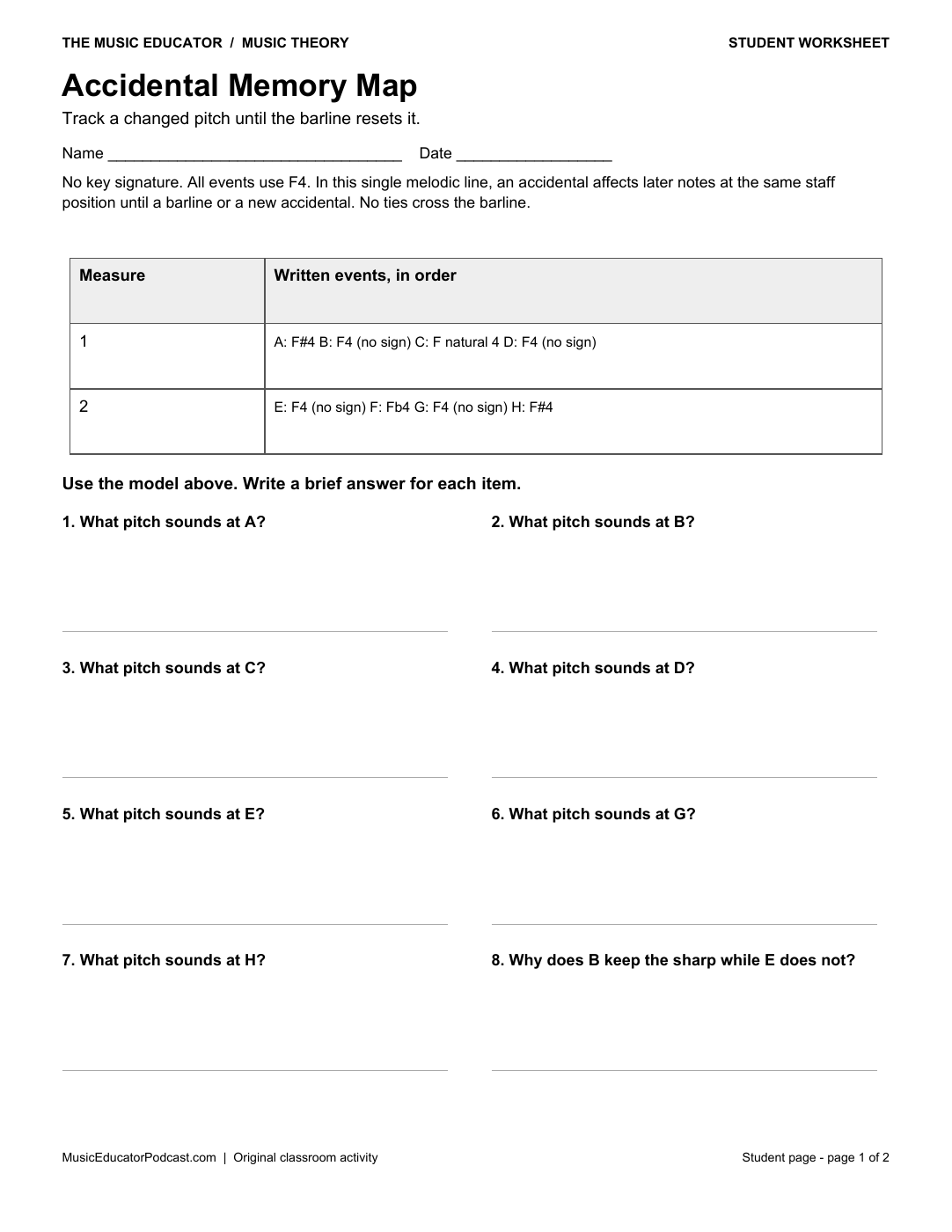
Accidental Memory Map
Track sharps, flats, naturals, and barline resets in one melodic line.
Download worksheet and key (2-page PDF)
Preview the student worksheet
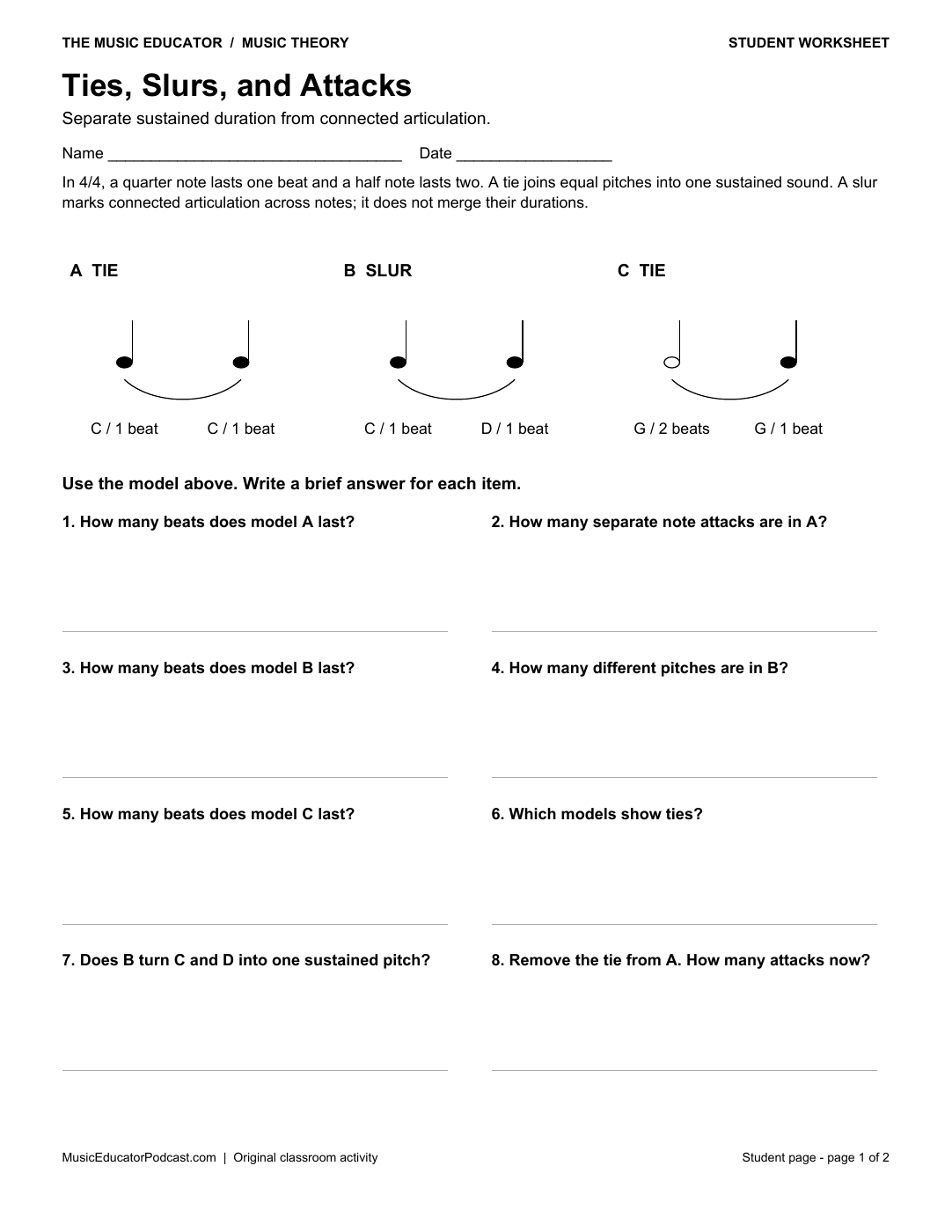
Ties, Slurs, and Attacks
Distinguish sustained ties from slurs and count durations and attacks.
Download worksheet and key (2-page PDF)
Preview the student worksheet
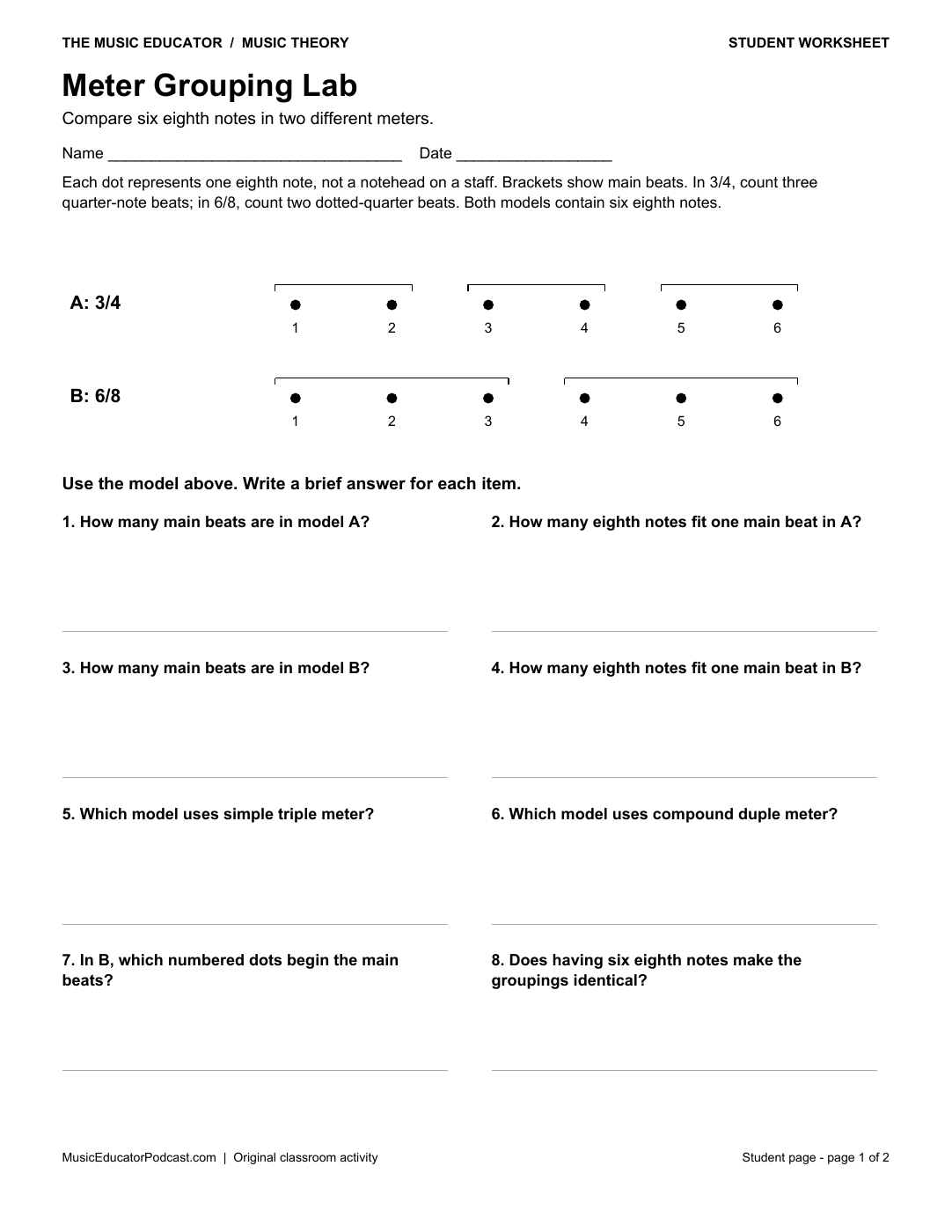
Meter Grouping Lab
Compare 3/4 and 6/8 using clearly bracketed groups of eighth notes.
Download worksheet and key (2-page PDF)
Preview the student worksheet
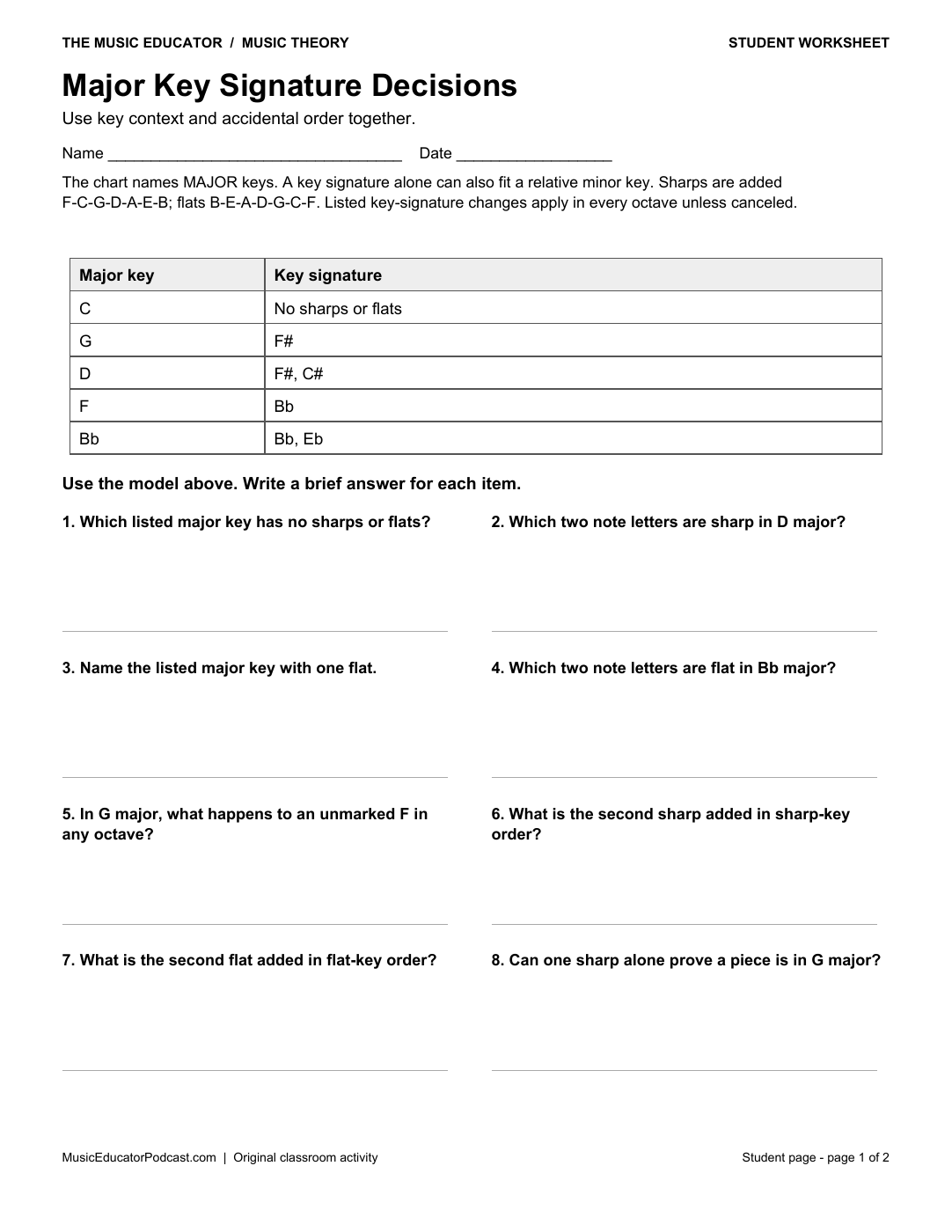
Major Key Signature Decisions
Apply major-key context, accidental order, and key-signature changes.
Download worksheet and key (2-page PDF)
Preview the student worksheet
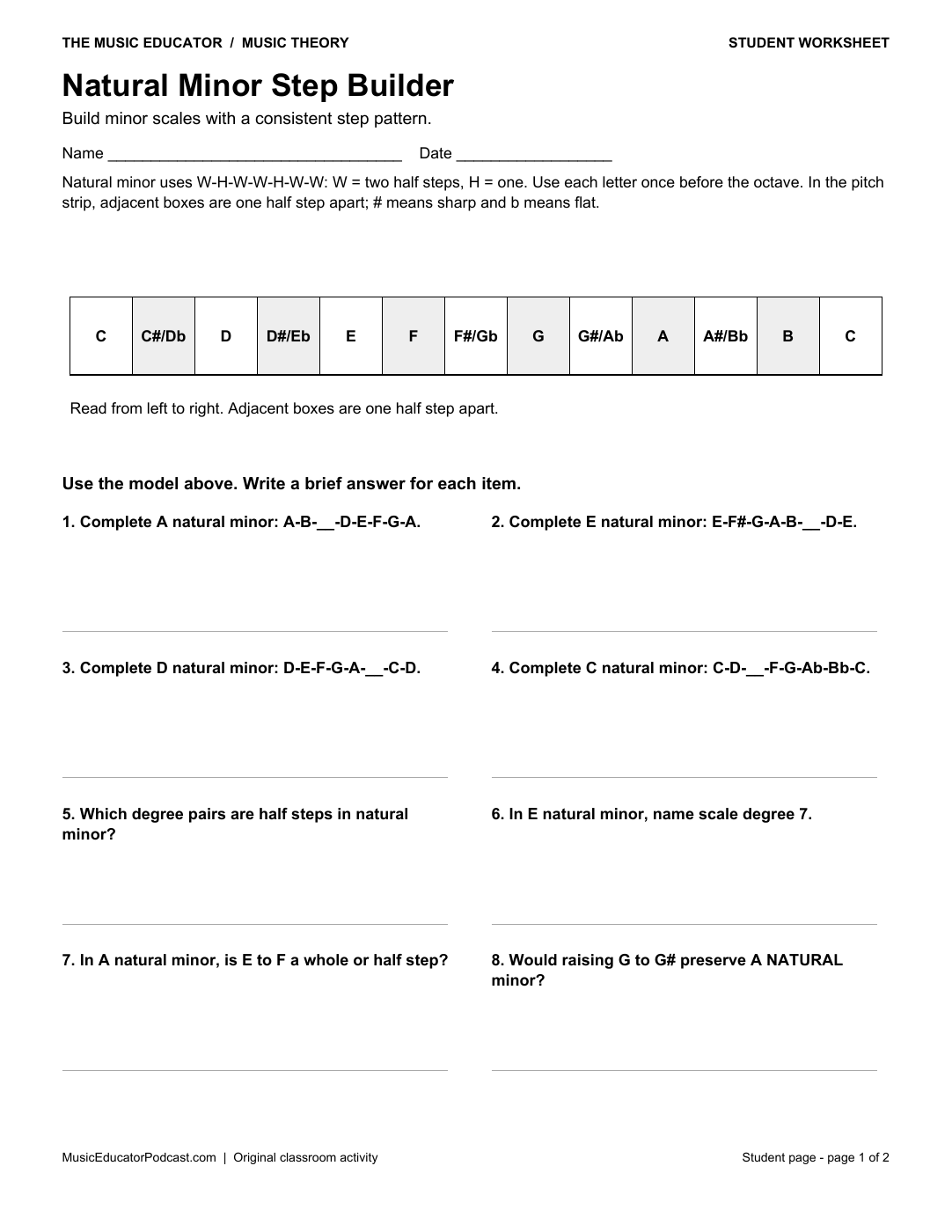
Natural Minor Step Builder
Complete natural-minor scales and explain their half-step locations.
Download worksheet and key (2-page PDF)
Preview the student worksheet
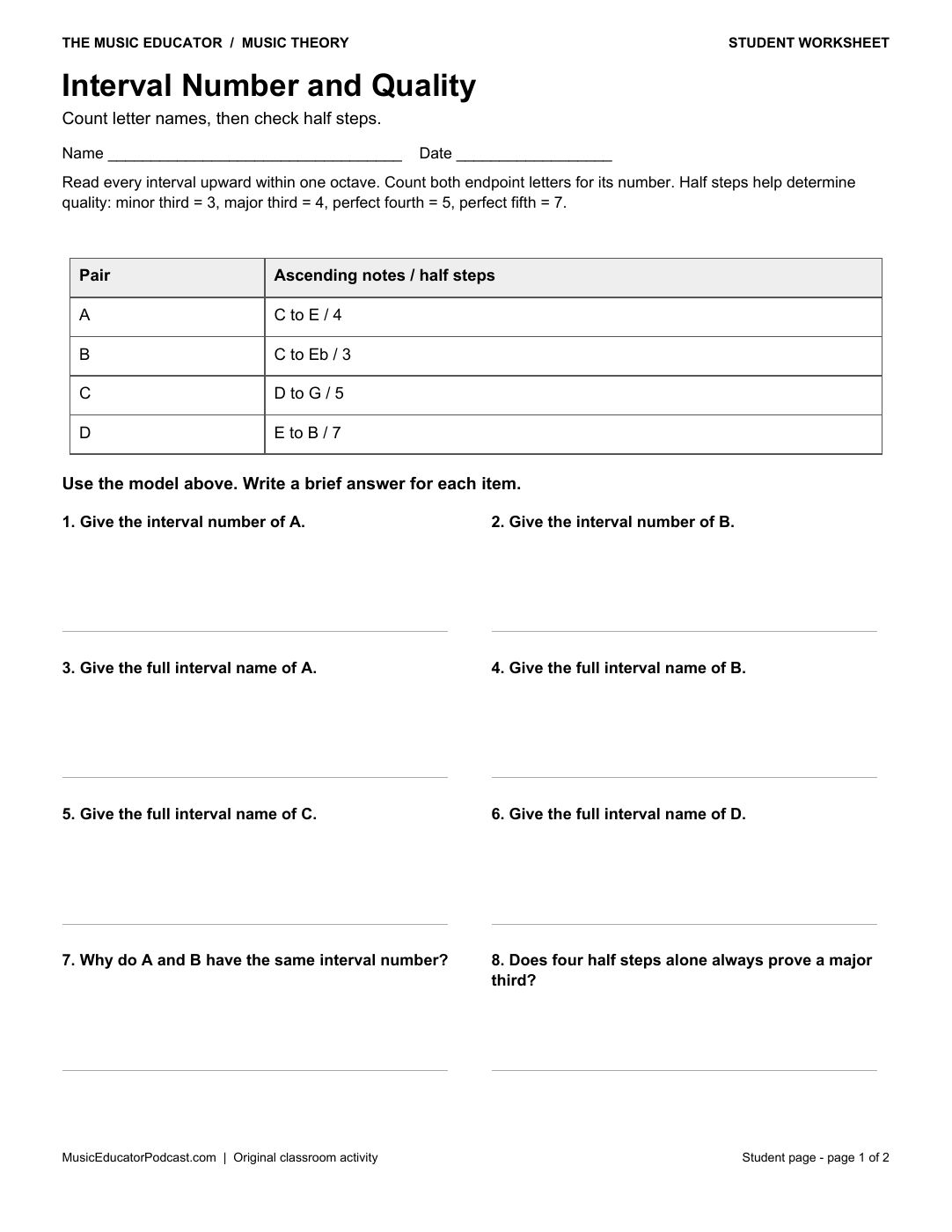
Interval Number and Quality
Use letter spelling and half-step distances to identify intervals.
Download worksheet and key (2-page PDF)
Preview the student worksheet
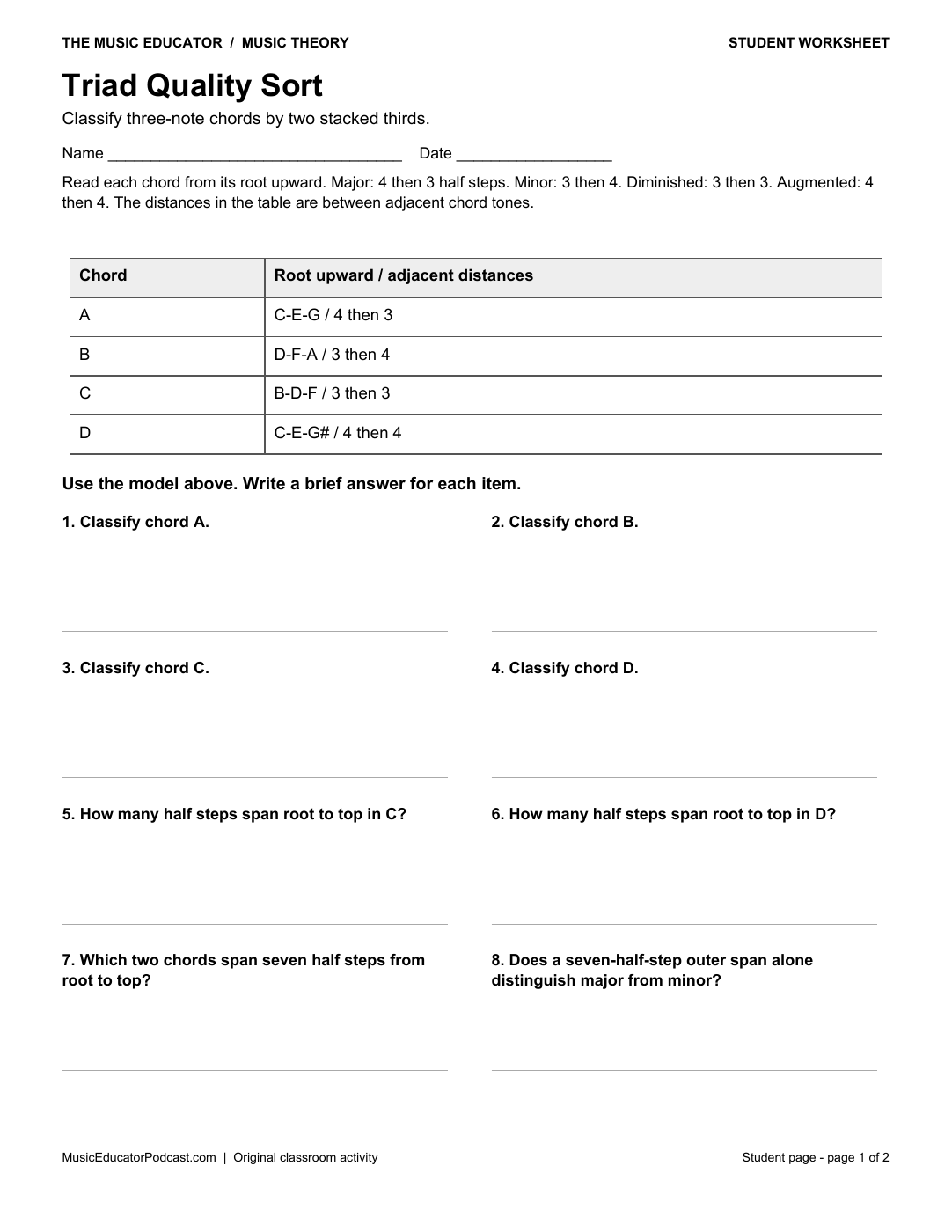
Triad Quality Sort
Compare major, minor, diminished, and augmented triads using stacked thirds.
Download worksheet and key (2-page PDF)
Preview the student worksheet
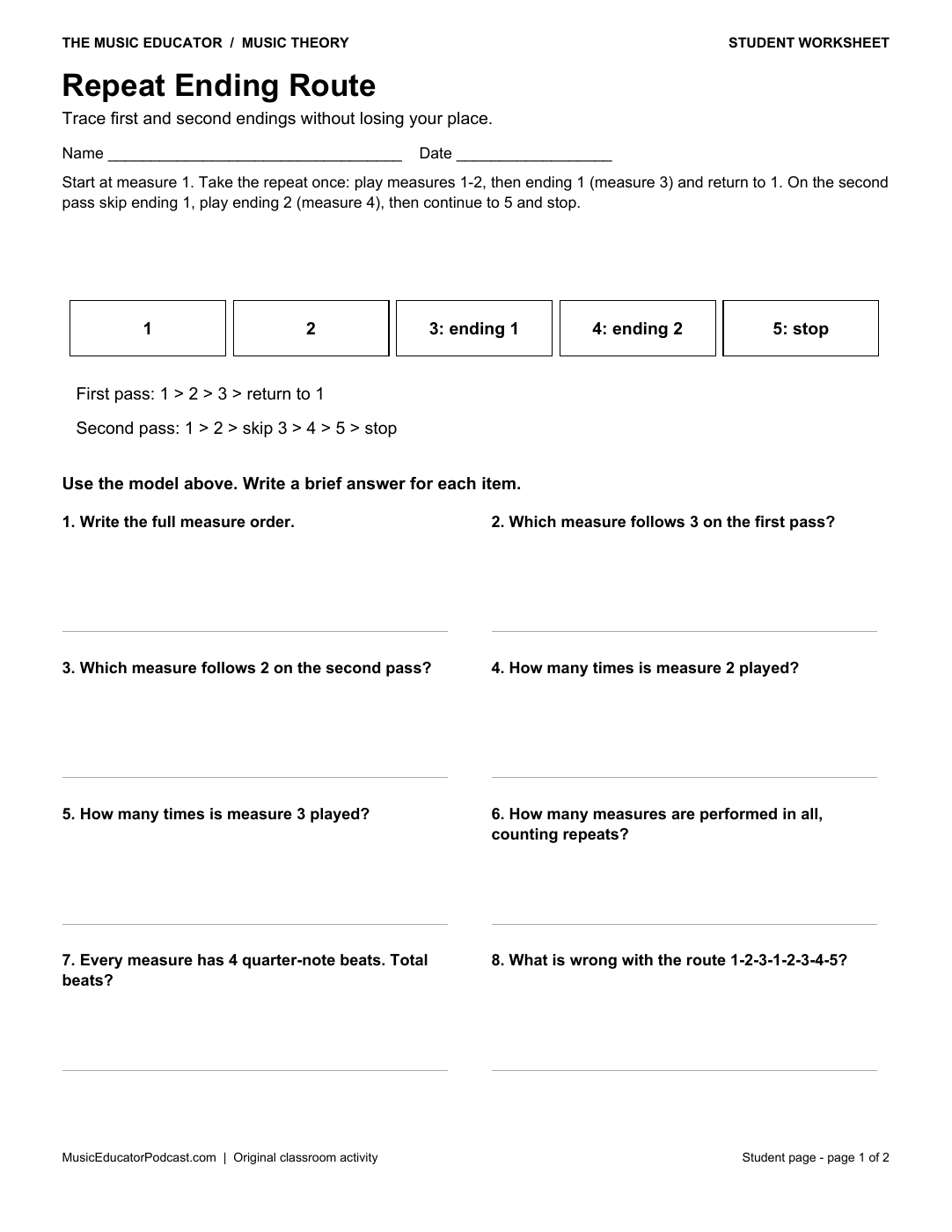
Repeat Ending Route
Trace two passes through first and second endings and count performed beats.
Download worksheet and key (2-page PDF)
Preview the student worksheet
Teach it in three steps
- Read the model. Demonstrate one staff position, one beat group, or one row. Ask students to identify what each label represents.
- Explain an answer. Have students point to the relevant evidence. For intervals, count letters as well as half steps; for accidentals, locate the barline.
- Transfer the idea. Find one comparable example in a familiar score, or write a new example together. Check the actual notation before performing it.
Suggested teaching sequences
Reading: Bass Clef Line and Space Lab → Ledger-Line Bridge → Accidental Memory Map. In the first two diagrams, numbers 1–8 identify examples; the note names are the answers.
Rhythm and navigation: Ties, Slurs, and Attacks → Meter Grouping Lab → Repeat Ending Route. The meter dots and repeat boxes are explanatory models, not complete scores.
Pitch relationships: Major Key Signature Decisions → Natural Minor Step Builder → Interval Number and Quality → Triad Quality Sort. Ask students to check note spelling before counting semitones.
Questions teachers ask
Are the answers included?
Yes. Each individual PDF has one student page and one matching key. In the full packet, all student pages precede all keys. Preview the print range before sharing.
What conventions are used?
The ledger-line page uses scientific pitch notation with middle C = C4. The accidental task uses one melodic line at F4, no key signature, and no ties across barlines. The meter task explicitly compares three quarter-note beats in 3/4 with two dotted-quarter beats in 6/8. The key chart is labeled for major keys; it does not imply that a signature alone determines tonality.
Do students need instruments or software?
No. The paper activities need only the worksheet and a pencil. A keyboard or a score can support the optional follow-up.
Related practice
Browse all Music Theory Worksheets · Piano Worksheets · All Free Music Worksheets
Teacher references
For further explanation, see musictheory.net: Minor Scales, Specific Intervals, Simple and Compound Meter, and Music Theory for the 21st-Century Classroom: Dots and Ties. The worksheet artwork, questions, and teaching examples are original.