
Orchestra Reading and Rehearsal Lab
18 free orchestra worksheets with answer keys
Build confident readers and thoughtful ensemble players with short, printable activities for violin, viola, cello and double bass. This collection covers pitch and register, bow planning, rhythm, entrances, repeats, tuning evidence and rehearsal decisions.
Each activity: one student page, eight questions, and one matching answer-key page. Download an individual two-page PDF below, or get the complete 36-page packet.
Download complete Orchestra Lab (PDF)Packet printing: pages 1–18 are student worksheets; pages 19–36 are the corresponding keys in the same order. Individual files place the key on page 2.
Choose a worksheet
- Violin A-String Pitch Path
- Viola C-String Interval Map
- Cello Register Matching
- Double Bass Octave Decoder
- Violin Staff-to-String Choices
- Viola Alto-Clef Neighbors
- Cello Bass-Clef Contour
- Pizzicato and Arco Switches
- Orchestra Bow Budget
- Orchestra String-Crossing Map
- Orchestra Slur Group Planner
- Orchestra Rest and Entry Counts
- Orchestra Repeat Roadmap
- Orchestra Melody Handoff
- Orchestra Tuning Evidence
- Orchestra Rhythm Repair
- Orchestra Rehearsal Priority Lab
- Orchestra Cue and Release Plan
Using the activities in class
Choose the instrument-specific pitch task that fits your students, then use an ensemble task as a warm-up, exit ticket or substitute lesson. Most pages take about 5–10 minutes, depending on discussion. Students need a pencil; instruments and audio are not required.
The pitch-distance maps are conceptual references, not fingering charts. The three staff activities name the clef and its reference line explicitly. Bow-allocation and cue activities follow the supplied paper models; adapt practical playing decisions with your teacher. Open-ended rehearsal questions include sample responses, and other answers supported by the evidence can also be valid.
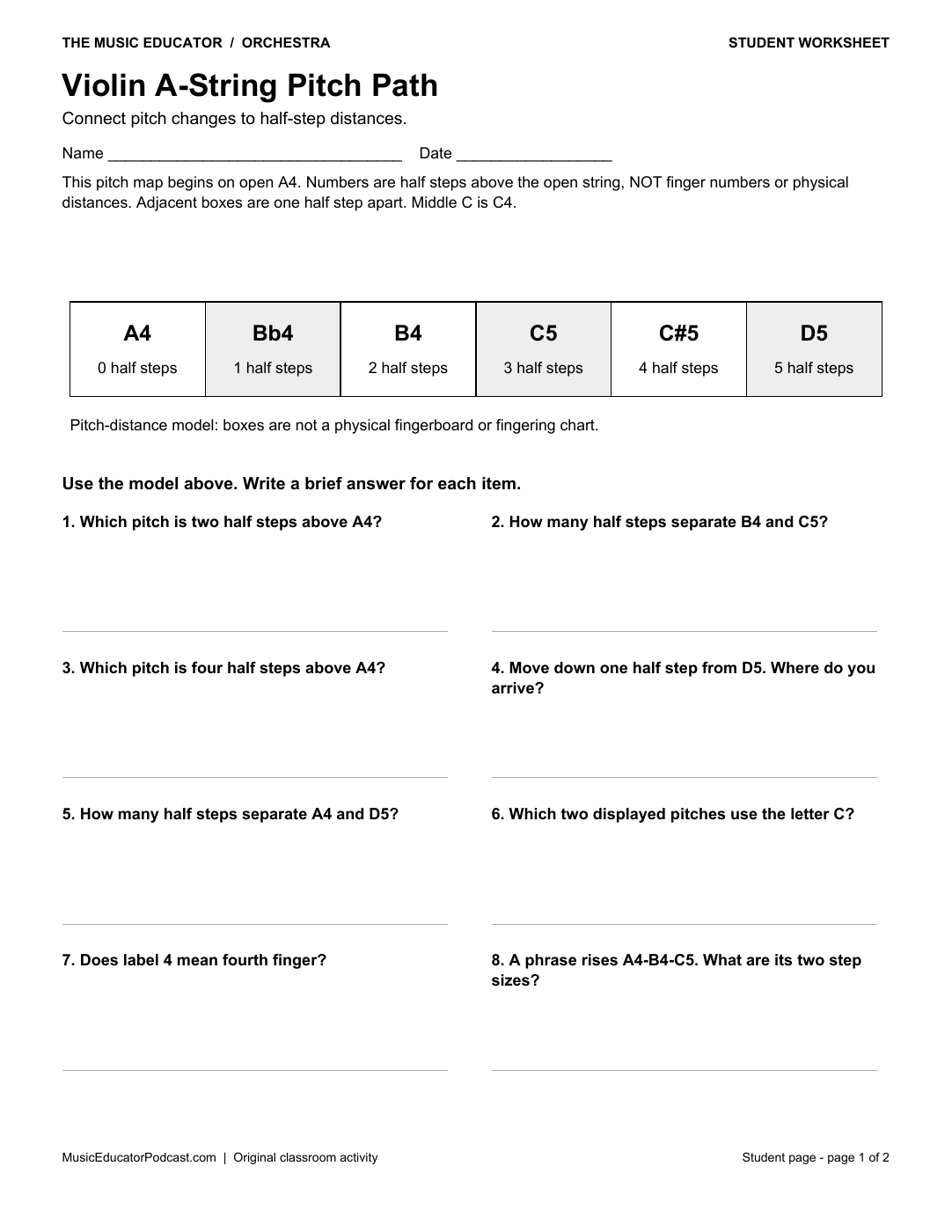
1. Violin A-String Pitch Path
Connect pitch changes to half-step distances. This pitch map begins on open A4. Numbers are half steps above the open string, NOT finger numbers or physical distances. Adjacent boxes are one half step apart. Middle C is C4.
Download Violin A-String Pitch Path (PDF)Includes the student worksheet and matching answer key.
Preview the student worksheet
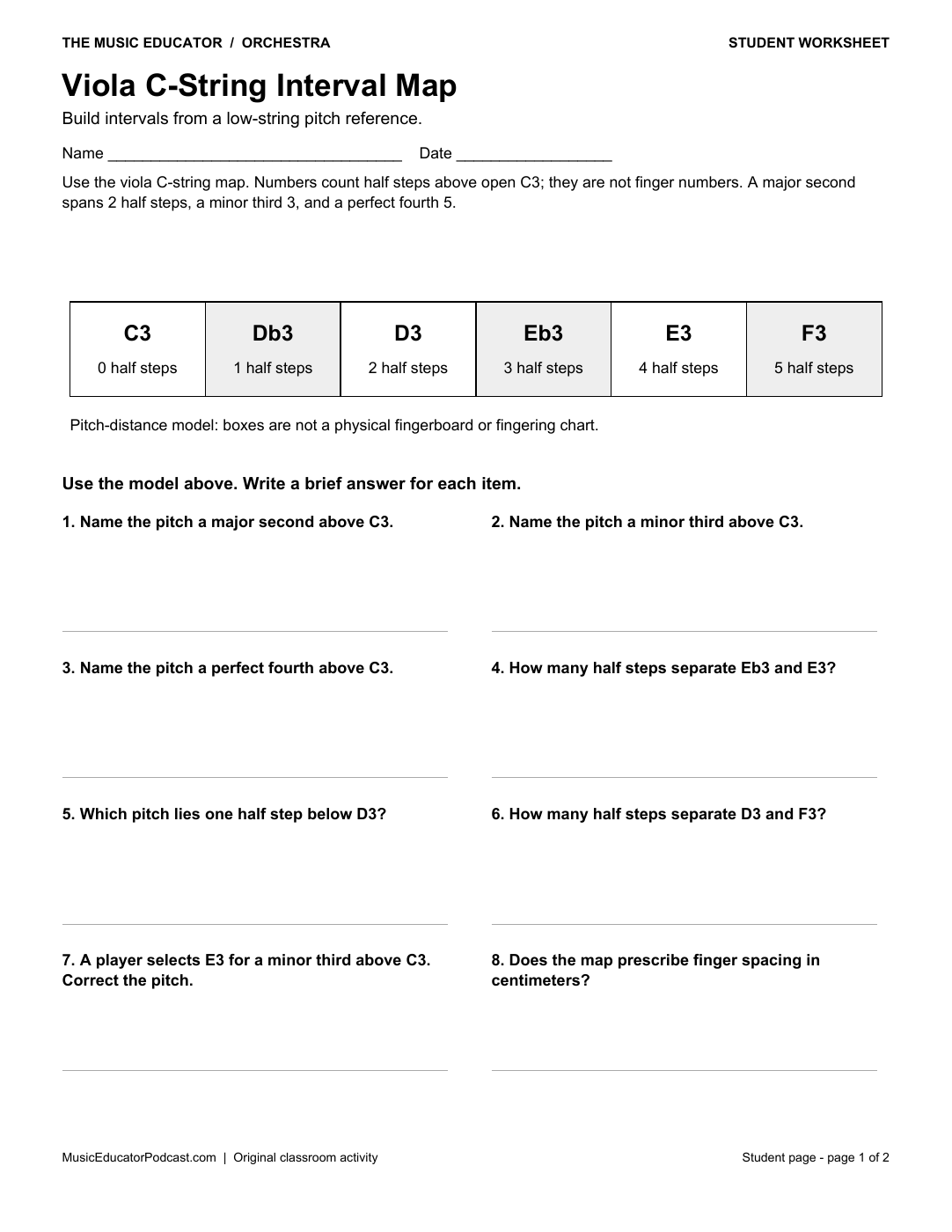
2. Viola C-String Interval Map
Build intervals from a low-string pitch reference. Use the viola C-string map. Numbers count half steps above open C3; they are not finger numbers. A major second spans 2 half steps, a minor third 3, and a perfect fourth 5.
Download Viola C-String Interval Map (PDF)Includes the student worksheet and matching answer key.
Preview the student worksheet
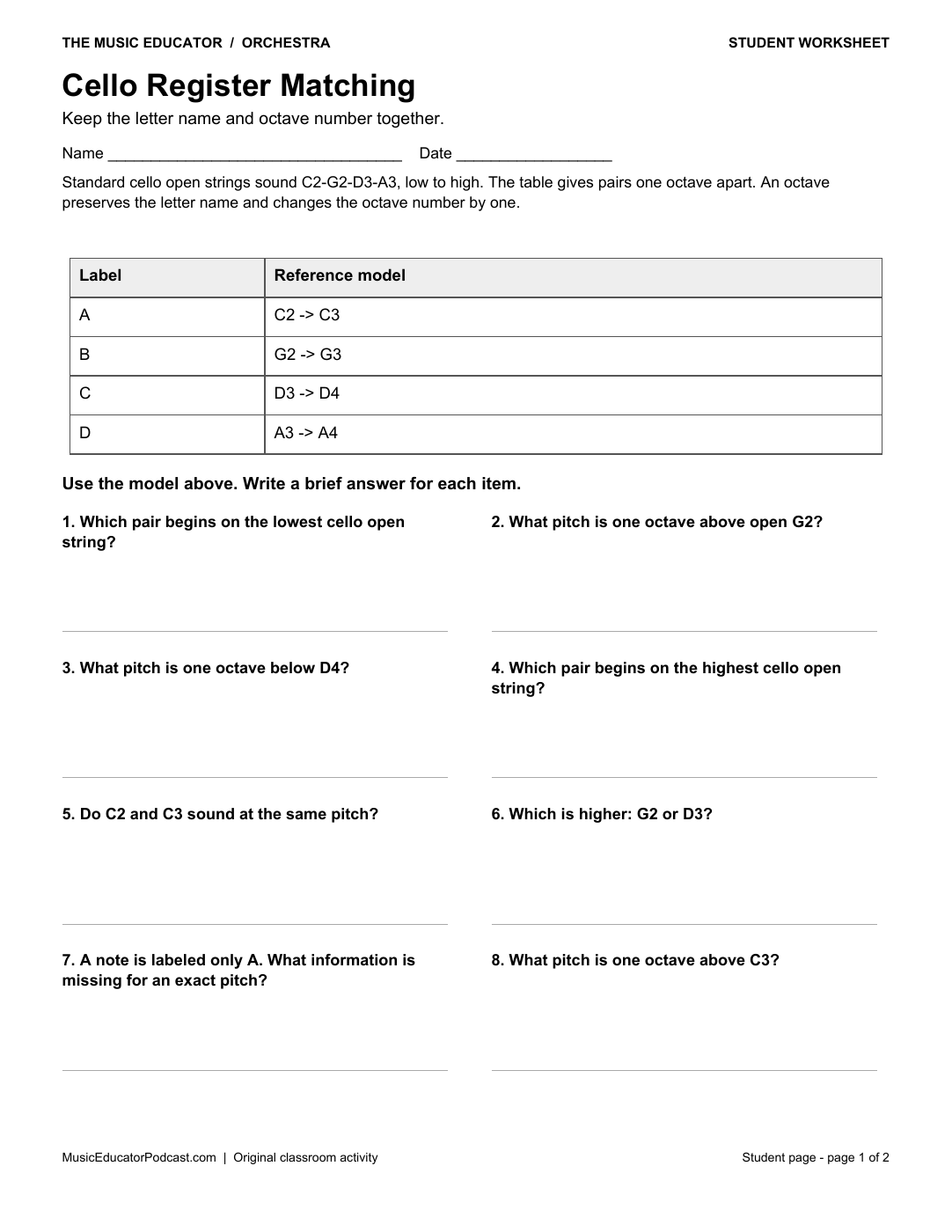
3. Cello Register Matching
Keep the letter name and octave number together. Standard cello open strings sound C2-G2-D3-A3, low to high. The table gives pairs one octave apart. An octave preserves the letter name and changes the octave number by one.
Download Cello Register Matching (PDF)Includes the student worksheet and matching answer key.
Preview the student worksheet
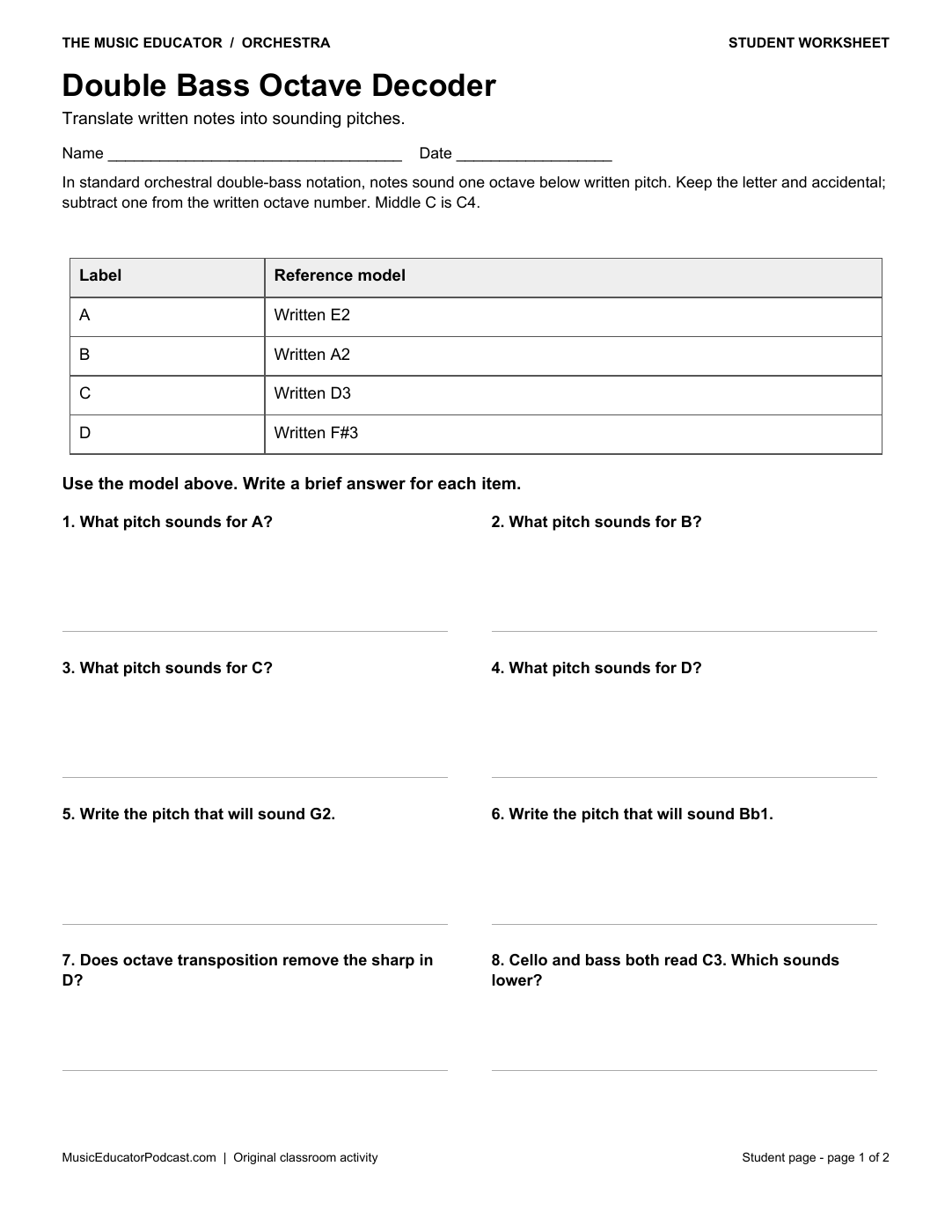
4. Double Bass Octave Decoder
Translate written notes into sounding pitches. In standard orchestral double-bass notation, notes sound one octave below written pitch. Keep the letter and accidental; subtract one from the written octave number. Middle C is C4.
Download Double Bass Octave Decoder (PDF)Includes the student worksheet and matching answer key.
Preview the student worksheet
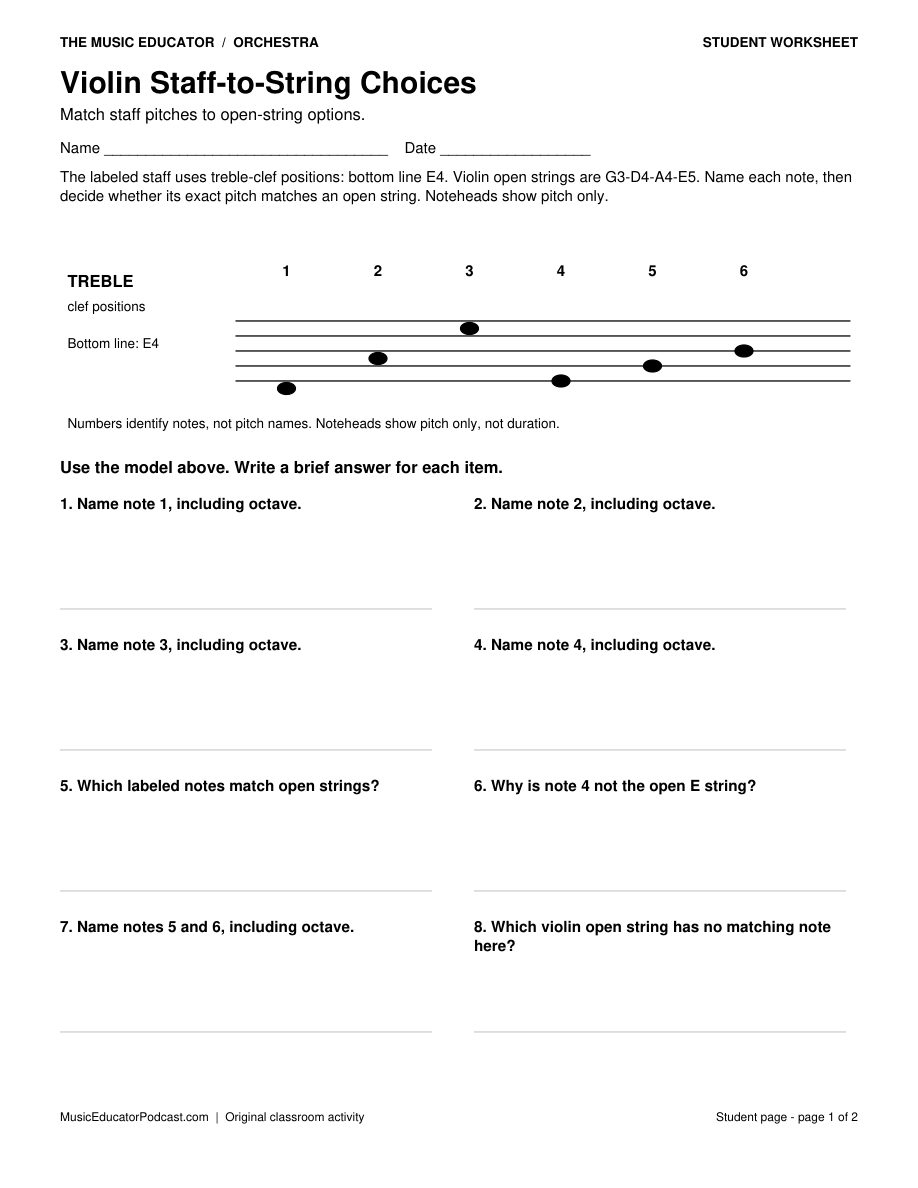
5. Violin Staff-to-String Choices
Match staff pitches to open-string options. The labeled staff uses treble-clef positions: bottom line E4. Violin open strings are G3-D4-A4-E5. Name each note, then decide whether its exact pitch matches an open string. Noteheads show pitch only.
Download Violin Staff-to-String Choices (PDF)Includes the student worksheet and matching answer key.
Preview the student worksheet
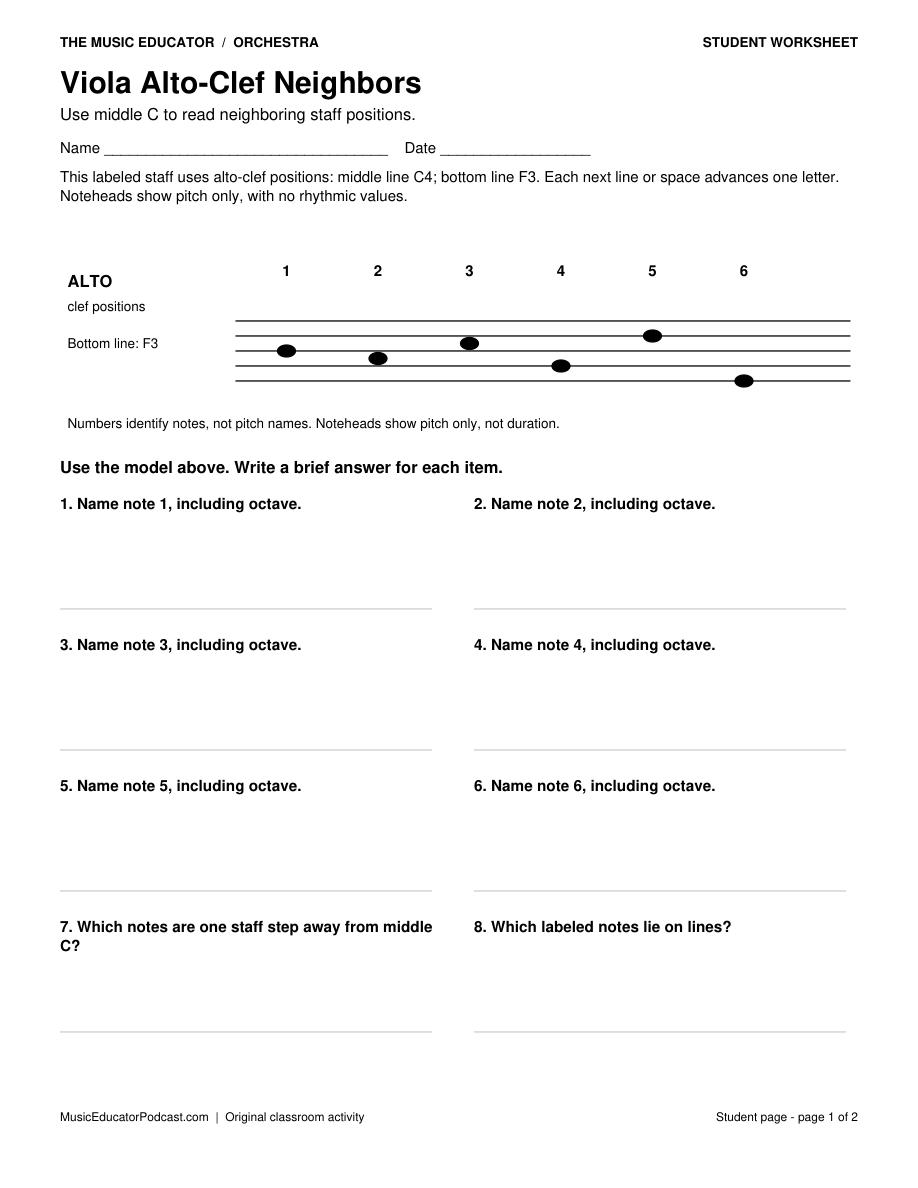
6. Viola Alto-Clef Neighbors
Use middle C to read neighboring staff positions. This labeled staff uses alto-clef positions: middle line C4; bottom line F3. Each next line or space advances one letter. Noteheads show pitch only, with no rhythmic values.
Download Viola Alto-Clef Neighbors (PDF)Includes the student worksheet and matching answer key.
Preview the student worksheet
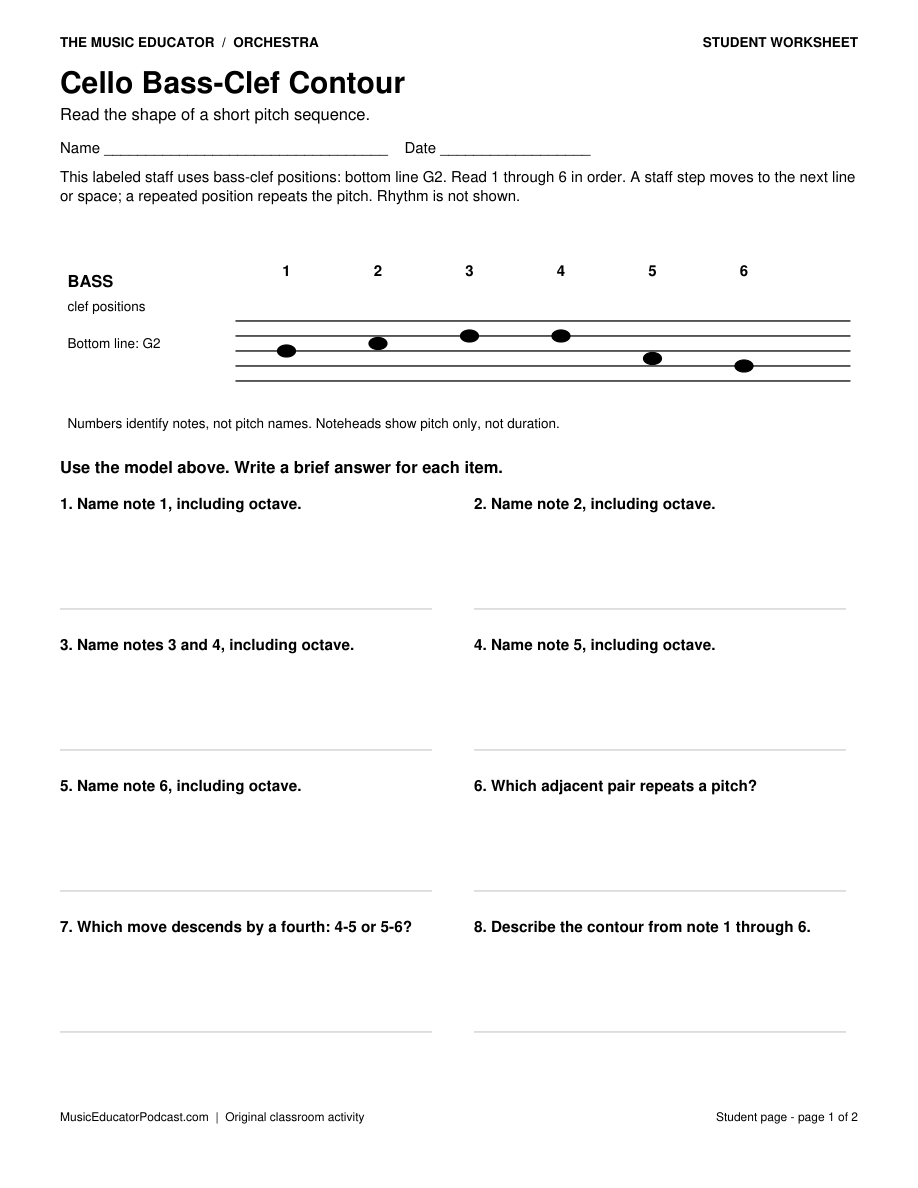
7. Cello Bass-Clef Contour
Read the shape of a short pitch sequence. This labeled staff uses bass-clef positions: bottom line G2. Read notes 1 through 6 in order. A staff step moves to the next line or space; a repeated position repeats the pitch. Rhythm is not shown.
Download Cello Bass-Clef Contour (PDF)Includes the student worksheet and matching answer key.
Preview the student worksheet
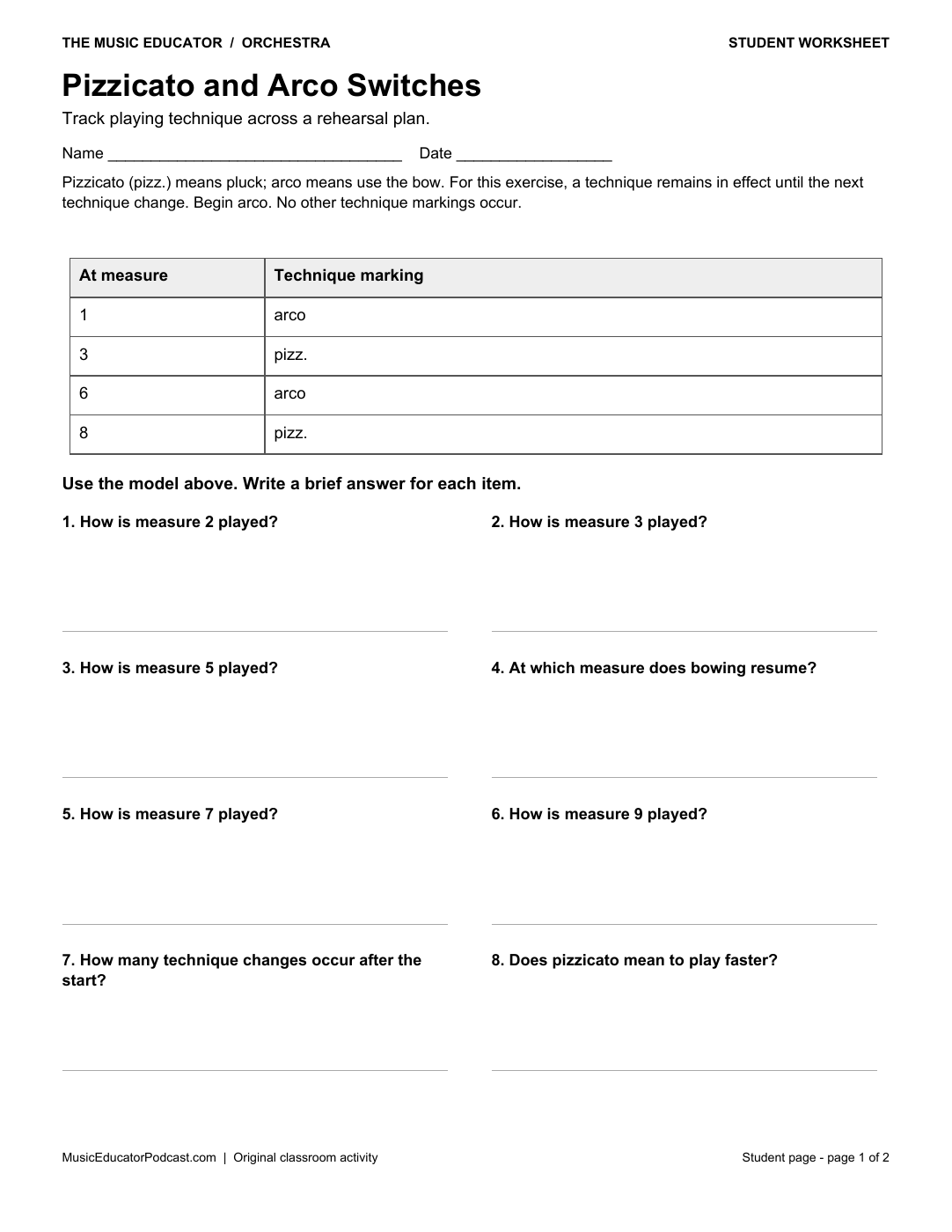
8. Pizzicato and Arco Switches
Track playing technique across a rehearsal plan. Pizzicato (pizz.) means pluck; arco means use the bow. For this exercise, a technique remains in effect until the next technique change. Begin arco. No other technique markings occur.
Download Pizzicato and Arco Switches (PDF)Includes the student worksheet and matching answer key.
Preview the student worksheet
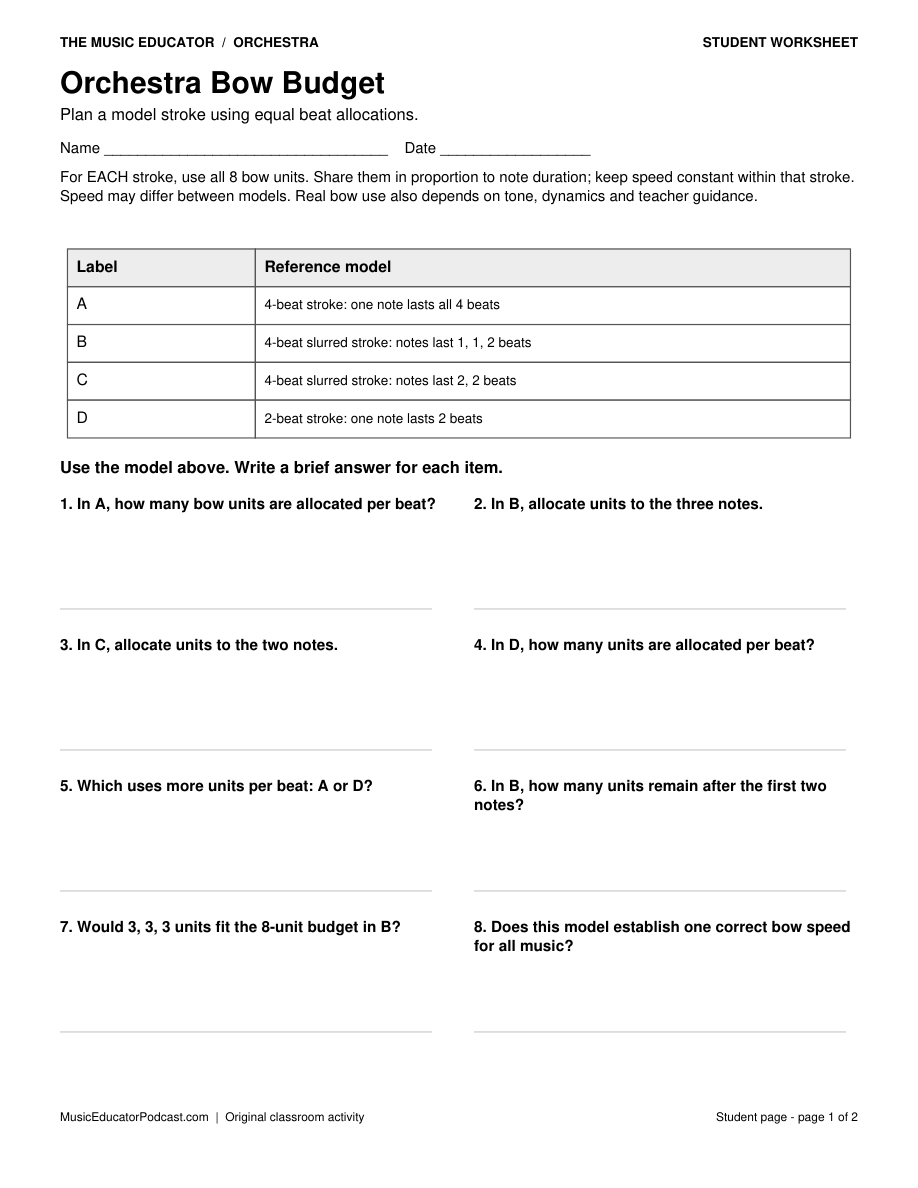
9. Orchestra Bow Budget
Plan a model stroke using equal beat allocations. For each stroke, use all 8 bow units. Share them in proportion to note duration; keep speed constant within that stroke. Speed may differ between models. Real bow use also depends on tone, dynamics and teacher guidance.
Download Orchestra Bow Budget (PDF)Includes the student worksheet and matching answer key.
Preview the student worksheet
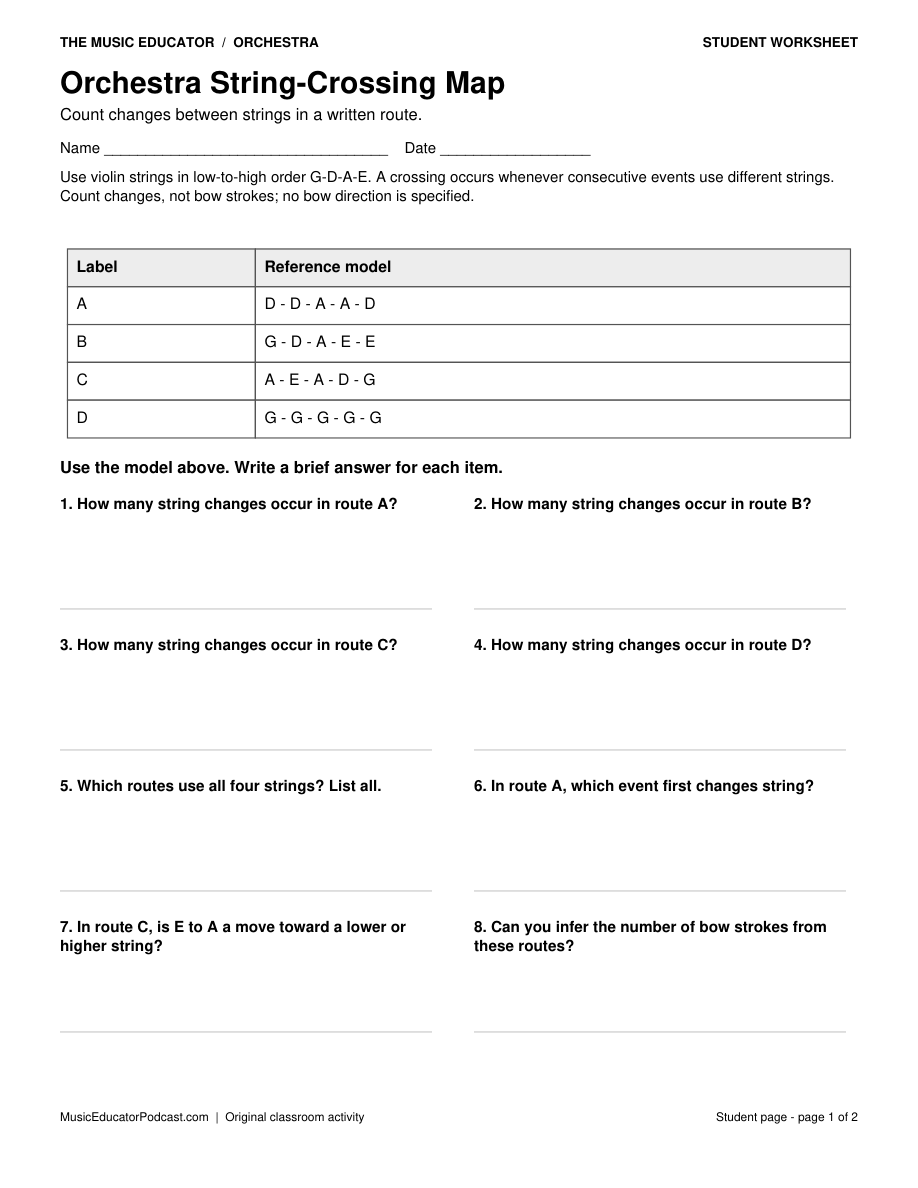
10. Orchestra String-Crossing Map
Count changes between strings in a written route. Use violin strings in low-to-high order G-D-A-E. A crossing occurs whenever consecutive events use different strings. Count changes, not bow strokes; no bow direction is specified.
Download Orchestra String-Crossing Map (PDF)Includes the student worksheet and matching answer key.
Preview the student worksheet
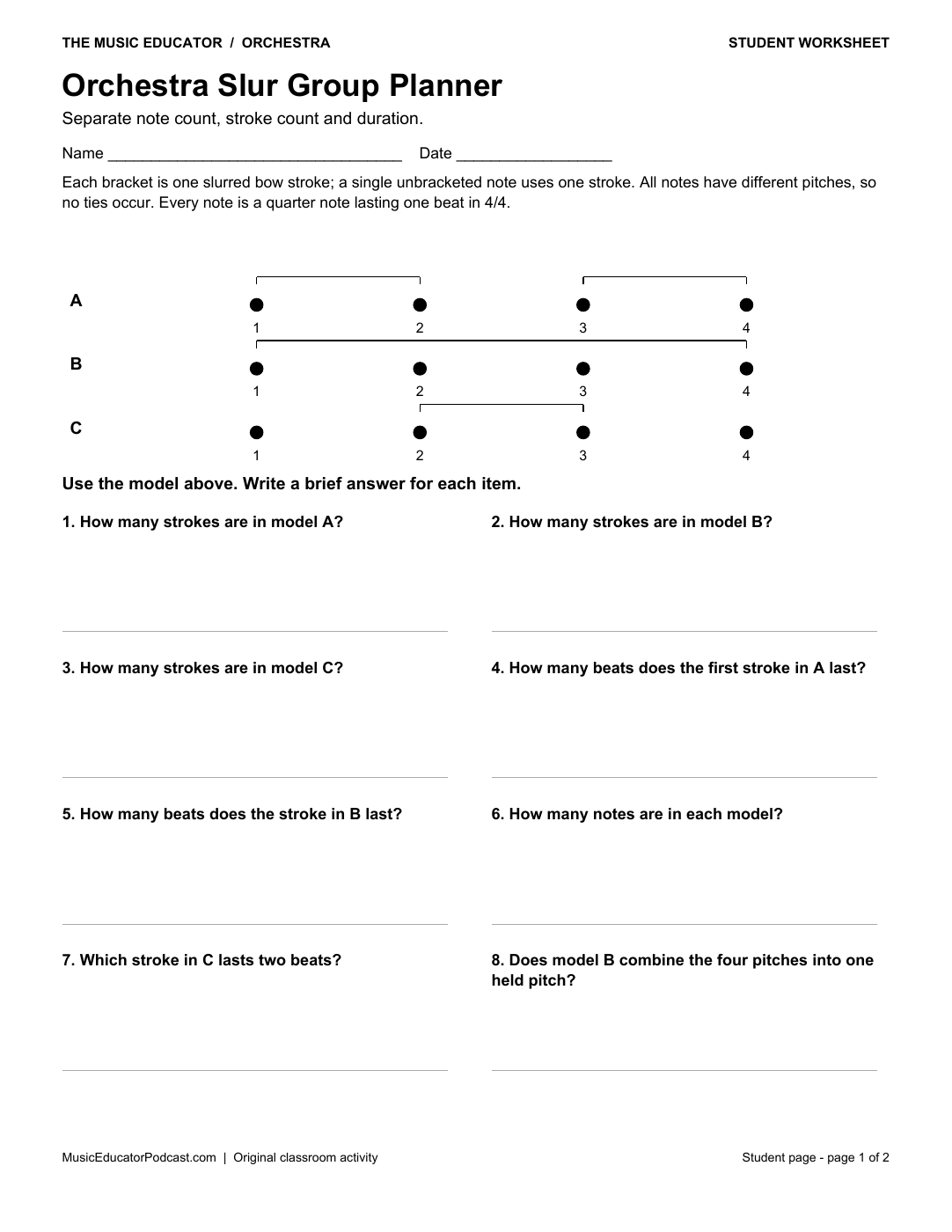
11. Orchestra Slur Group Planner
Separate note count, stroke count and duration. Each bracket is one slurred bow stroke; a single unbracketed note uses one stroke. All notes have different pitches, so no ties occur. Every note is a quarter note lasting one beat in 4/4.
Download Orchestra Slur Group Planner (PDF)Includes the student worksheet and matching answer key.
Preview the student worksheet
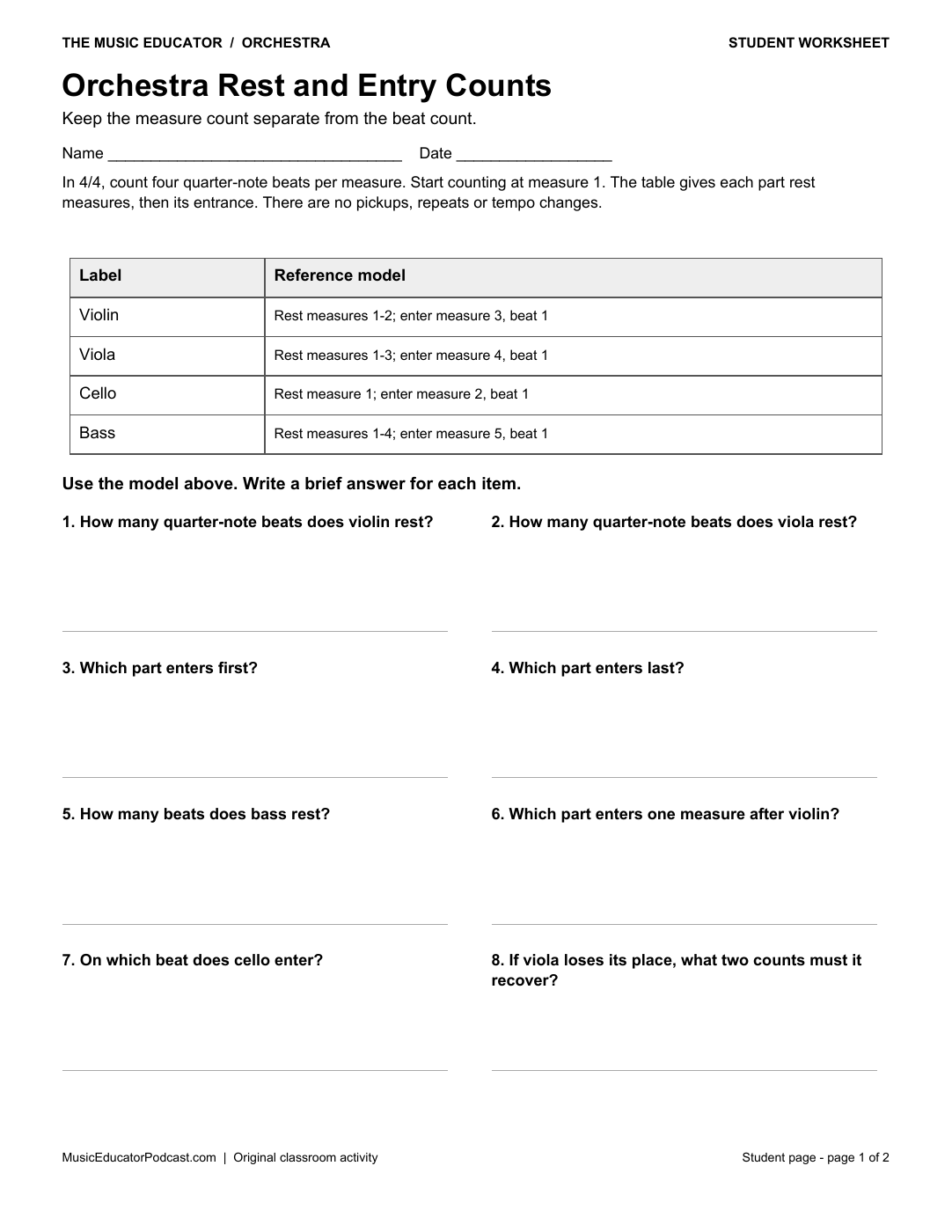
12. Orchestra Rest and Entry Counts
Keep the measure count separate from the beat count. In 4/4, count four quarter-note beats per measure. Start counting at measure 1. The table gives each part rest measures, then its entrance. There are no pickups, repeats or tempo changes.
Download Orchestra Rest and Entry Counts (PDF)Includes the student worksheet and matching answer key.
Preview the student worksheet
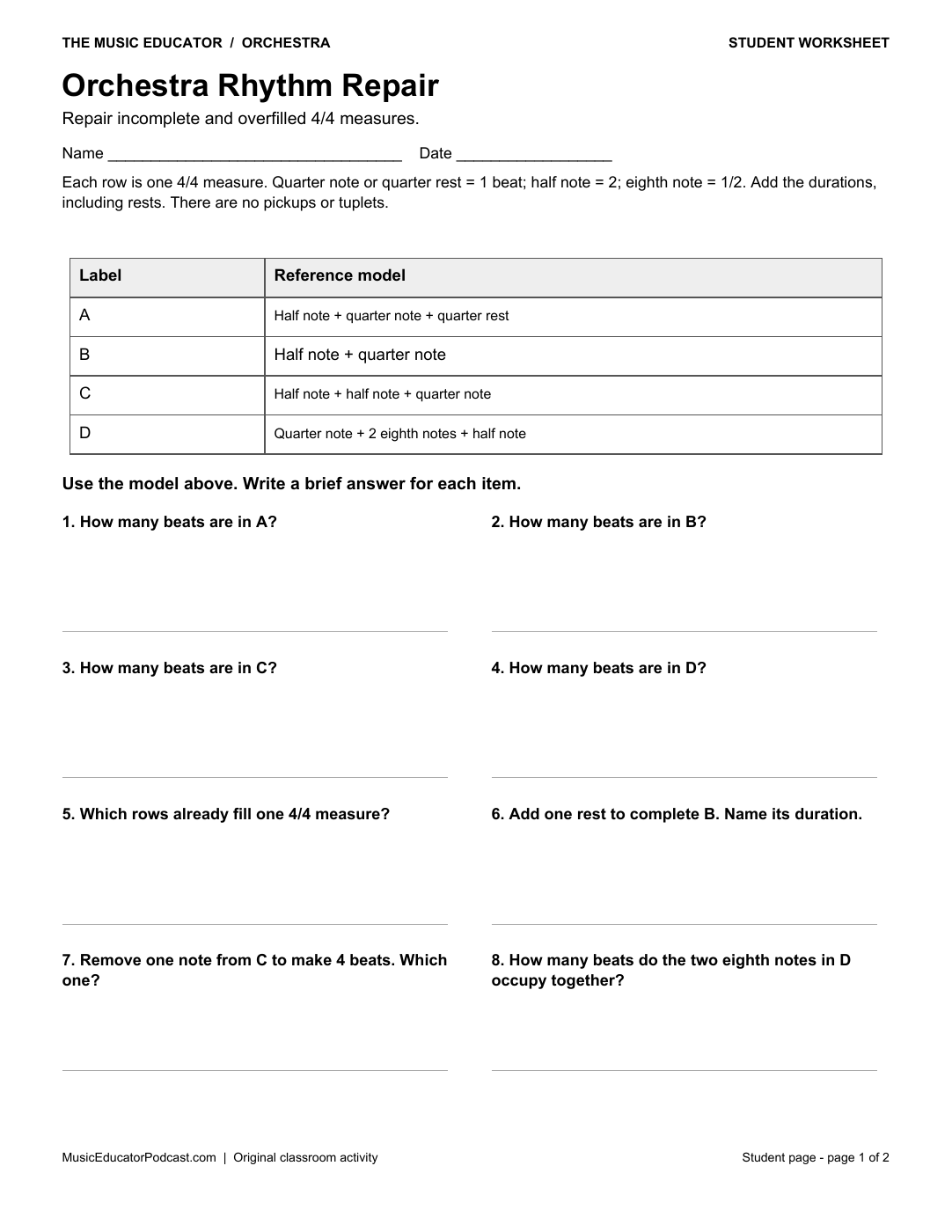
13. Orchestra Repeat Roadmap
Follow a repeat and two endings in order. Follow this supplied route: play measures 1-4, then first ending 5-6; repeat from 1. On the second pass, skip 5-6 and play second ending 7-8, then stop. Each measure is 4/4; there are no other repeats.
Download Orchestra Repeat Roadmap (PDF)Includes the student worksheet and matching answer key.
Preview the student worksheet
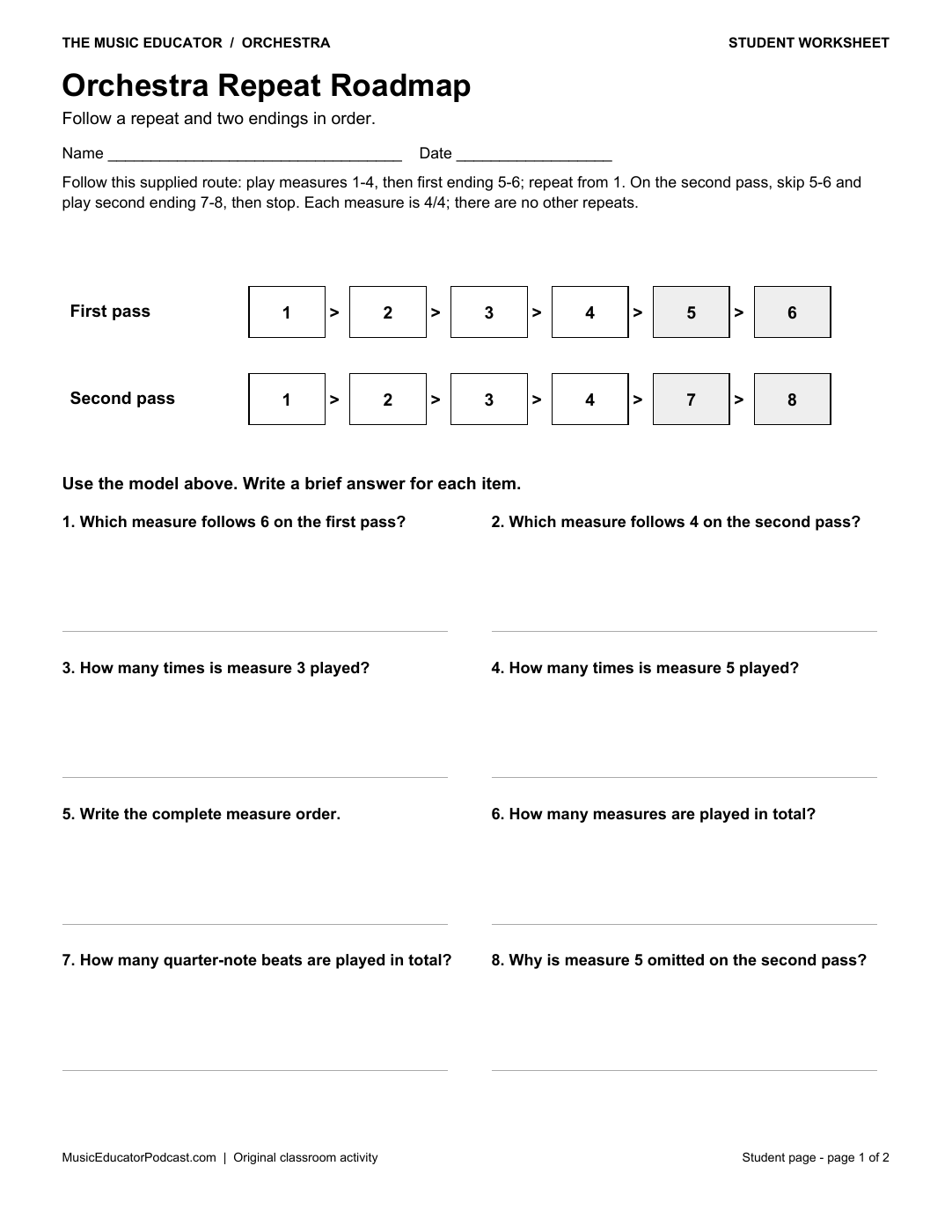
14. Orchestra Melody Handoff
Track which section carries the principal line. This rehearsal plan names the principal melody and supporting parts. Support does not mean silence. Balance is judged by listening to whether the melody is clear within the intended ensemble sound.
Download Orchestra Melody Handoff (PDF)Includes the student worksheet and matching answer key.
Preview the student worksheet
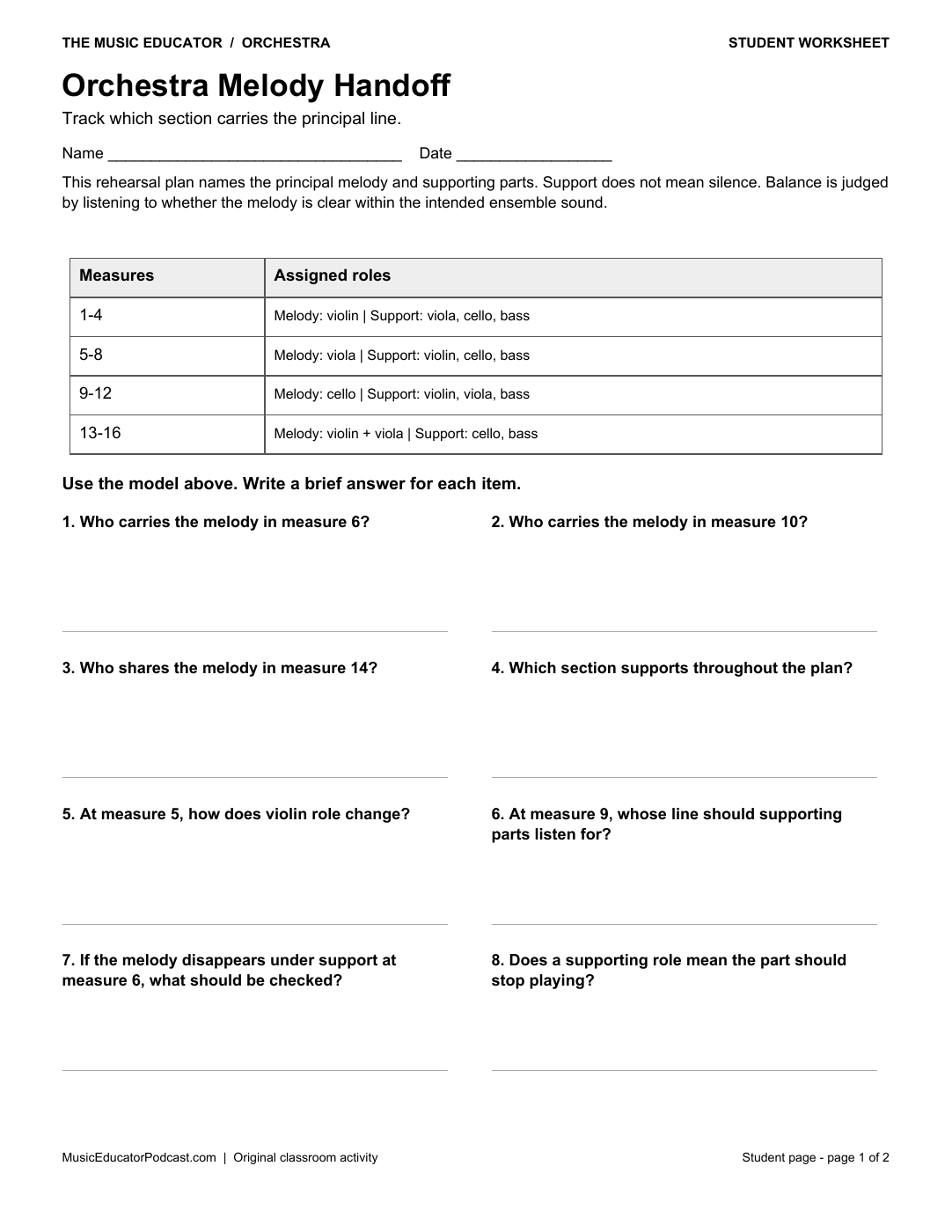
15. Orchestra Tuning Evidence
Read tuner evidence without confusing pitch and volume. For this paper task, the tuner is set to the intended note and reference. Negative cents = flat; positive cents = sharp; 0 = matching the target. Use absolute distance from 0 to compare closeness.
Download Orchestra Tuning Evidence (PDF)Includes the student worksheet and matching answer key.
Preview the student worksheet
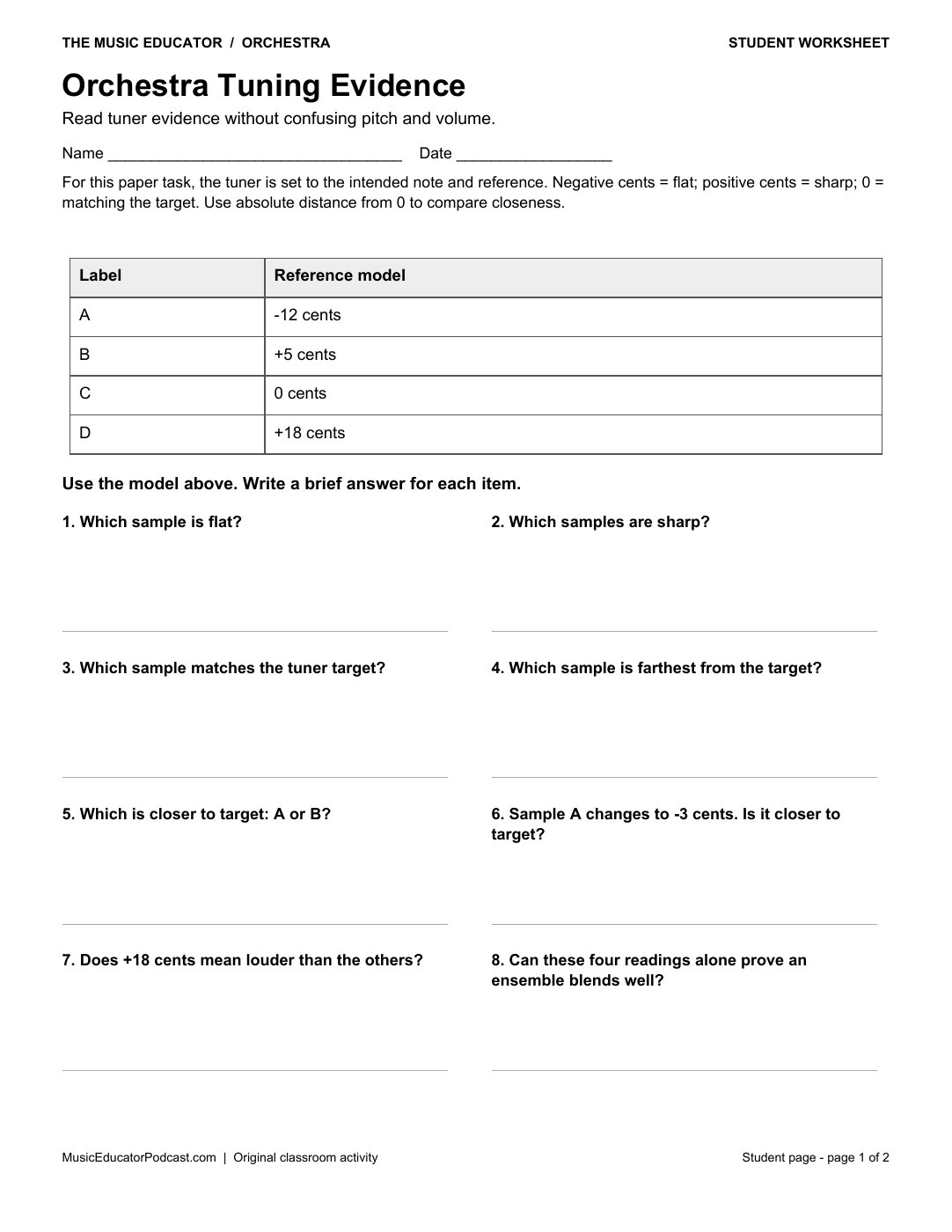
16. Orchestra Rhythm Repair
Repair incomplete and overfilled 4/4 measures. Each row is one 4/4 measure. Quarter note or quarter rest = 1 beat; half note = 2; eighth note = 1/2. Add the durations, including rests. There are no pickups or tuplets.
Download Orchestra Rhythm Repair (PDF)Includes the student worksheet and matching answer key.
Preview the student worksheet
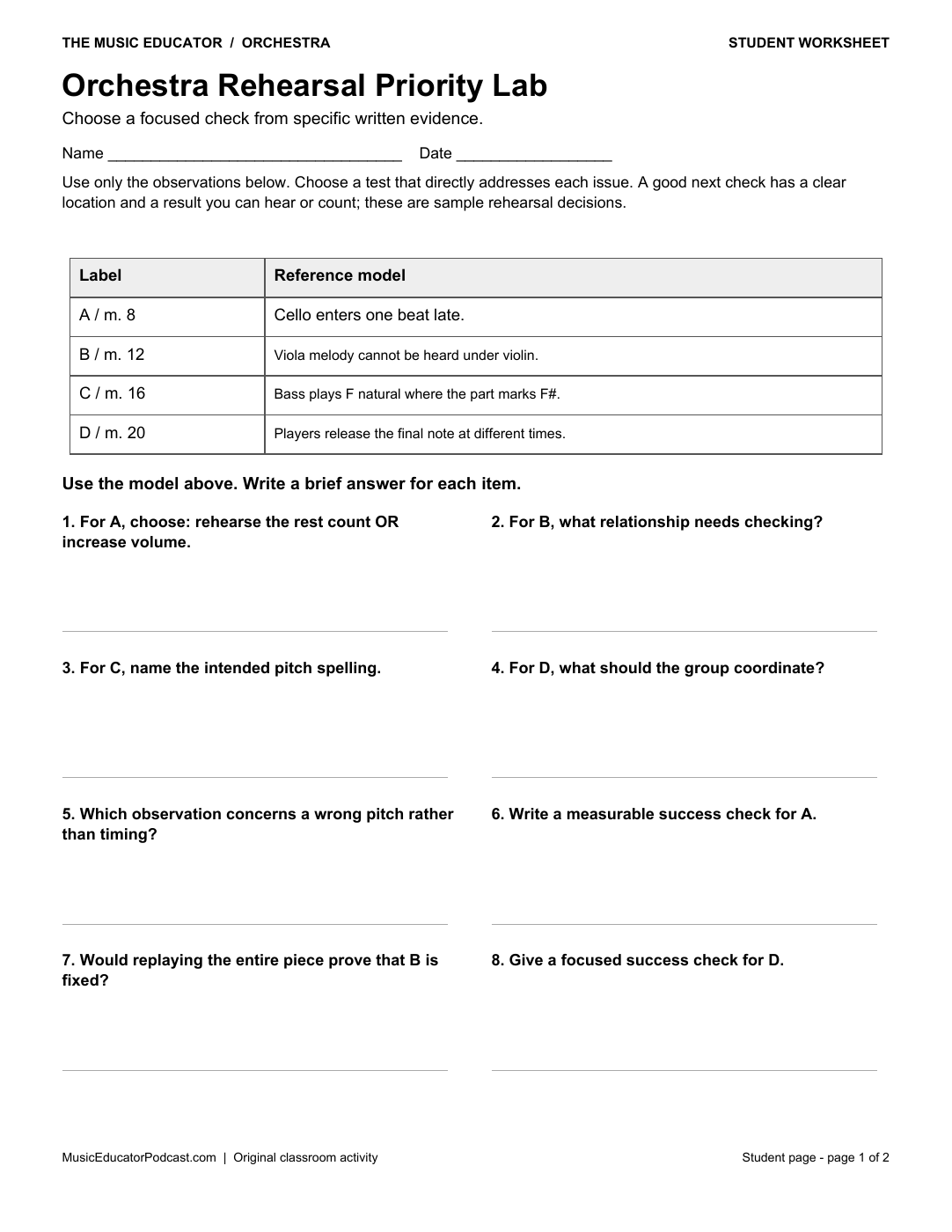
17. Orchestra Rehearsal Priority Lab
Choose a focused check from specific written evidence. Use only the observations below. Choose a test that directly addresses each issue. A good next check has a clear location and a result you can hear or count; these are sample rehearsal decisions.
Download Orchestra Rehearsal Priority Lab (PDF)Includes the student worksheet and matching answer key.
Preview the student worksheet
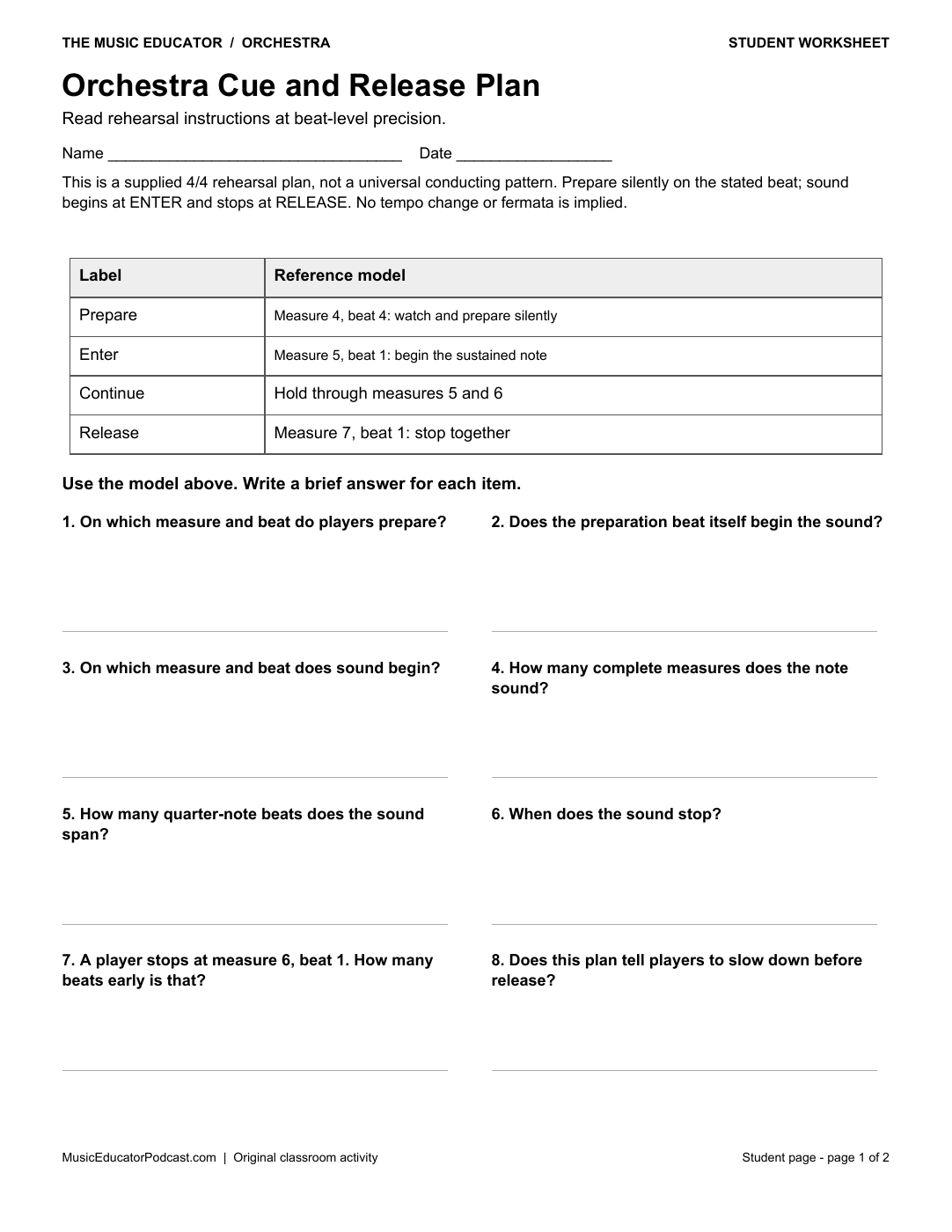
18. Orchestra Cue and Release Plan
Read rehearsal instructions at beat-level precision. This is a supplied 4/4 rehearsal plan, not a universal conducting pattern. Prepare silently on the stated beat; sound begins at ENTER and stops at RELEASE. No tempo change or fermata is implied.
Download Orchestra Cue and Release Plan (PDF)Includes the student worksheet and matching answer key.
Preview the student worksheet
More free music resources
Continue with all Orchestra Worksheets or browse the Free Music Worksheets hub for band, theory, technology, choir, guitar and piano.