
Choir Reading and Musicianship Lab
18 free choir worksheets with answer keys
Help beginning choir students connect the notes they read with the musical decisions they make. These short paper activities explore starting pitches, transposition, melodic contour, rhythm, lyric setting and relationships between vocal parts. Each worksheet has eight questions and a matching answer key.
Download complete Choir Lab (PDF)36-page packet: print pages 1–18 for students. Pages 19–36 contain the keys in the same order. Individual downloads below contain one student page followed by its key.
Choose a worksheet
- Tonic to Starting Pitch
- Same Melody, New Key
- Melodic Contour Check
- Choir Interval Number Builder
- Unison, Octave, or Other Harmony?
- Tenor Octave Reading
- Key Signature Rehearsal Check
- Tied Vowel Duration
- Pickup Measure Puzzle
- Six-Eight Syllable Grid
- Dotted Rhythm Duration
- Offbeat Entrance Grid
- Syllabic or Melismatic Setting?
- Lyric Stress Decisions
- Consonant Release Timeline
- Two-Part Motion Lab
- Choir Chord-Member Map
- Rehearsal Results Comparison
What students practice
- Identify starting pitches and transpose short major-key patterns by scale degree.
- Compare melodic contour, intervals, octave relationships and chord members.
- Calculate tied and dotted durations, pickup complements and attack positions.
- Distinguish lyric-setting choices and interpret a supplied consonant-release plan.
- Use specific trial results to choose a focused rehearsal follow-up.
Classroom use
Choose one activity that matches your current repertoire or review goal. Model a question together, let students work independently or in pairs, then discuss the evidence behind their answers. These are suitable for a short written warm-up, substitute lesson or exit ticket. The tasks require a pencil, not a recording or live singing; their written results do not measure vocal technique.
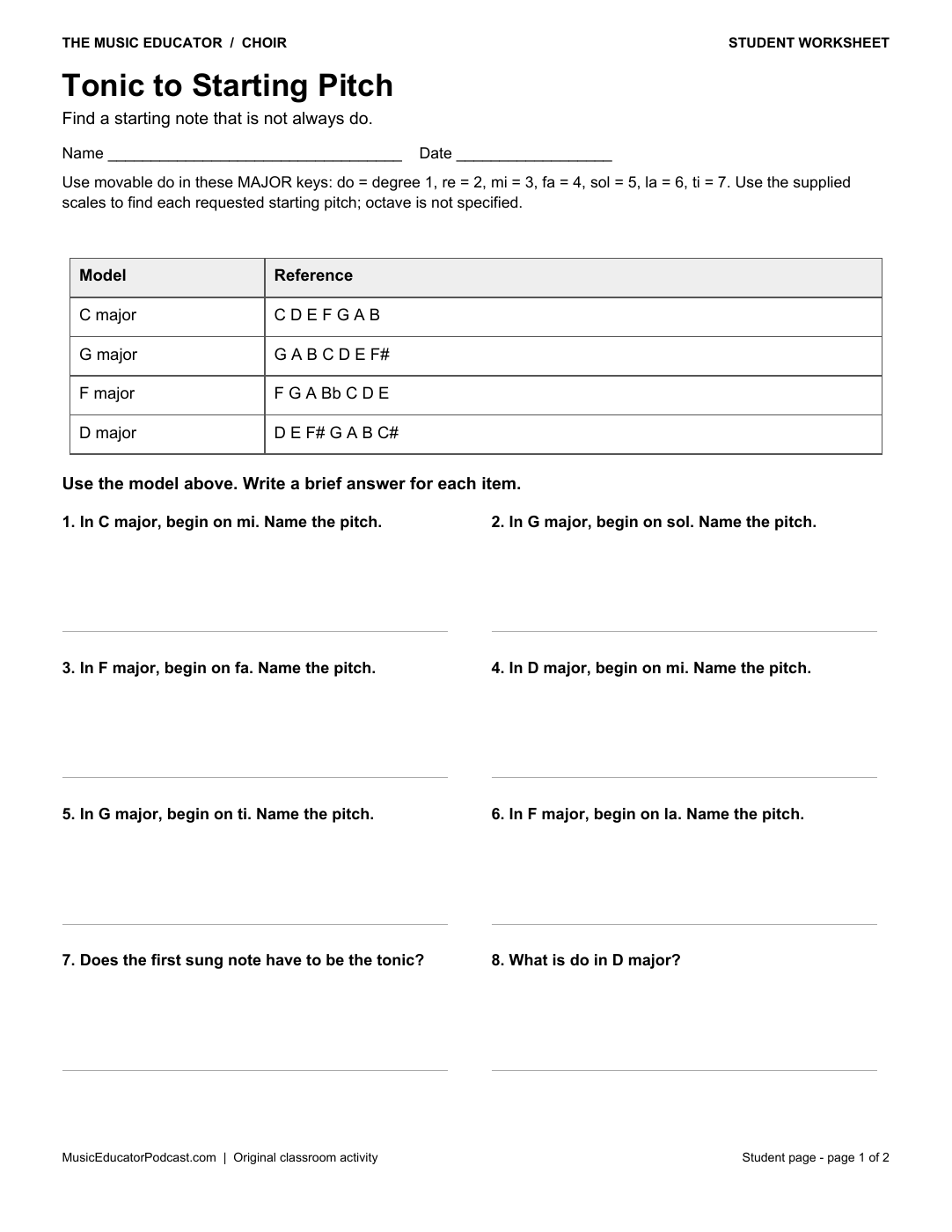
1. Tonic to Starting Pitch
Find a starting note that is not always do. Use movable do in these MAJOR keys: do = degree 1, re = 2, mi = 3, fa = 4, sol = 5, la = 6, ti = 7. Use the supplied scales to find each requested starting pitch; octave is not specified.
Download Tonic to Starting Pitch (PDF)Eight questions. Student worksheet on page 1; matching key on page 2.
Preview the student worksheet
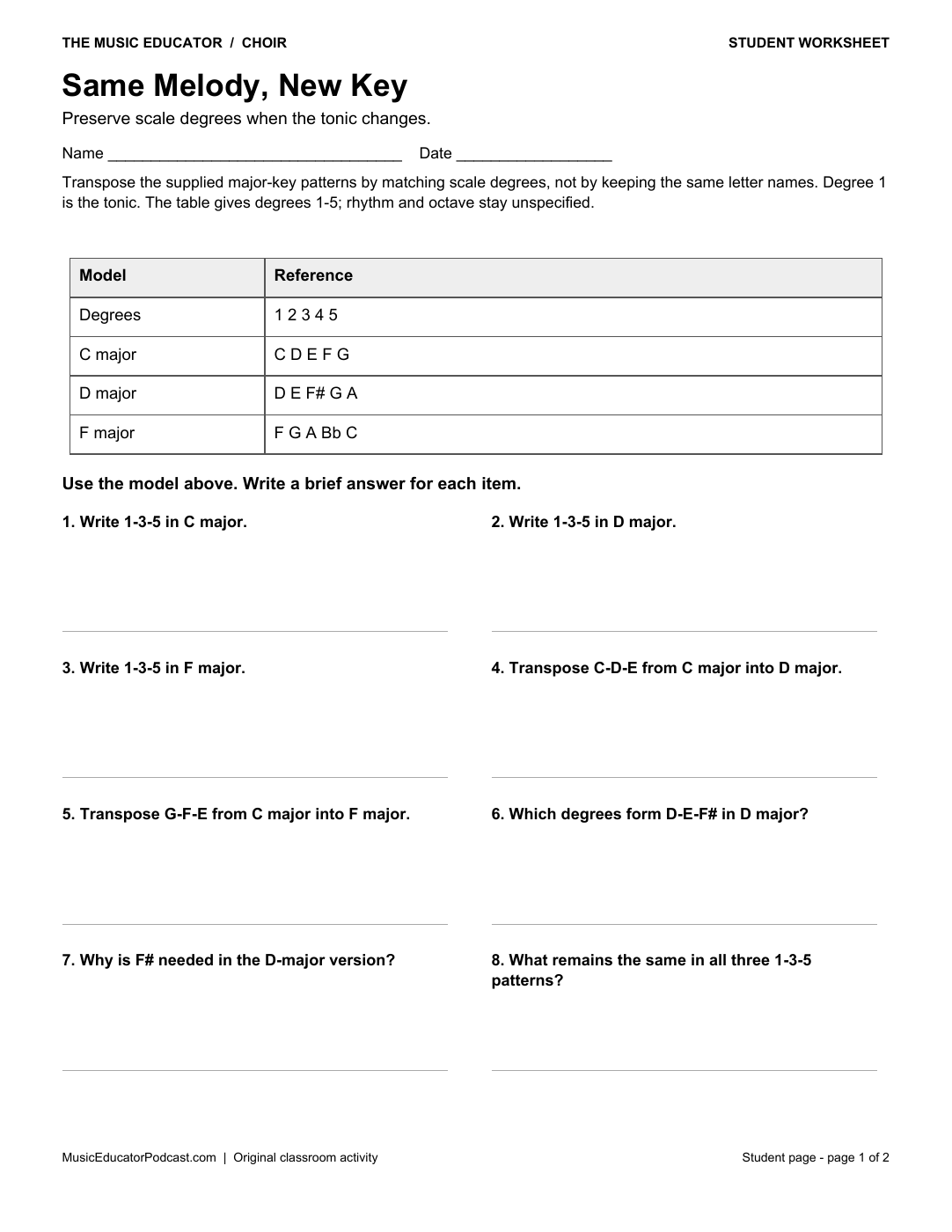
2. Same Melody, New Key
Preserve scale degrees when the tonic changes. Transpose the supplied major-key patterns by matching scale degrees, not by keeping the same letter names. Degree 1 is the tonic. The table gives degrees 1-5; rhythm and octave stay unspecified.
Download Same Melody, New Key (PDF)Eight questions. Student worksheet on page 1; matching key on page 2.
Preview the student worksheet
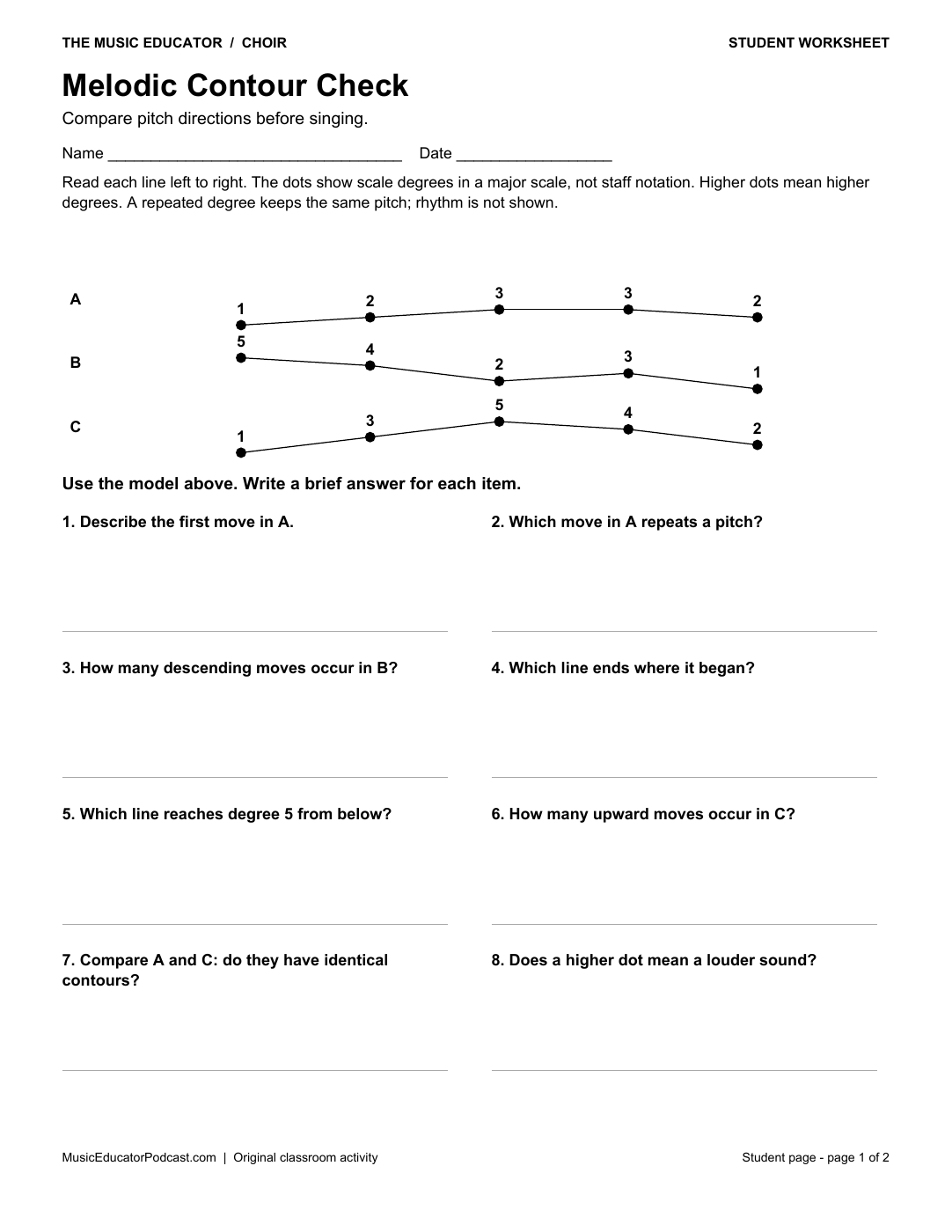
3. Melodic Contour Check
Compare pitch directions before singing. Read each line left to right. The dots show scale degrees in a major scale, not staff notation. Higher dots mean higher degrees. A repeated degree keeps the same pitch; rhythm is not shown.
Download Melodic Contour Check (PDF)Eight questions. Student worksheet on page 1; matching key on page 2.
Preview the student worksheet
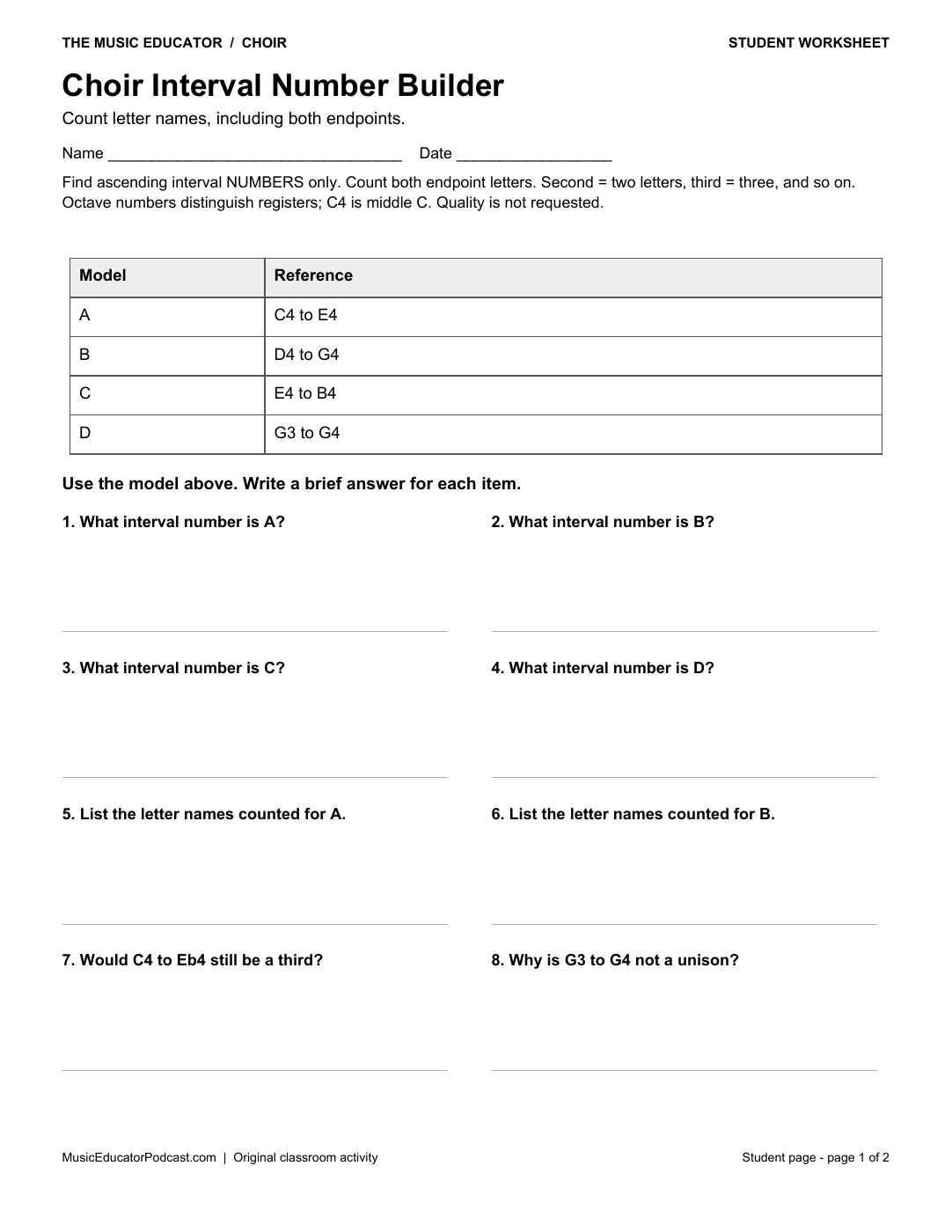
4. Choir Interval Number Builder
Count letter names, including both endpoints. Find ascending interval NUMBERS only. Count both endpoint letters. Second = two letters, third = three, and so on. Octave numbers distinguish registers; C4 is middle C. Quality is not requested.
Download Choir Interval Number Builder (PDF)Eight questions. Student worksheet on page 1; matching key on page 2.
Preview the student worksheet
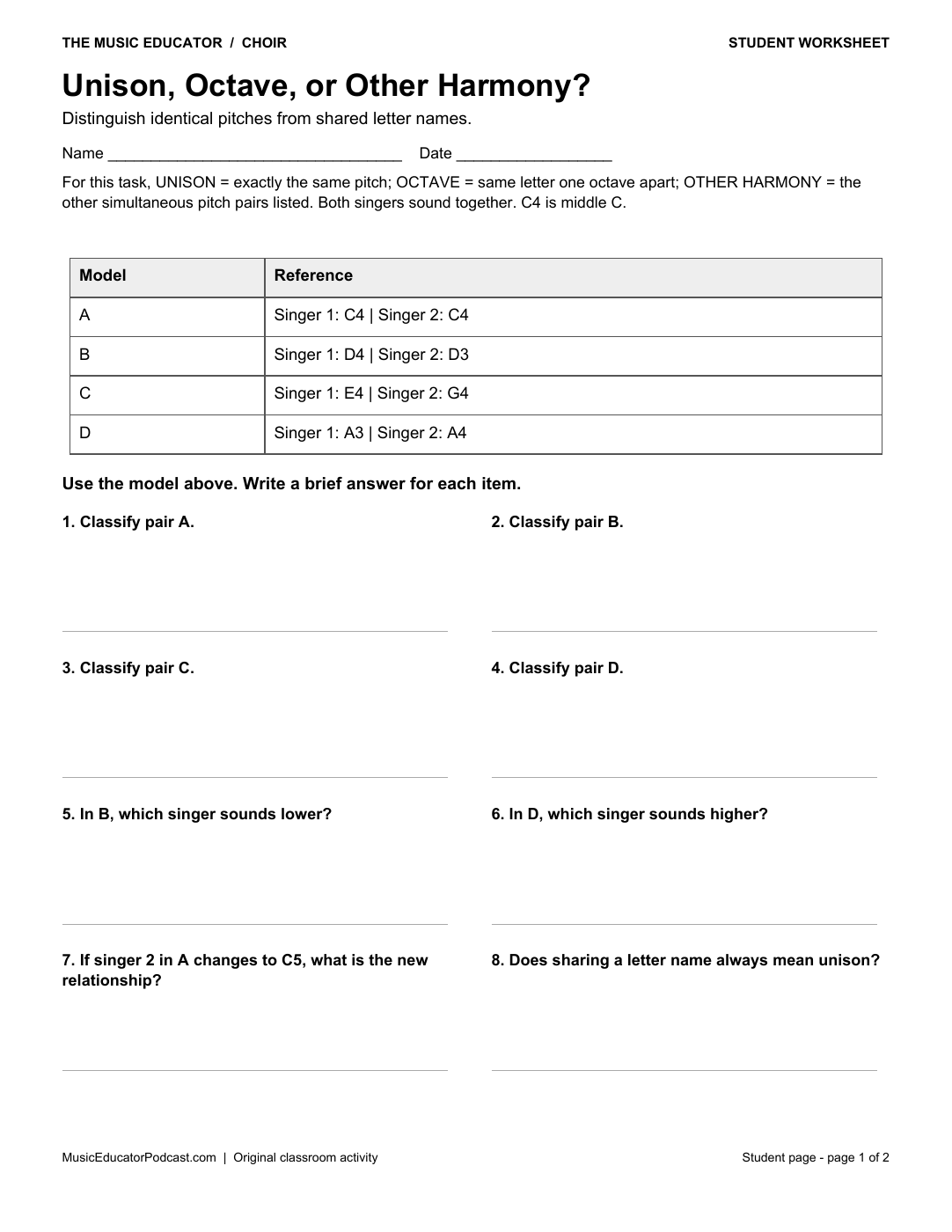
5. Unison, Octave, or Other Harmony?
Distinguish identical pitches from shared letter names. For this task, UNISON = exactly the same pitch; OCTAVE = same letter one octave apart; OTHER HARMONY = the other simultaneous pitch pairs listed. Both singers sound together. C4 is middle C.
Download Unison, Octave, or Other Harmony? (PDF)Eight questions. Student worksheet on page 1; matching key on page 2.
Preview the student worksheet
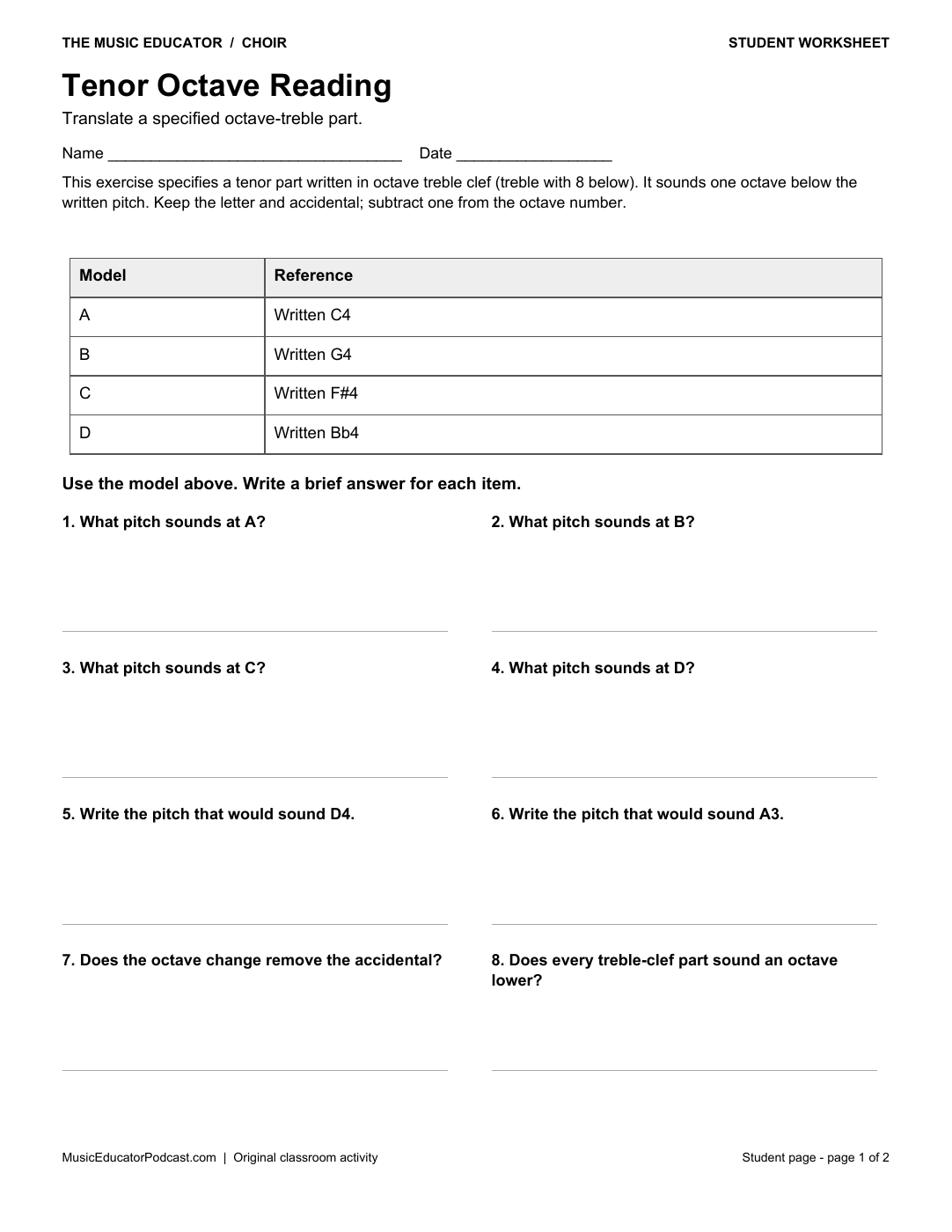
6. Tenor Octave Reading
Translate a specified octave-treble part. This exercise specifies a tenor part written in octave treble clef (treble with 8 below). It sounds one octave below the written pitch. Keep the letter and accidental; subtract one from the octave number.
Download Tenor Octave Reading (PDF)Eight questions. Student worksheet on page 1; matching key on page 2.
Preview the student worksheet
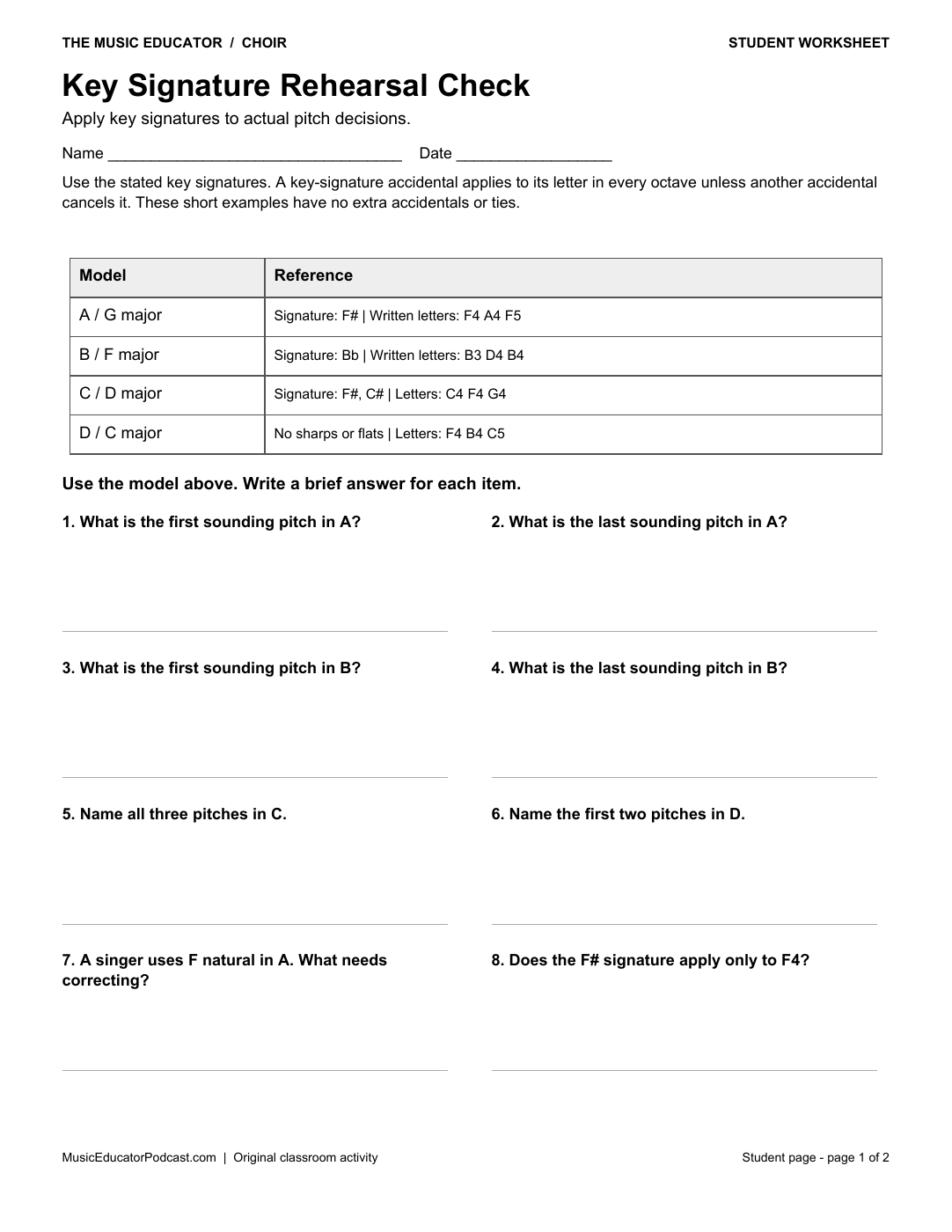
7. Key Signature Rehearsal Check
Apply key signatures to actual pitch decisions. Use the stated key signatures. A key-signature accidental applies to its letter in every octave unless another accidental cancels it. These short examples have no extra accidentals or ties.
Download Key Signature Rehearsal Check (PDF)Eight questions. Student worksheet on page 1; matching key on page 2.
Preview the student worksheet
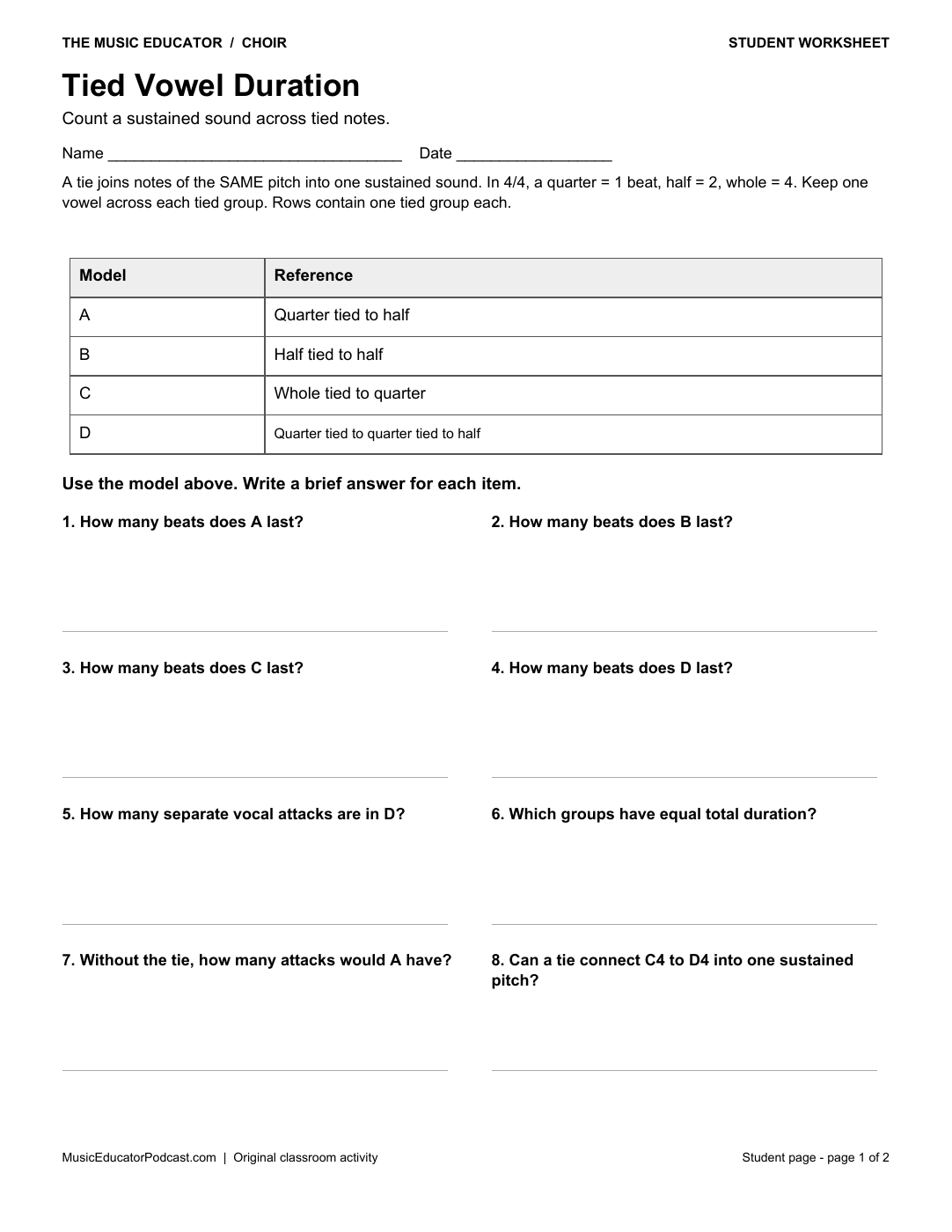
8. Tied Vowel Duration
Count a sustained sound across tied notes. A tie joins notes of the SAME pitch into one sustained sound. In 4/4, a quarter = 1 beat, half = 2, whole = 4. Keep one vowel across each tied group. Rows contain one tied group each.
Download Tied Vowel Duration (PDF)Eight questions. Student worksheet on page 1; matching key on page 2.
Preview the student worksheet
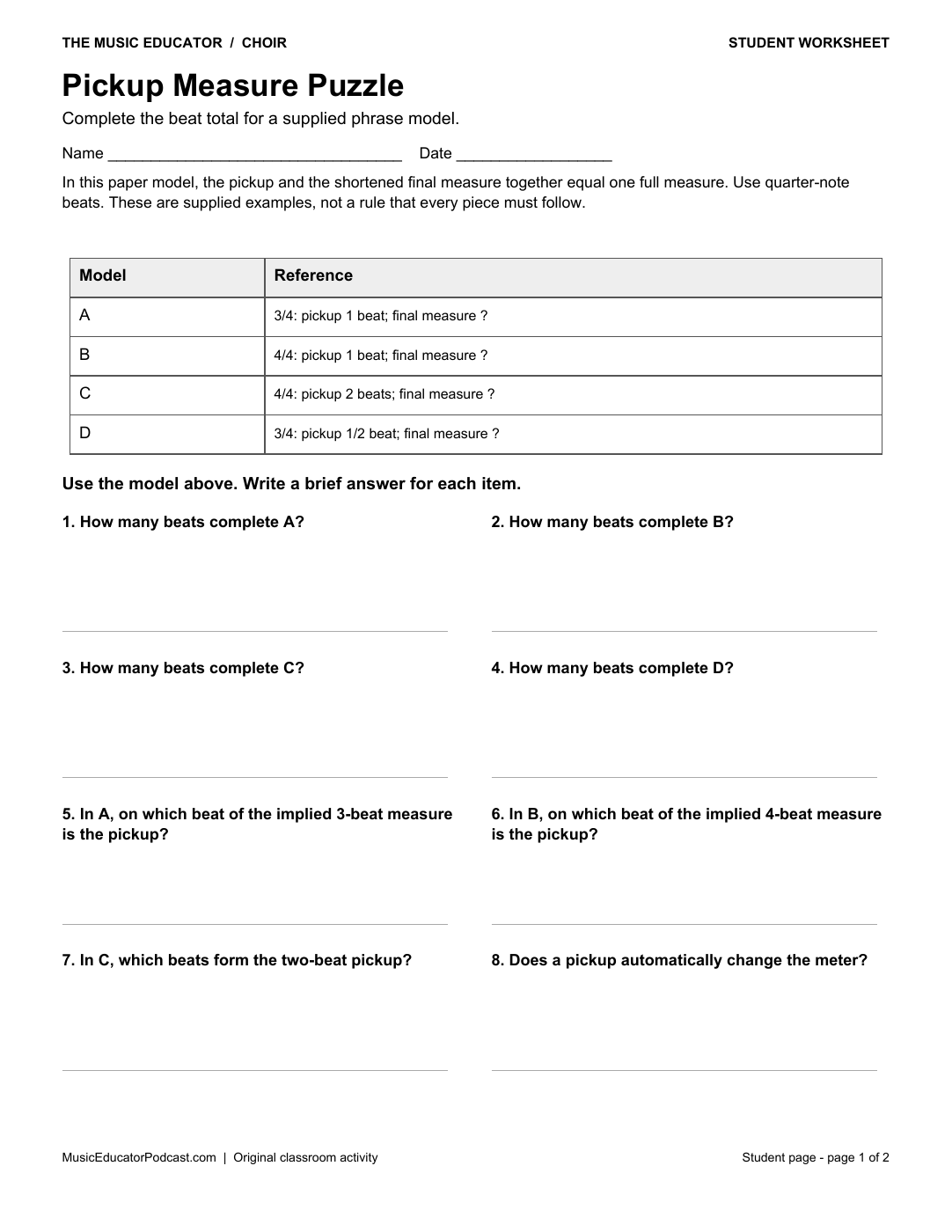
9. Pickup Measure Puzzle
Complete the beat total for a supplied phrase model. In this paper model, the pickup and the shortened final measure together equal one full measure. Use quarter-note beats. These are supplied examples, not a rule that every piece must follow.
Download Pickup Measure Puzzle (PDF)Eight questions. Student worksheet on page 1; matching key on page 2.
Preview the student worksheet
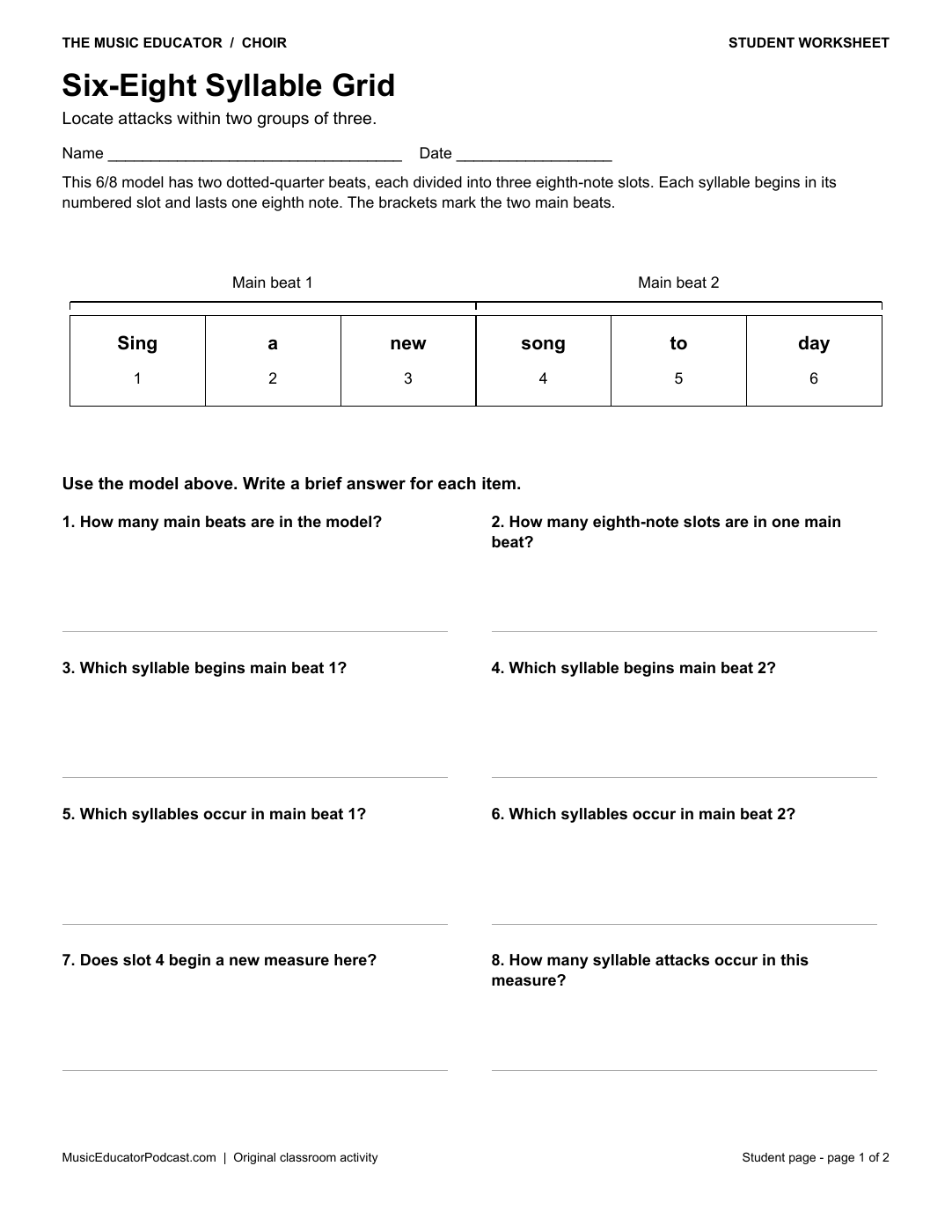
10. Six-Eight Syllable Grid
Locate attacks within two groups of three. This 6/8 model has two dotted-quarter beats, each divided into three eighth-note slots. Each syllable begins in its numbered slot and lasts one eighth note. The brackets mark the two main beats.
Download Six-Eight Syllable Grid (PDF)Eight questions. Student worksheet on page 1; matching key on page 2.
Preview the student worksheet
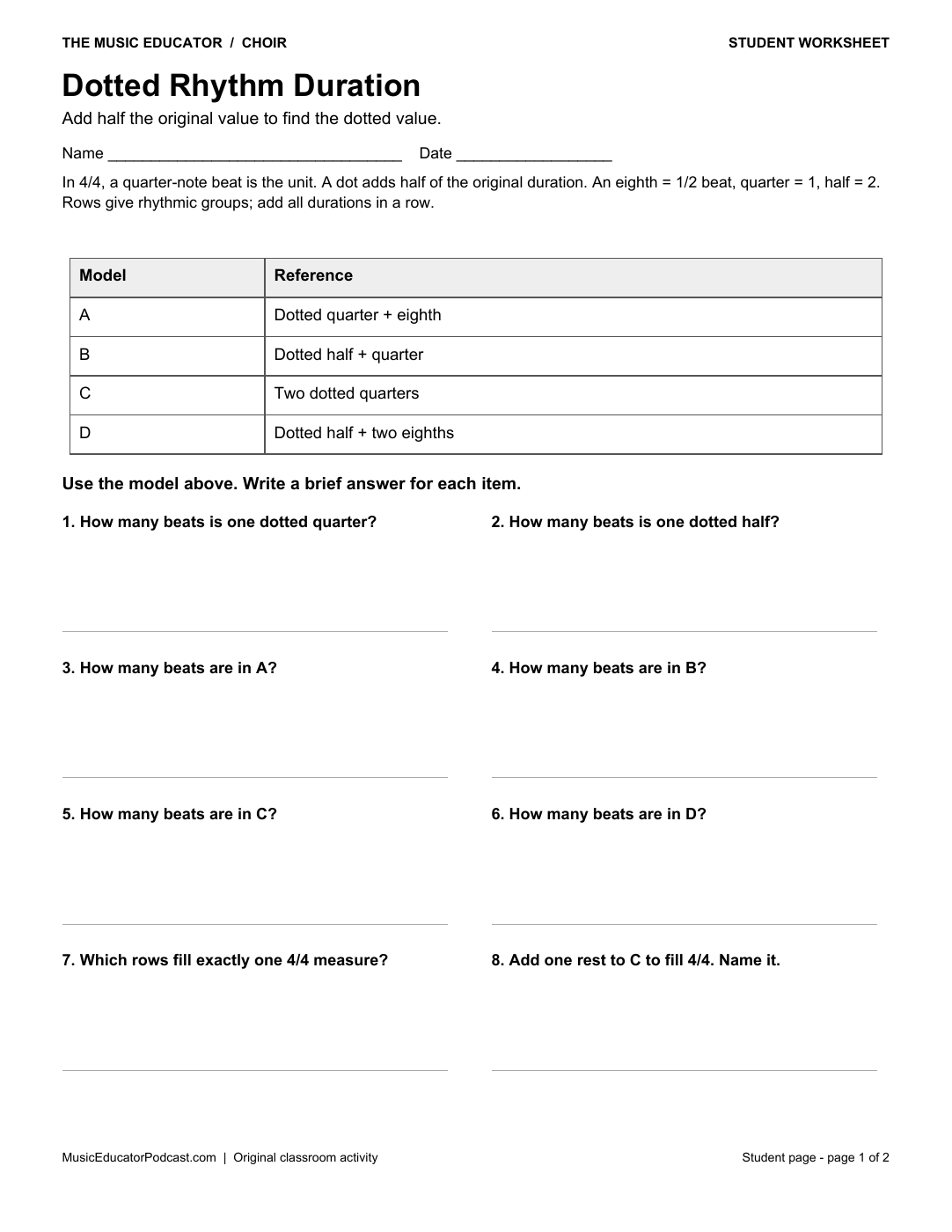
11. Dotted Rhythm Duration
Add half the original value to find the dotted value. In 4/4, a quarter-note beat is the unit. A dot adds half of the original duration. An eighth = 1/2 beat, quarter = 1, half = 2. Rows give rhythmic groups; add all durations in a row.
Download Dotted Rhythm Duration (PDF)Eight questions. Student worksheet on page 1; matching key on page 2.
Preview the student worksheet
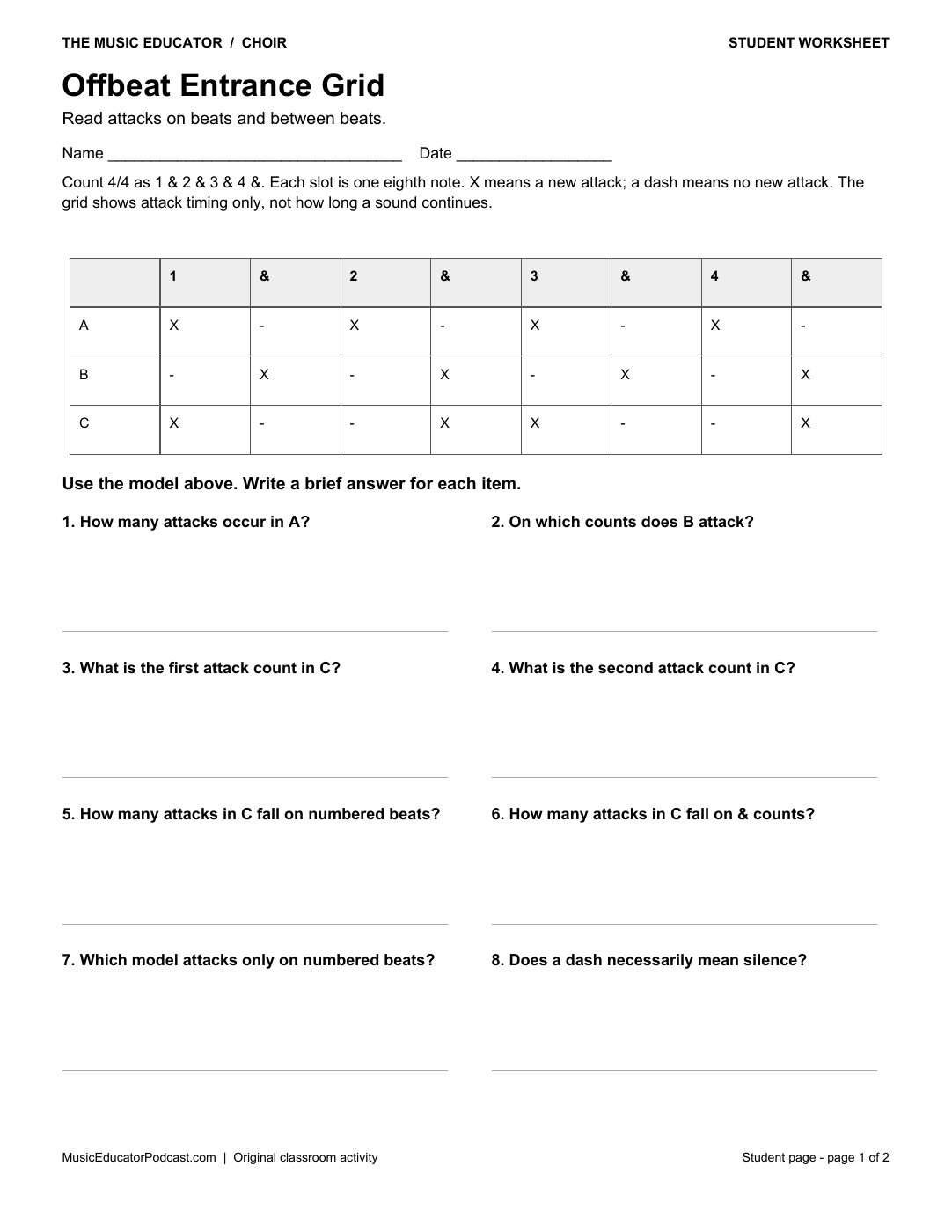
12. Offbeat Entrance Grid
Read attacks on beats and between beats. Count 4/4 as 1 & 2 & 3 & 4 &. Each slot is one eighth note. X means a new attack; a dash means no new attack. The grid shows attack timing only, not how long a sound continues.
Download Offbeat Entrance Grid (PDF)Eight questions. Student worksheet on page 1; matching key on page 2.
Preview the student worksheet
13. Syllabic or Melismatic Setting?
Compare syllable counts with note counts. Syllabic setting uses one note per syllable. A melisma uses multiple notes on one syllable. Brackets below group note labels sung on the SAME syllable. Labels show note events, not pitch or duration.
Download Syllabic or Melismatic Setting? (PDF)Eight questions. Student worksheet on page 1; matching key on page 2.
Preview the student worksheet
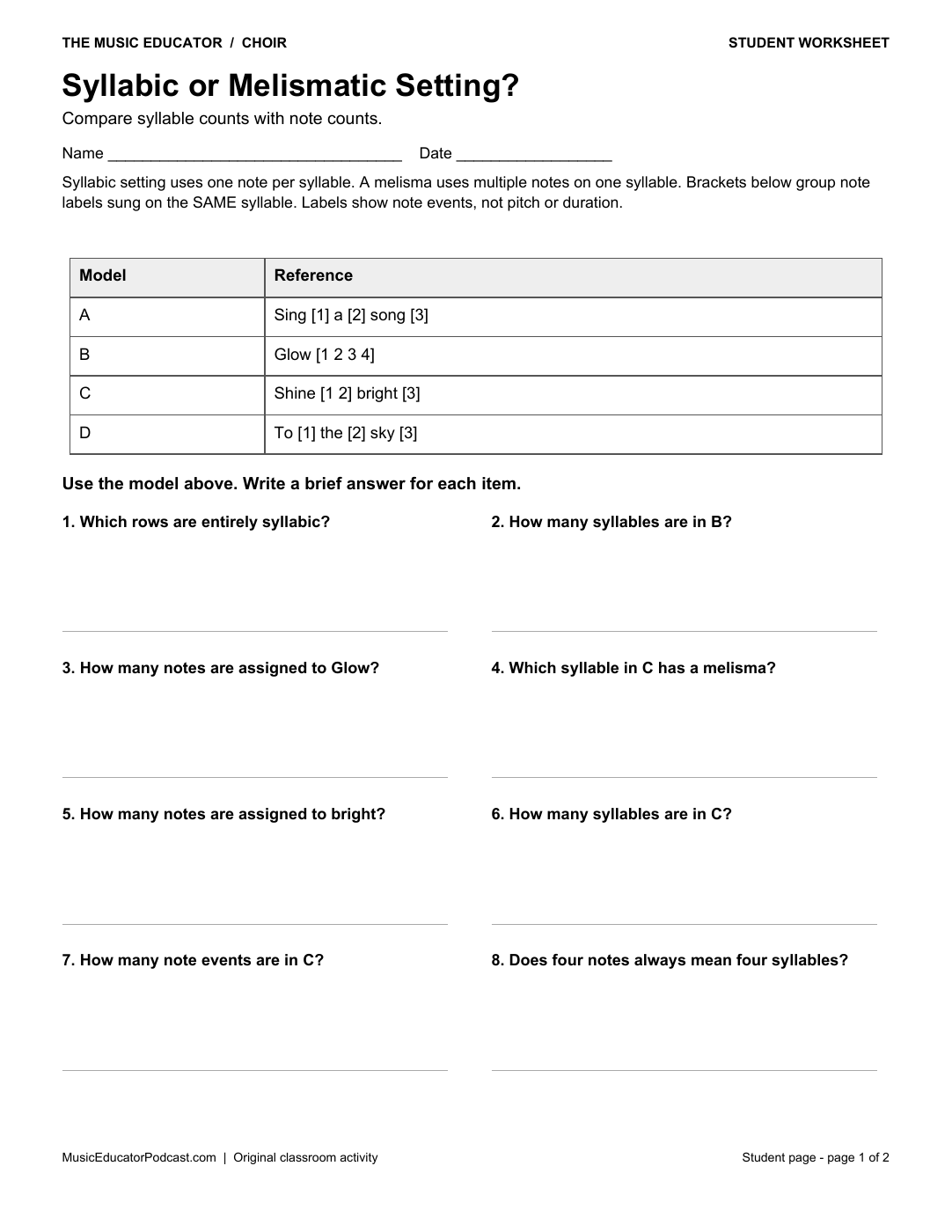
14. Lyric Stress Decisions
Compare supplied spoken stress with musical emphasis. For this exercise, capital letters show the stressed syllable: MU-sic, to-GETH-er, BRIGHT-ly. The model names the syllable given musical emphasis. Classify each as MATCH or MISMATCH with the supplied stress.
Download Lyric Stress Decisions (PDF)Eight questions. Student worksheet on page 1; matching key on page 2.
Preview the student worksheet
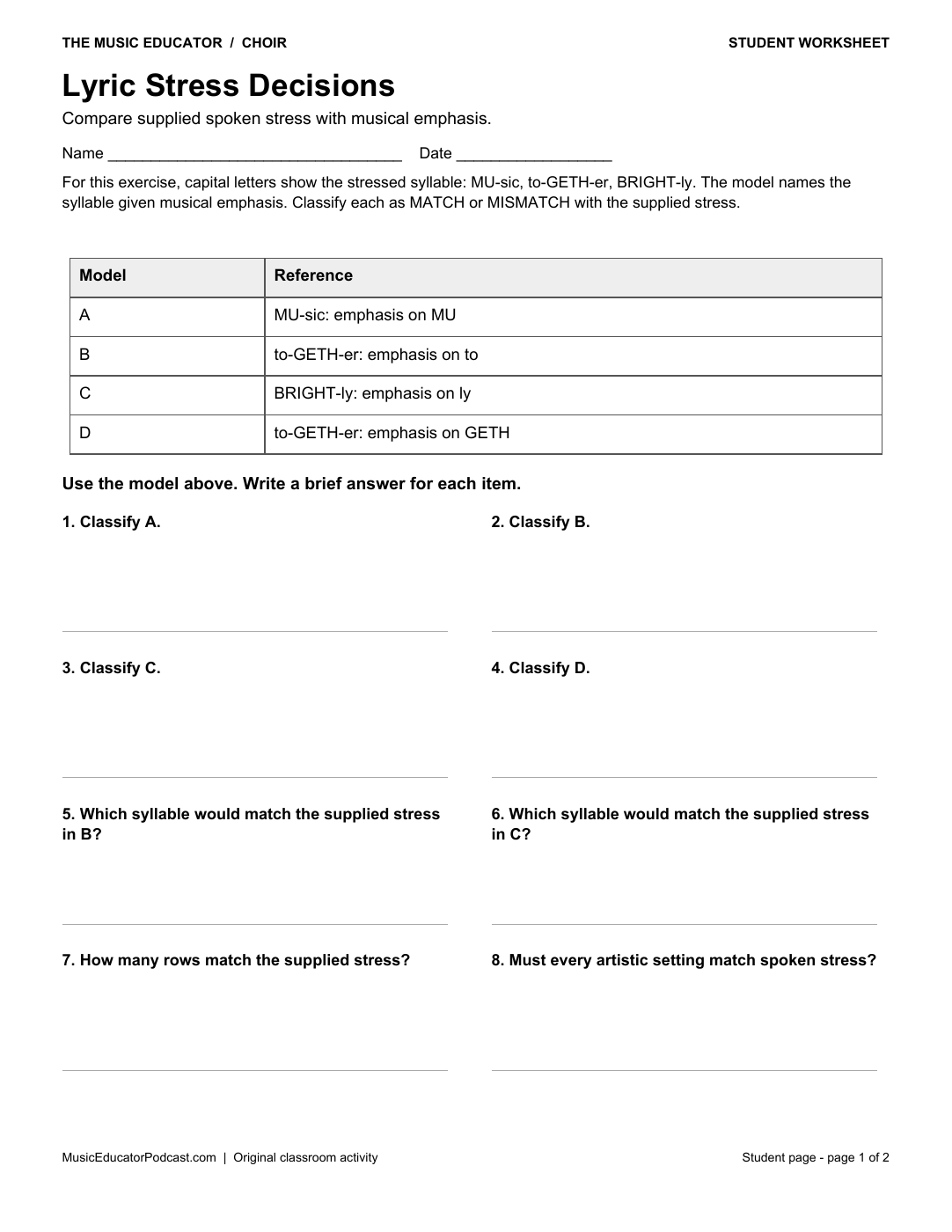
15. Consonant Release Timeline
Coordinate a final consonant using a supplied plan. Read this teacher-supplied 4/4 plan for the word light. Start the word at beat 1, sustain its vowel through beat 3, place the final /t/ at beat 4, then rest. This is one exercise plan, not a rule for every word.
Download Consonant Release Timeline (PDF)Eight questions. Student worksheet on page 1; matching key on page 2.
Preview the student worksheet
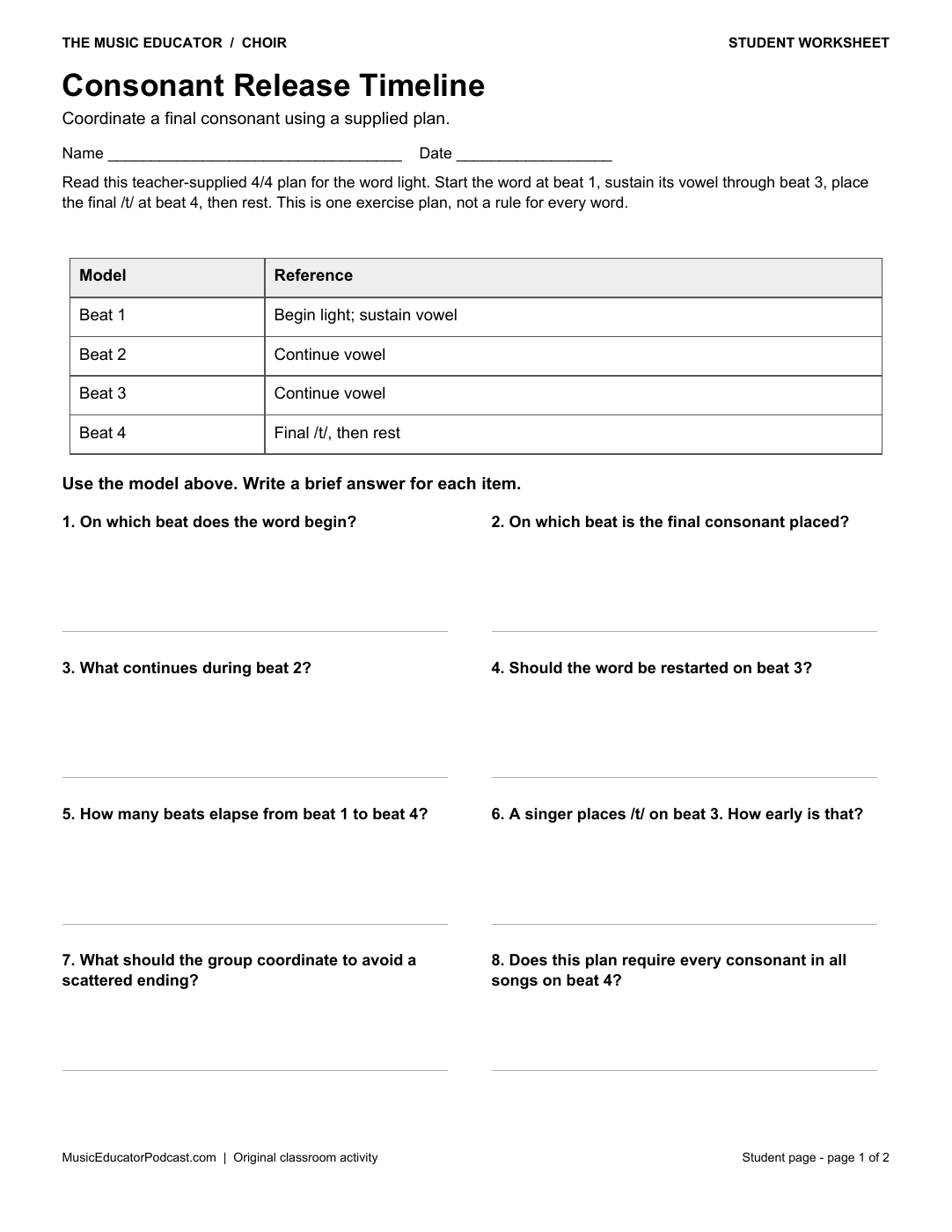
16. Two-Part Motion Lab
Compare how two pitch lines move together. Each row shows one simultaneous change in two voices. CONTRARY: one rises, one falls. OBLIQUE: one stays, one moves. SIMILAR: both move in the same direction. Use sounding pitches; C4 is middle C.
Download Two-Part Motion Lab (PDF)Eight questions. Student worksheet on page 1; matching key on page 2.
Preview the student worksheet
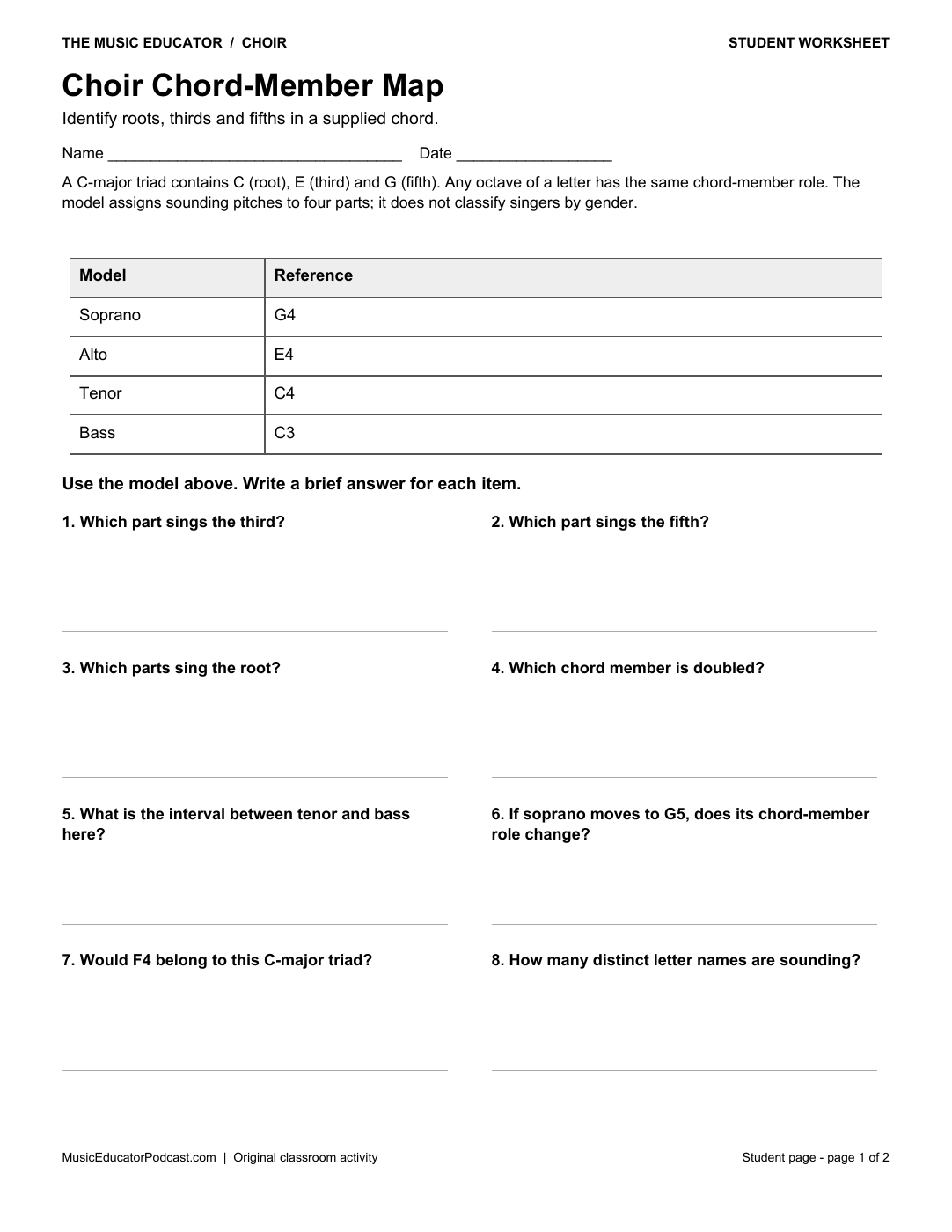
17. Choir Chord-Member Map
Identify roots, thirds and fifths in a supplied chord. A C-major triad contains C (root), E (third) and G (fifth). Any octave of a letter has the same chord-member role. The model assigns sounding pitches to four parts; it does not classify singers by gender.
Download Choir Chord-Member Map (PDF)Eight questions. Student worksheet on page 1; matching key on page 2.
Preview the student worksheet
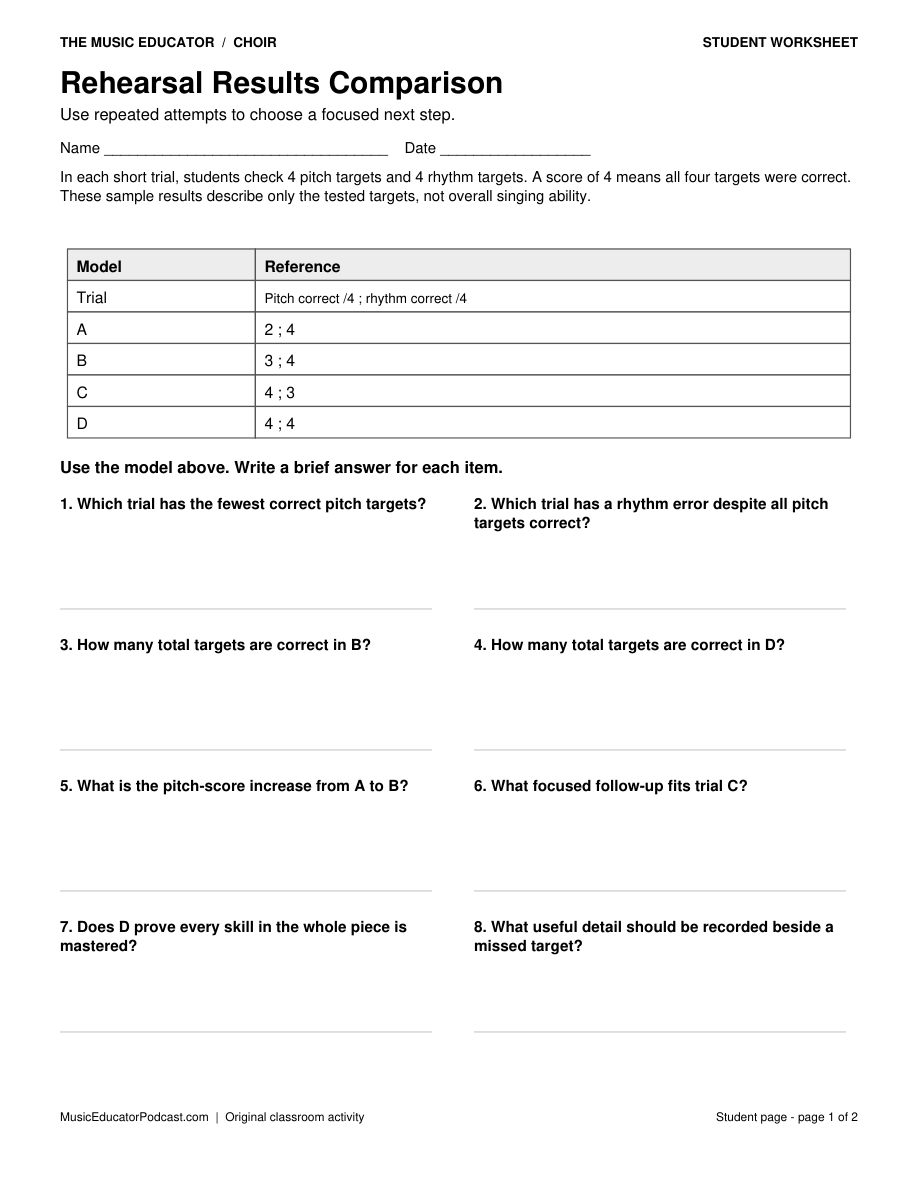
18. Rehearsal Results Comparison
Use repeated attempts to choose a focused next step. In each short trial, students check 4 pitch targets and 4 rhythm targets. A score of 4 means all four targets were correct. These sample results describe only the tested targets, not overall singing ability.
Download Rehearsal Results Comparison (PDF)Eight questions. Student worksheet on page 1; matching key on page 2.
Preview the student worksheet
Common questions
Who are these activities for?
Beginning choir readers who are learning pitch names, basic note values and part-reading. Each sheet supplies its own reference model. Select tasks by readiness rather than assuming every beginner knows every topic.
Are answer keys included?
Yes. Every individual PDF has its key on page 2. The full packet places all student pages before all keys. The rehearsal-results sheet includes sample responses for its open-ended items.
Can I print in black and white?
Yes. The US Letter pages use black text, grayscale tables and simple diagrams, with space for handwritten answers.
Are the diagrams performance scores?
No. The contour and counting grids are labeled teaching models. Pitch names include octave numbers when register matters. Use your repertoire and teacher guidance for practical singing and phrasing.