
Guitar Fretboard and Chord Lab
18 free guitar worksheets with answer keys
Connect chord diagrams and tablature to the music they represent. These printable activities explore fretboard pitches, chord tones, capo transposition, arpeggios and rhythm using clear, self-contained models.
Each activity has eight questions on one student page and a matching answer key on page 2.
Download complete Guitar Lab (PDF)Complete packet: 36 pages. Print pages 1–18 for students; pages 19–36 contain the corresponding answer keys in the same order.
Learning objectives
- Translate string and fret locations into sounding pitches.
- Read open, muted and fretted strings in chord diagrams.
- Distinguish chord roots, bass notes and chord quality.
- Apply capo offsets while keeping relative and physical frets separate.
- Interpret simultaneous tab notes, picking order and supplied durations.
Choose a worksheet
- B-String Chromatic Map
- Same Pitch, Different Strings
- Twelve-Fret Octave Map
- C-Major Shape Audit
- D Major to D Minor
- G-Major Voicing Compare
- A-Minor Bass-Note Choices
- Capo Sounding-Chord Decoder
- Capo Relative-Fret Map
- Power-Chord Structure
- Tab Stacks and Sequences
- Tab with Beat Lengths
- Arpeggio Picking Route
- Alternate-Picking Plan
- Chord Duration Roadmap
- Roman-Numeral Chord Map
- A-Minor Pentatonic Path
- Adjacent-String Interval Check
Using the activities in class
Choose one page that matches your current lesson. Students can work from the supplied model with a pencil, then compare reasoning with a partner before reviewing the key. Use the pages as lesson starters, substitute activities or exit tickets. Instruments are optional; a teacher can extend a paper answer into a short playing demonstration. The examples use standard tuning. Pitch maps show relationships rather than physical fret spacing, and fret numbers do not prescribe fingers.
1. B-String Chromatic Map
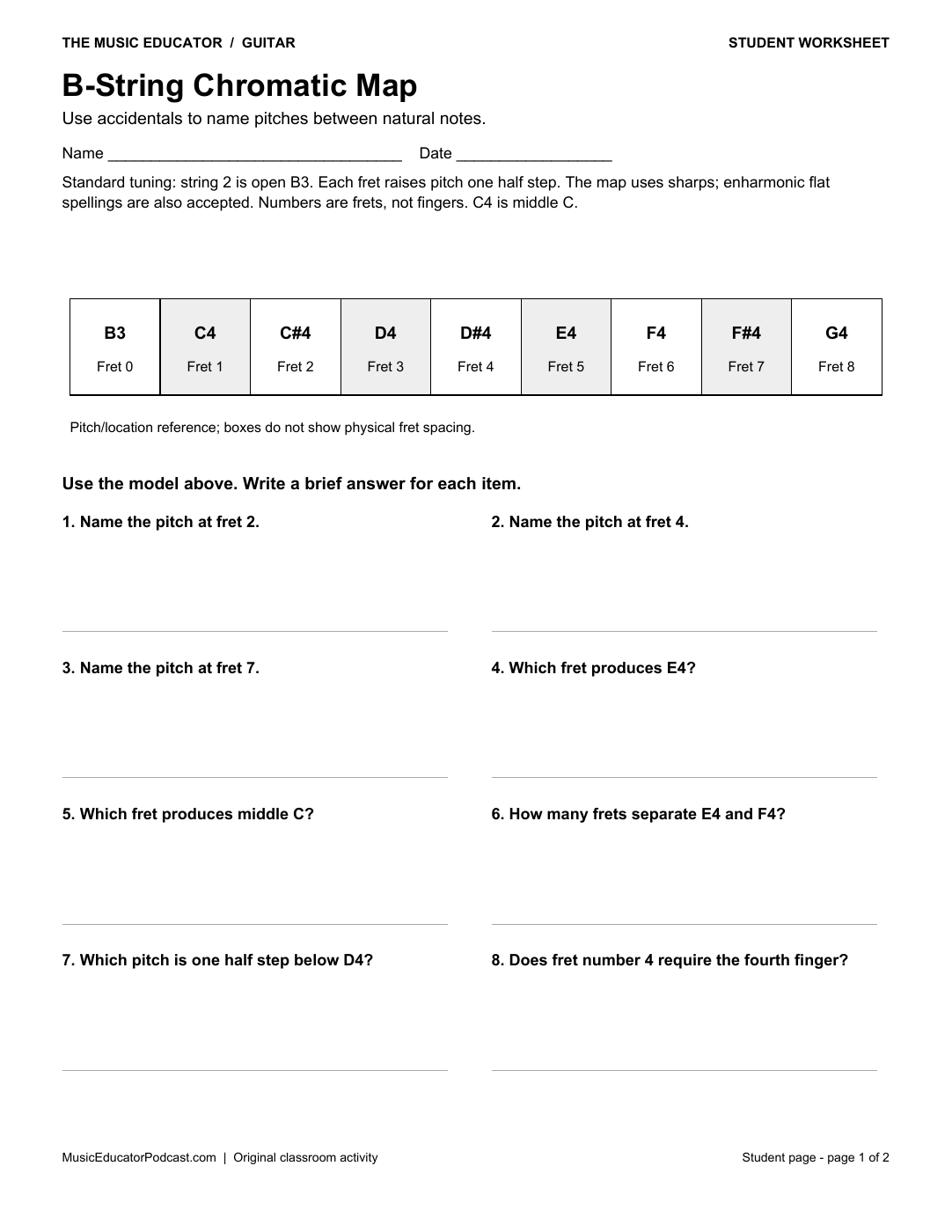
Use accidentals to name pitches between natural notes. Standard tuning: string 2 is open B3. Each fret raises pitch one half step. The map uses sharps; enharmonic flat spellings are also accepted. Numbers are frets, not fingers. C4 is middle C.
Download B-String Chromatic Map (PDF)Student worksheet on page 1; matching answer key on page 2.
Preview the student worksheet
2. Same Pitch, Different Strings
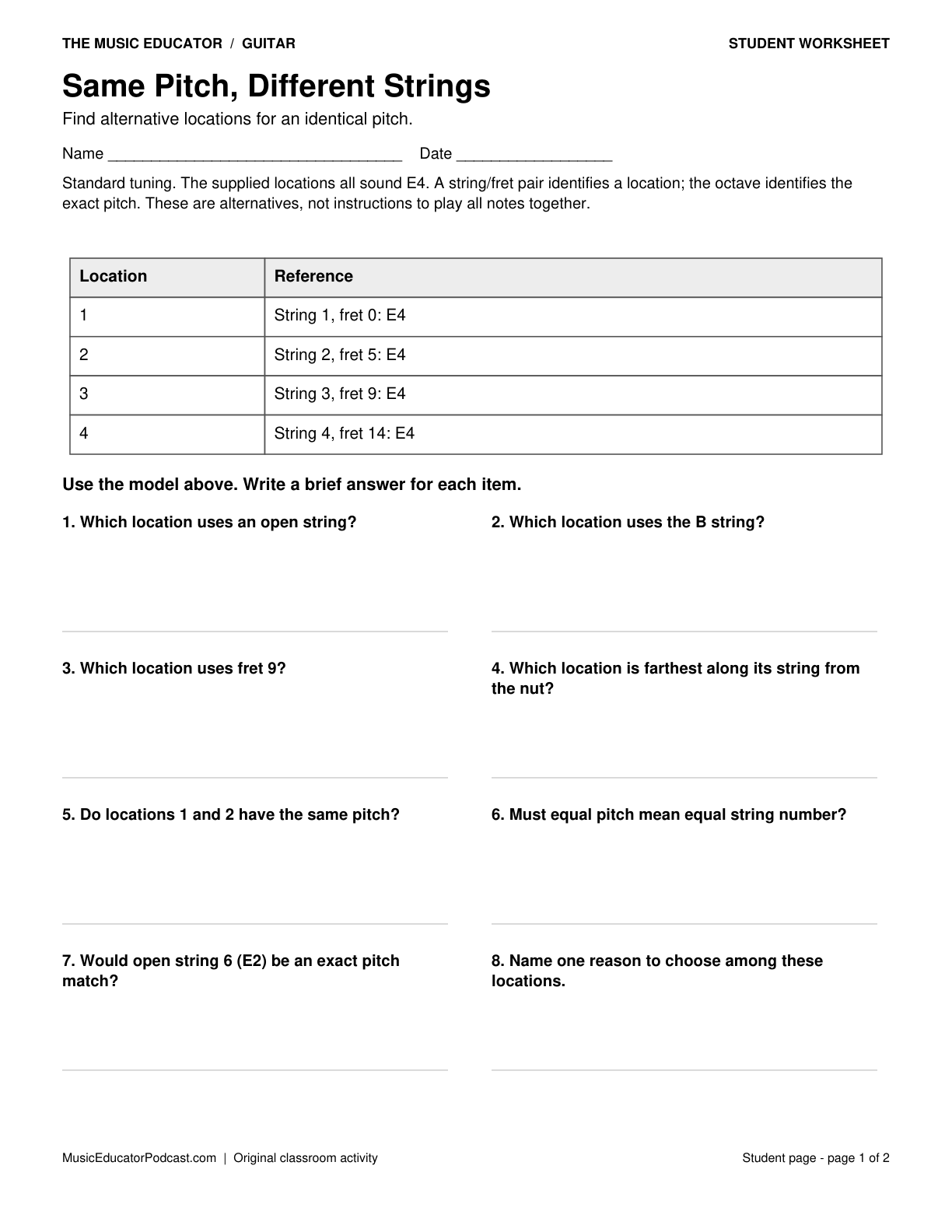
Find alternative locations for an identical pitch. Standard tuning. The supplied locations all sound E4. A string/fret pair identifies a location; the octave identifies the exact pitch. These are alternatives, not instructions to play all notes together.
Download Same Pitch, Different Strings (PDF)Student worksheet on page 1; matching answer key on page 2.
Preview the student worksheet
3. Twelve-Fret Octave Map
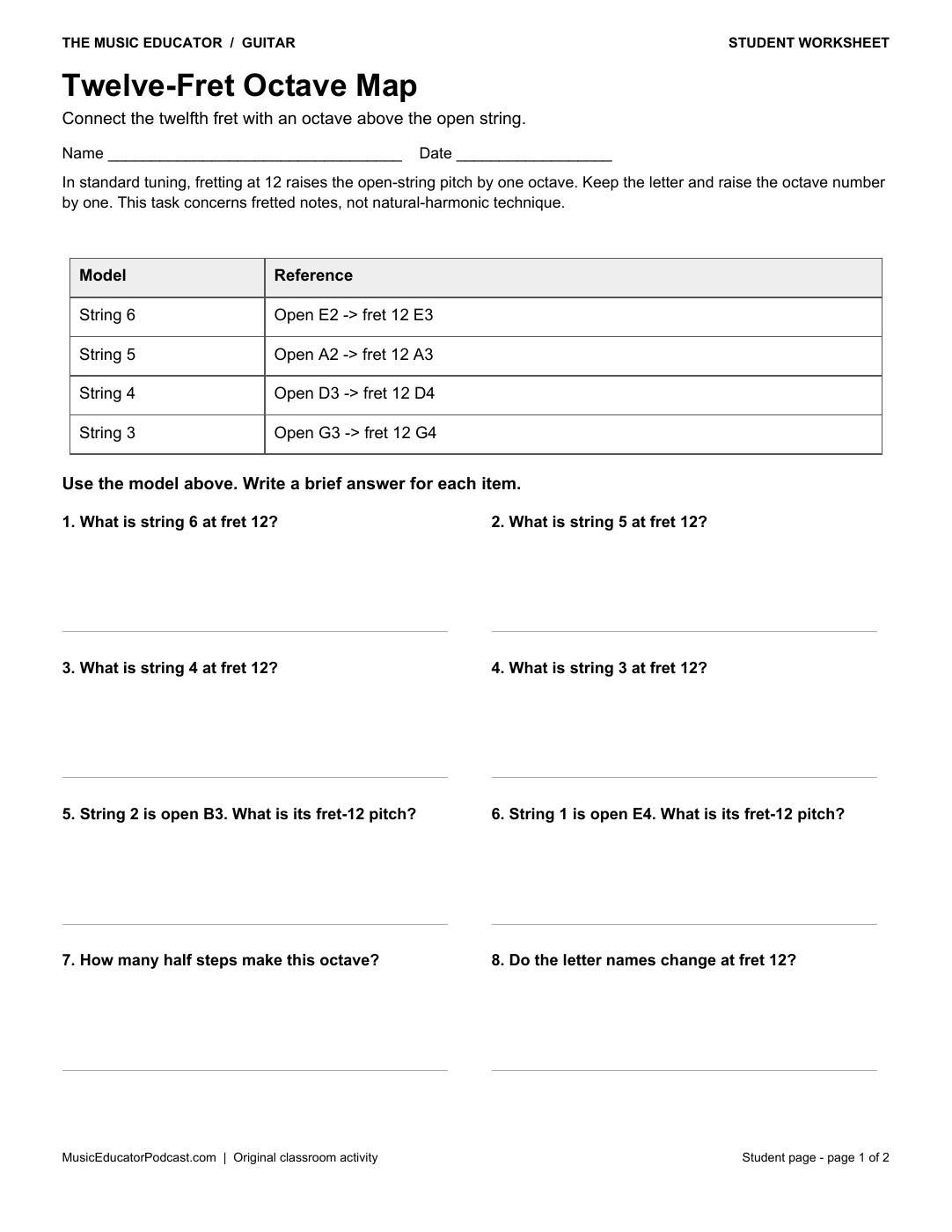
Connect the twelfth fret with an octave above the open string. In standard tuning, fretting at 12 raises the open-string pitch by one octave. Keep the letter and raise the octave number by one. This task concerns fretted notes, not natural-harmonic technique.
Download Twelve-Fret Octave Map (PDF)Student worksheet on page 1; matching answer key on page 2.
Preview the student worksheet
4. C-Major Shape Audit
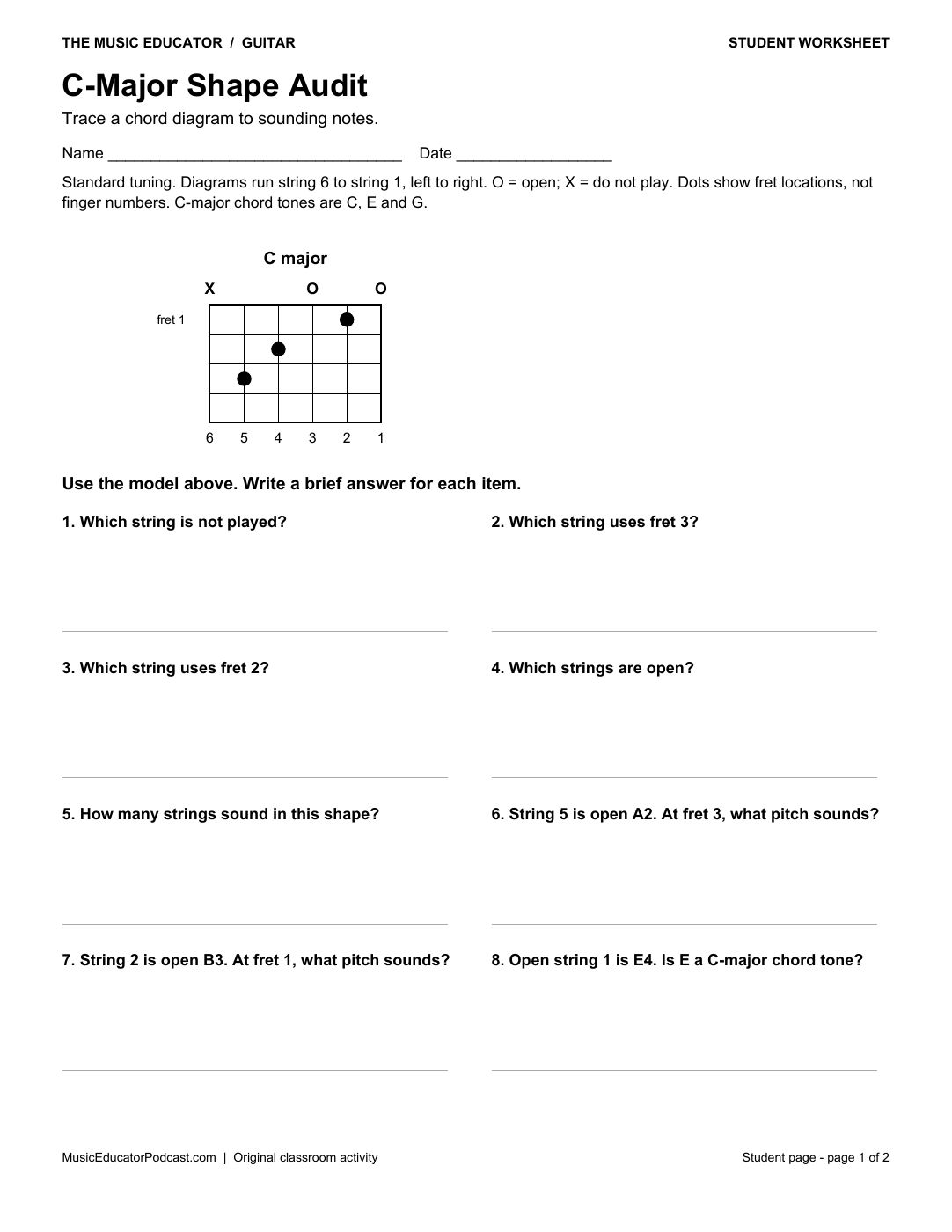
Trace a chord diagram to sounding notes. Standard tuning. Diagrams run string 6 to string 1, left to right. O = open; X = do not play. Dots show fret locations, not finger numbers. C-major chord tones are C, E and G.
Download C-Major Shape Audit (PDF)Student worksheet on page 1; matching answer key on page 2.
Preview the student worksheet
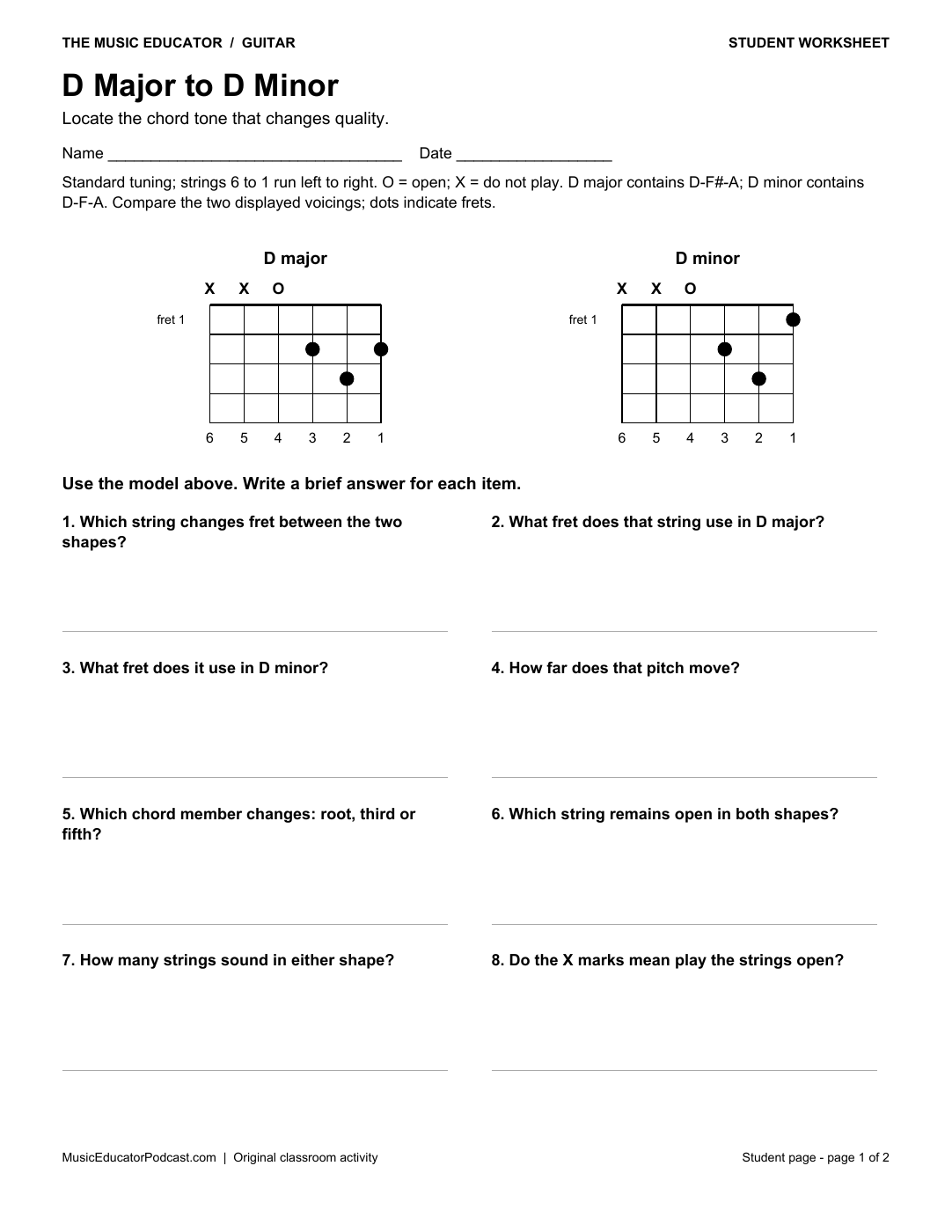
5. D Major to D Minor
Locate the chord tone that changes quality. Standard tuning; strings 6 to 1 run left to right. O = open; X = do not play. D major contains D-F#-A; D minor contains D-F-A. Compare the two displayed voicings; dots indicate frets.
Download D Major to D Minor (PDF)Student worksheet on page 1; matching answer key on page 2.
Preview the student worksheet
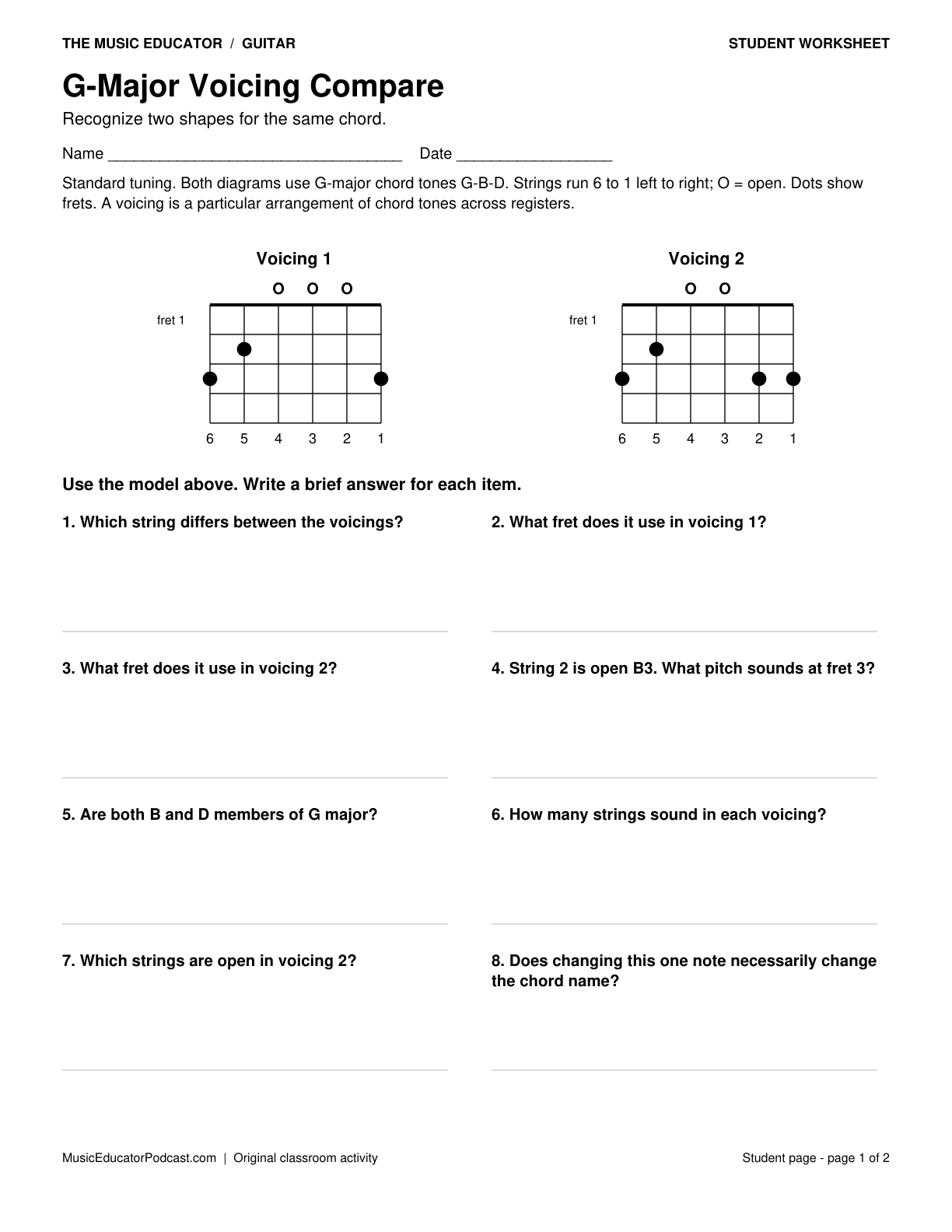
6. G-Major Voicing Compare
Recognize two shapes for the same chord. Standard tuning. Both diagrams use G-major chord tones G-B-D. Strings run 6 to 1 left to right; O = open. Dots show frets. A voicing is a particular arrangement of chord tones across registers.
Download G-Major Voicing Compare (PDF)Student worksheet on page 1; matching answer key on page 2.
Preview the student worksheet
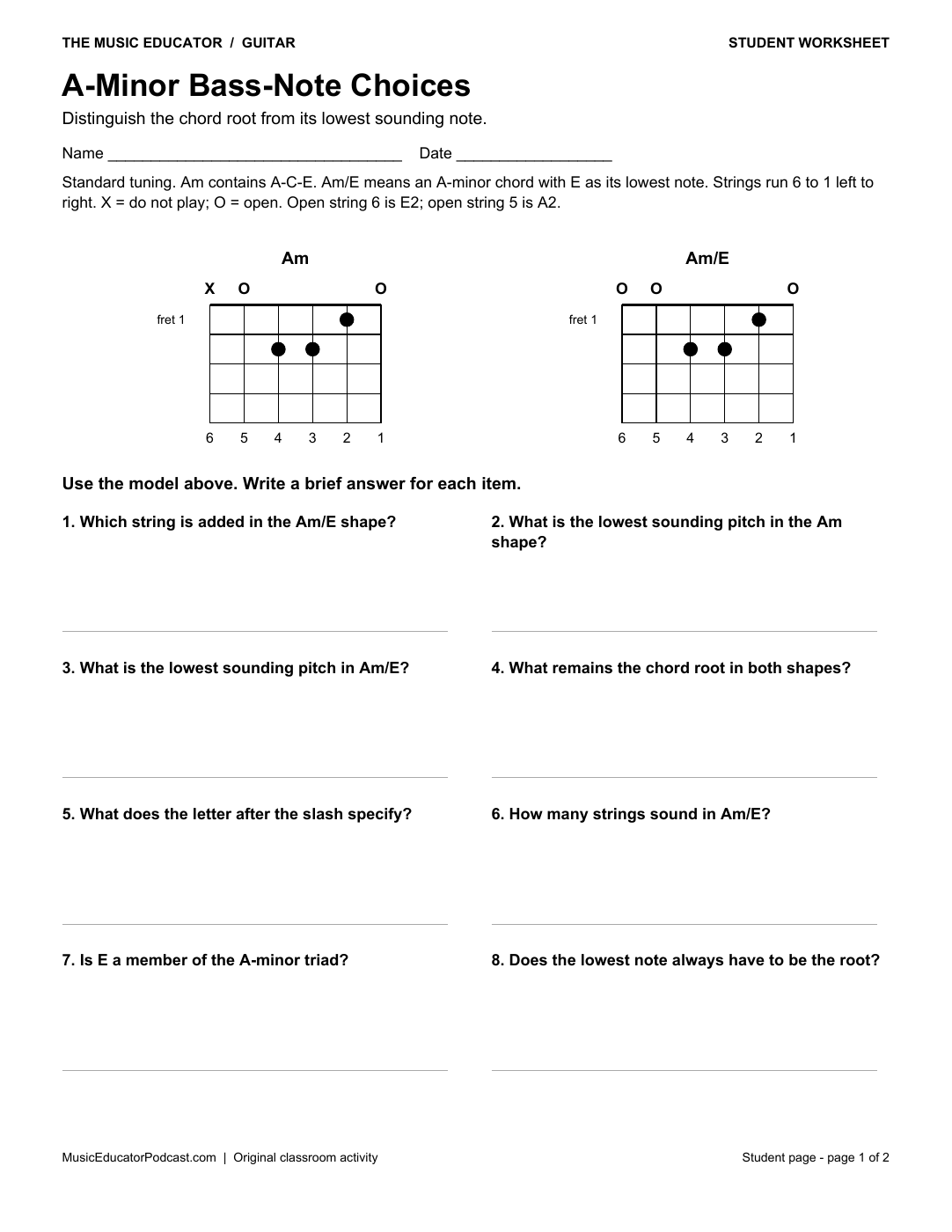
7. A-Minor Bass-Note Choices
Distinguish the chord root from its lowest sounding note. Standard tuning. Am contains A-C-E. Am/E means an A-minor chord with E as its lowest note. Strings run 6 to 1 left to right. X = do not play; O = open. Open string 6 is E2; open string 5 is A2.
Download A-Minor Bass-Note Choices (PDF)Student worksheet on page 1; matching answer key on page 2.
Preview the student worksheet
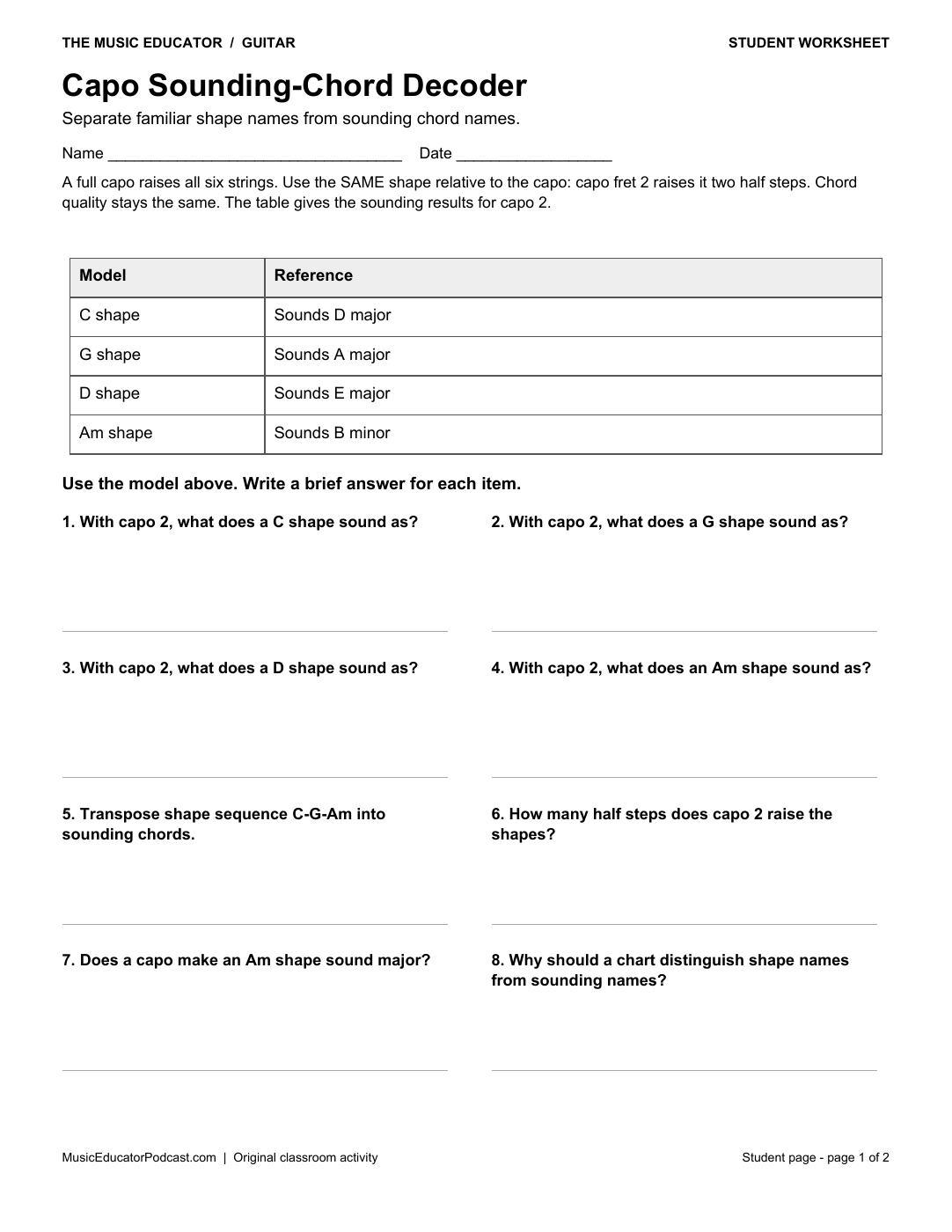
8. Capo Sounding-Chord Decoder
Separate familiar shape names from sounding chord names. A full capo raises all six strings. Use the SAME shape relative to the capo: capo fret 2 raises it two half steps. Chord quality stays the same. The table gives the sounding results for capo 2.
Download Capo Sounding-Chord Decoder (PDF)Student worksheet on page 1; matching answer key on page 2.
Preview the student worksheet
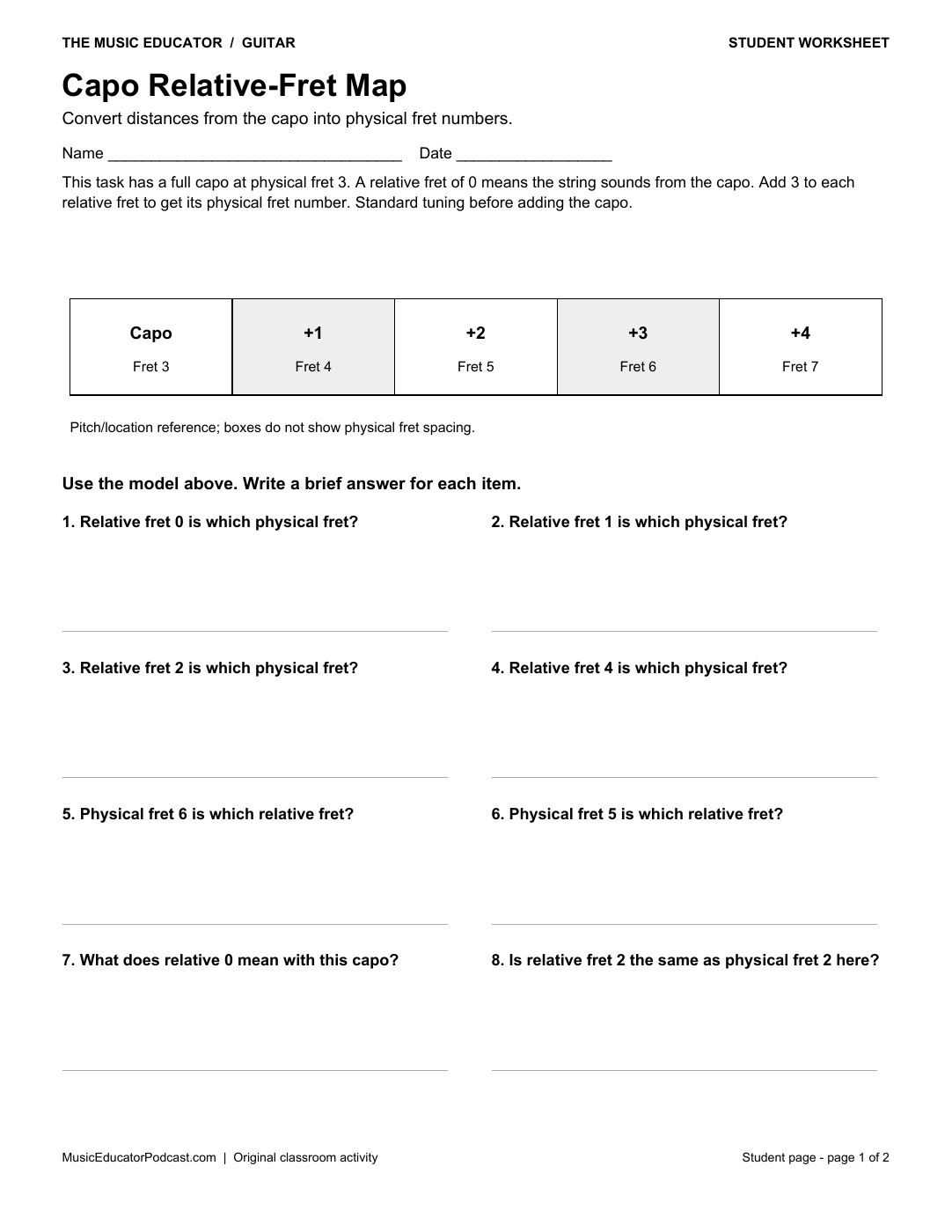
9. Capo Relative-Fret Map
Convert distances from the capo into physical fret numbers. This task has a full capo at physical fret 3. A relative fret of 0 means the string sounds from the capo. Add 3 to each relative fret to get its physical fret number. Standard tuning before adding the capo.
Download Capo Relative-Fret Map (PDF)Student worksheet on page 1; matching answer key on page 2.
Preview the student worksheet
10. Power-Chord Structure
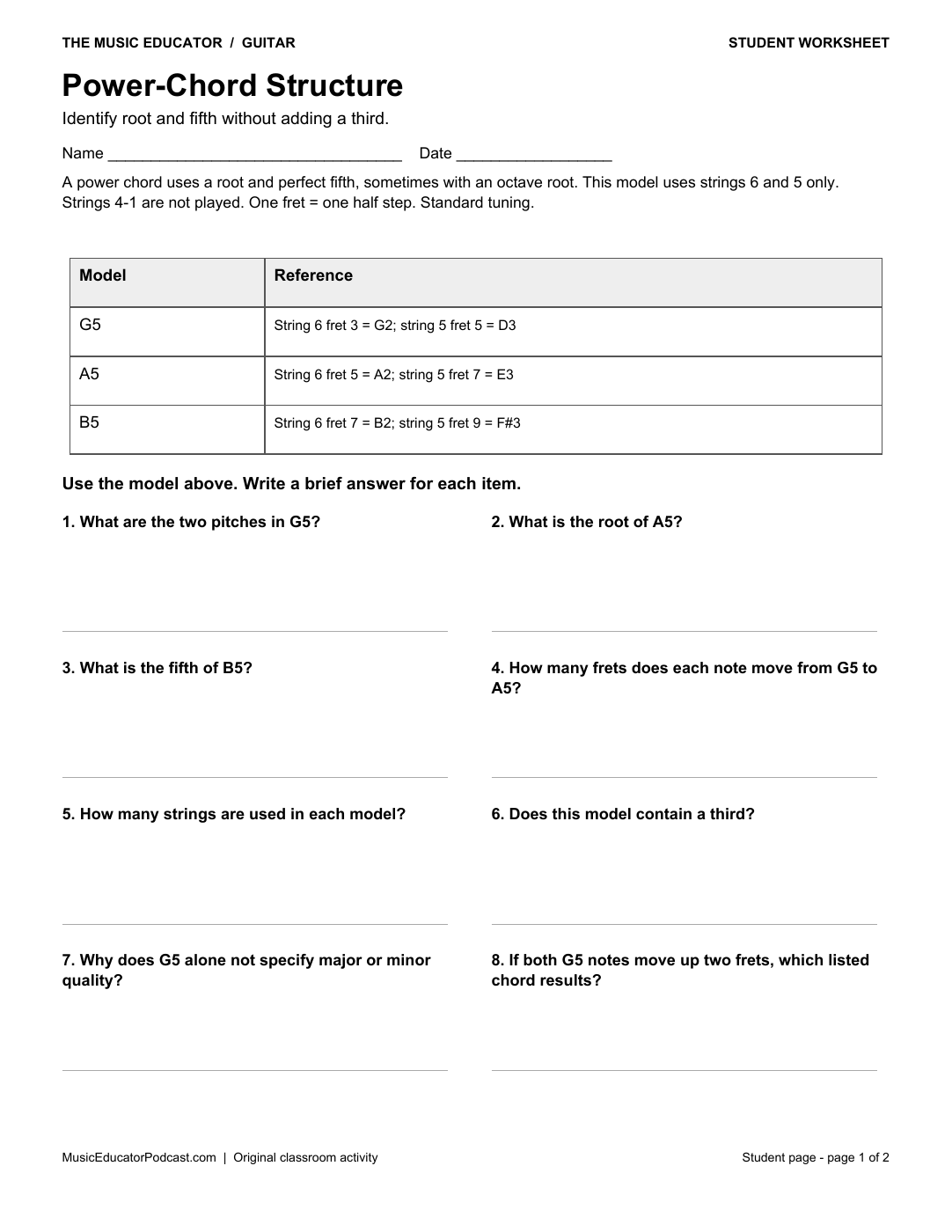
Identify root and fifth without adding a third. A power chord uses a root and perfect fifth, sometimes with an octave root. This model uses strings 6 and 5 only. Strings 4-1 are not played. One fret = one half step. Standard tuning.
Download Power-Chord Structure (PDF)Student worksheet on page 1; matching answer key on page 2.
Preview the student worksheet
11. Tab Stacks and Sequences
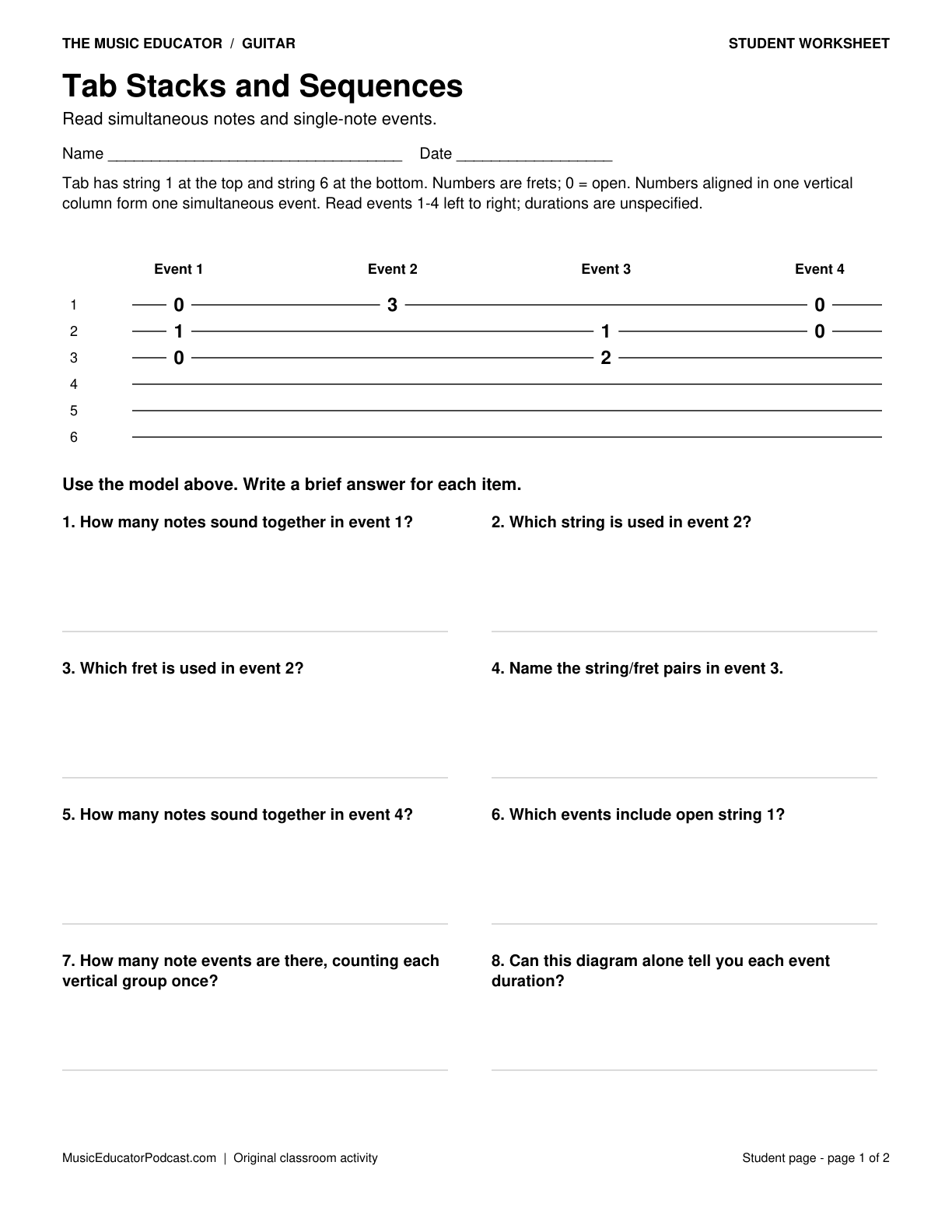
Read simultaneous notes and single-note events. Tab has string 1 at the top and string 6 at the bottom. Numbers are frets; 0 = open. Numbers aligned in one vertical column form one simultaneous event. Read events 1-4 left to right; durations are unspecified.
Download Tab Stacks and Sequences (PDF)Student worksheet on page 1; matching answer key on page 2.
Preview the student worksheet
12. Tab with Beat Lengths
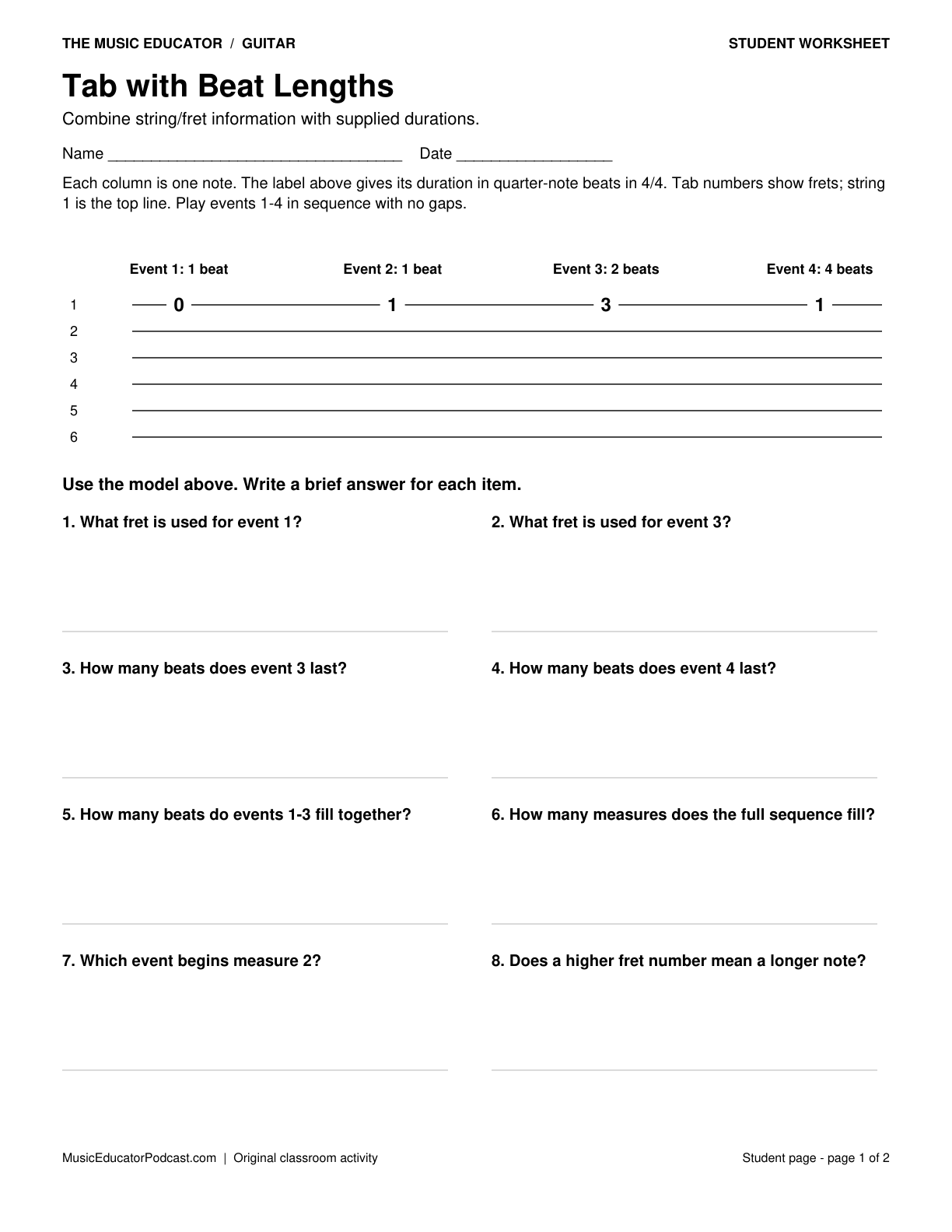
Combine string/fret information with supplied durations. Each column is one note. The label above gives its duration in quarter-note beats in 4/4. Tab numbers show frets; string 1 is the top line. Play events 1-4 in sequence with no gaps.
Download Tab with Beat Lengths (PDF)Student worksheet on page 1; matching answer key on page 2.
Preview the student worksheet
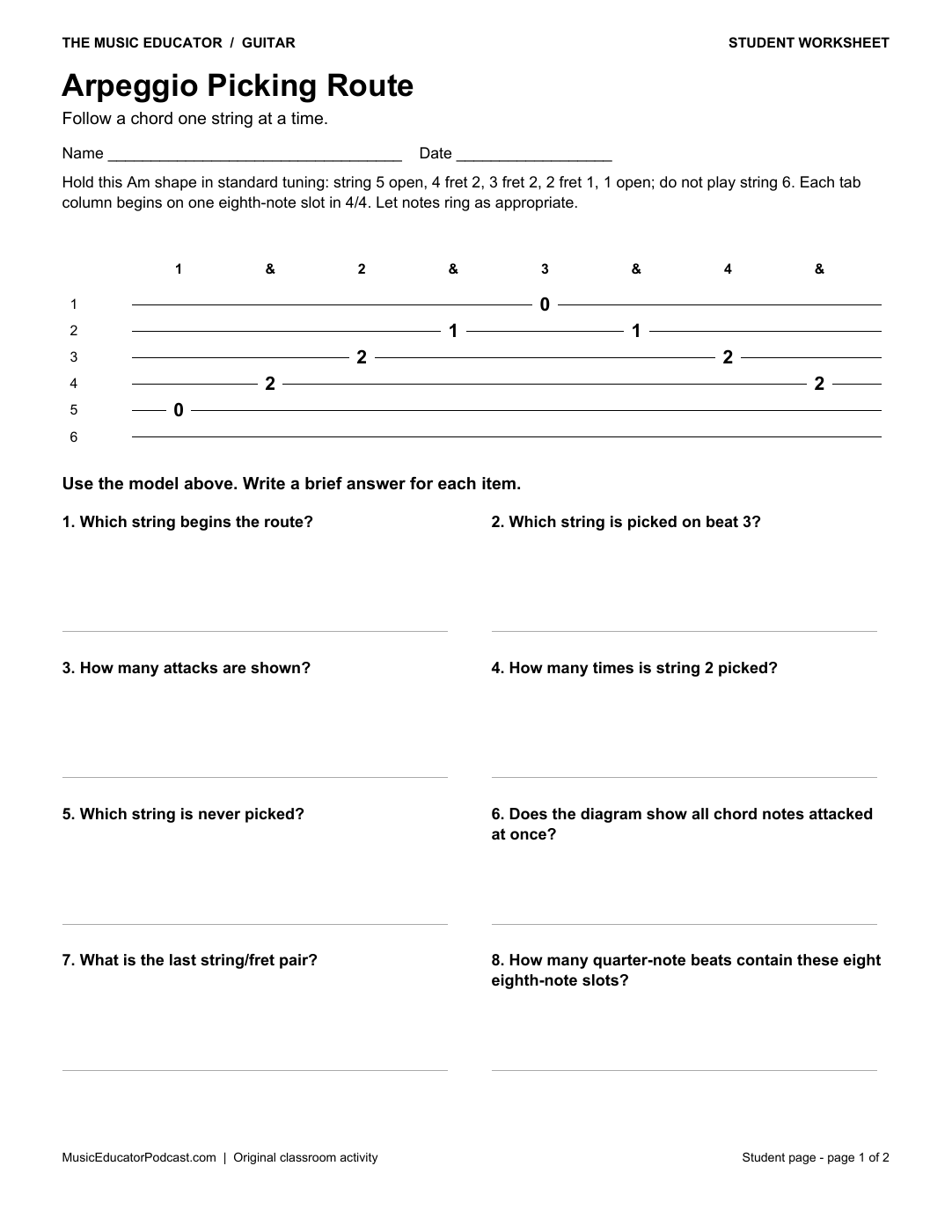
13. Arpeggio Picking Route
Follow a chord one string at a time. Hold this Am shape in standard tuning: string 5 open, 4 fret 2, 3 fret 2, 2 fret 1, 1 open; do not play string 6. Each tab column begins on one eighth-note slot in 4/4. Let notes ring as appropriate.
Download Arpeggio Picking Route (PDF)Student worksheet on page 1; matching answer key on page 2.
Preview the student worksheet
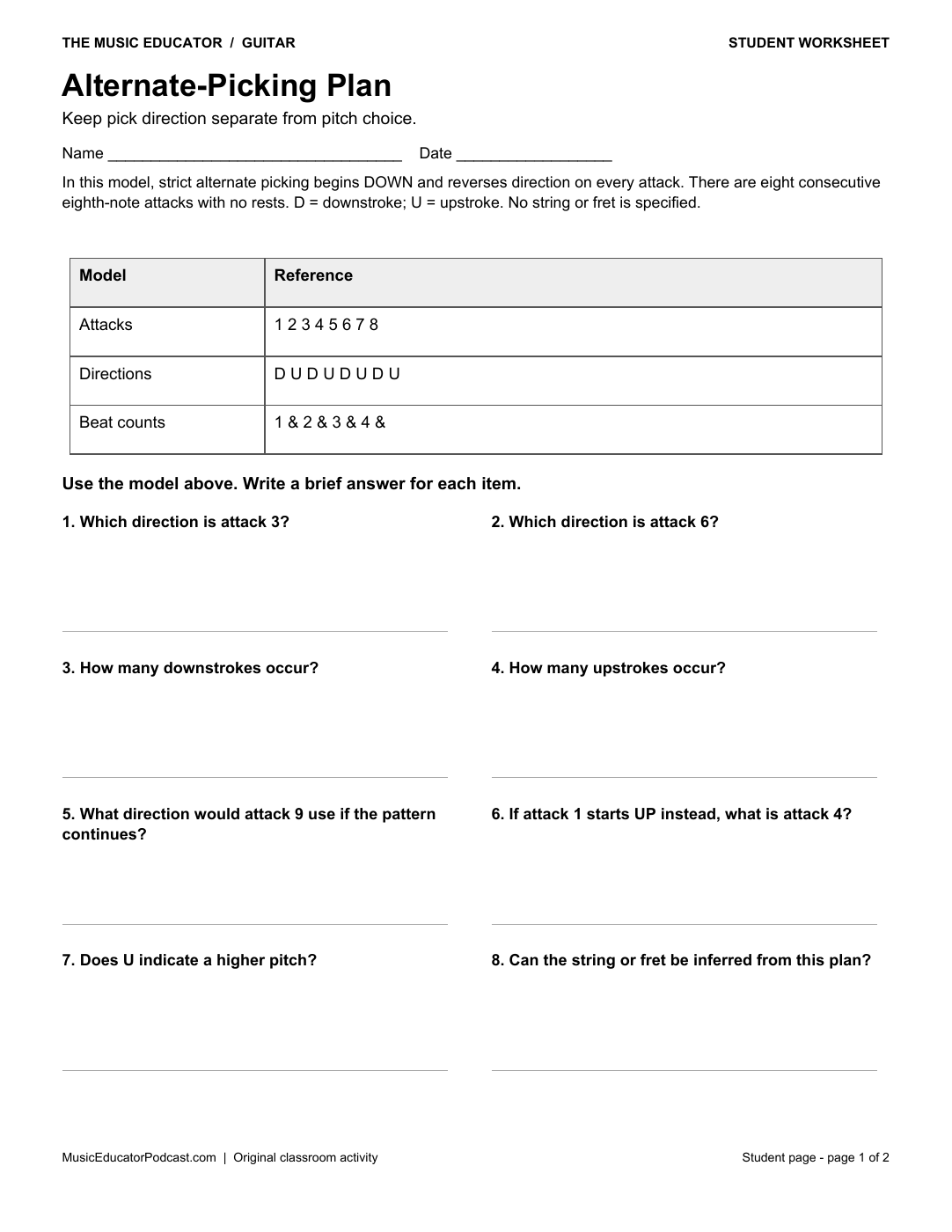
14. Alternate-Picking Plan
Keep pick direction separate from pitch choice. In this model, strict alternate picking begins DOWN and reverses direction on every attack. There are eight consecutive eighth-note attacks with no rests. D = downstroke; U = upstroke. No string or fret is specified.
Download Alternate-Picking Plan (PDF)Student worksheet on page 1; matching answer key on page 2.
Preview the student worksheet
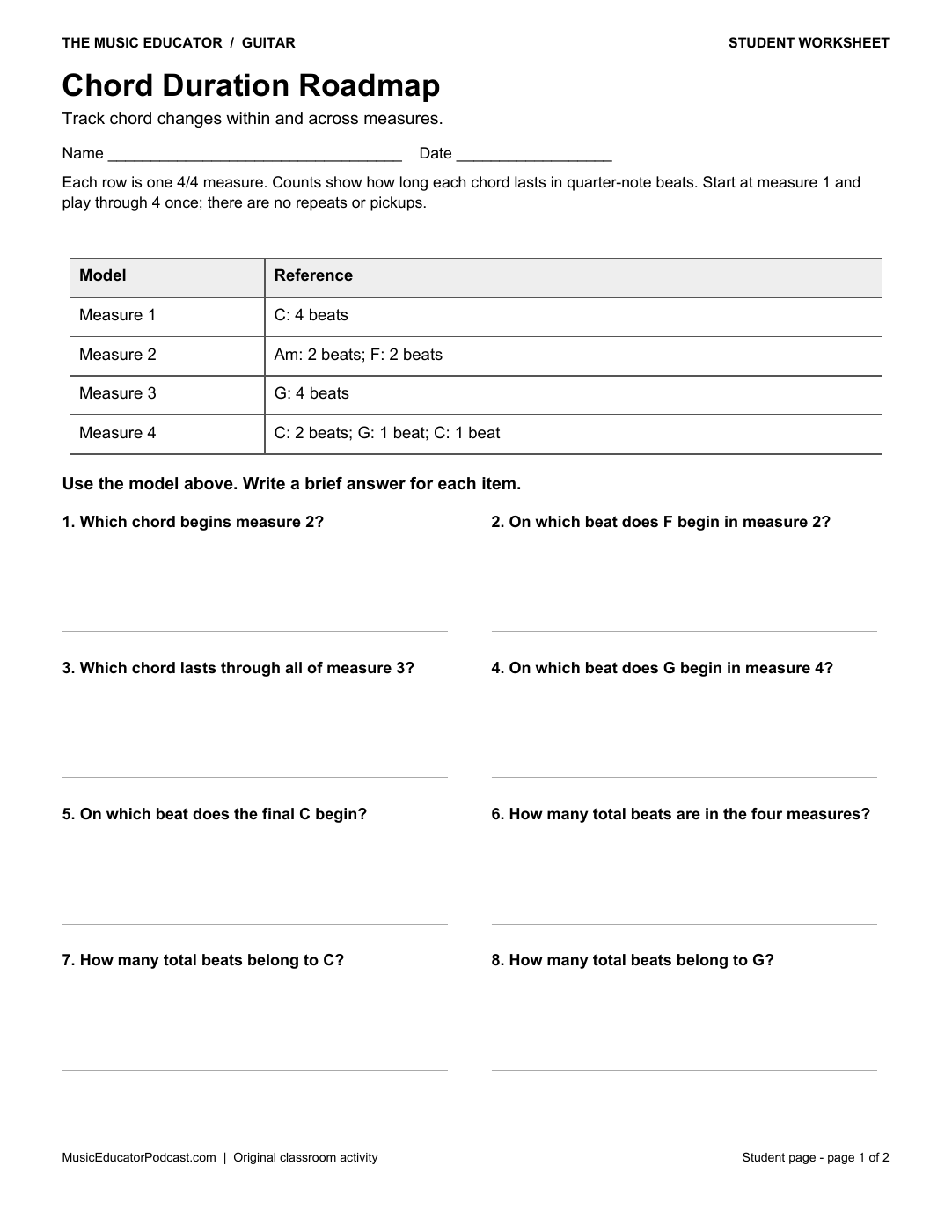
15. Chord Duration Roadmap
Track chord changes within and across measures. Each row is one 4/4 measure. Counts show how long each chord lasts in quarter-note beats. Start at measure 1 and play through 4 once; there are no repeats or pickups.
Download Chord Duration Roadmap (PDF)Student worksheet on page 1; matching answer key on page 2.
Preview the student worksheet
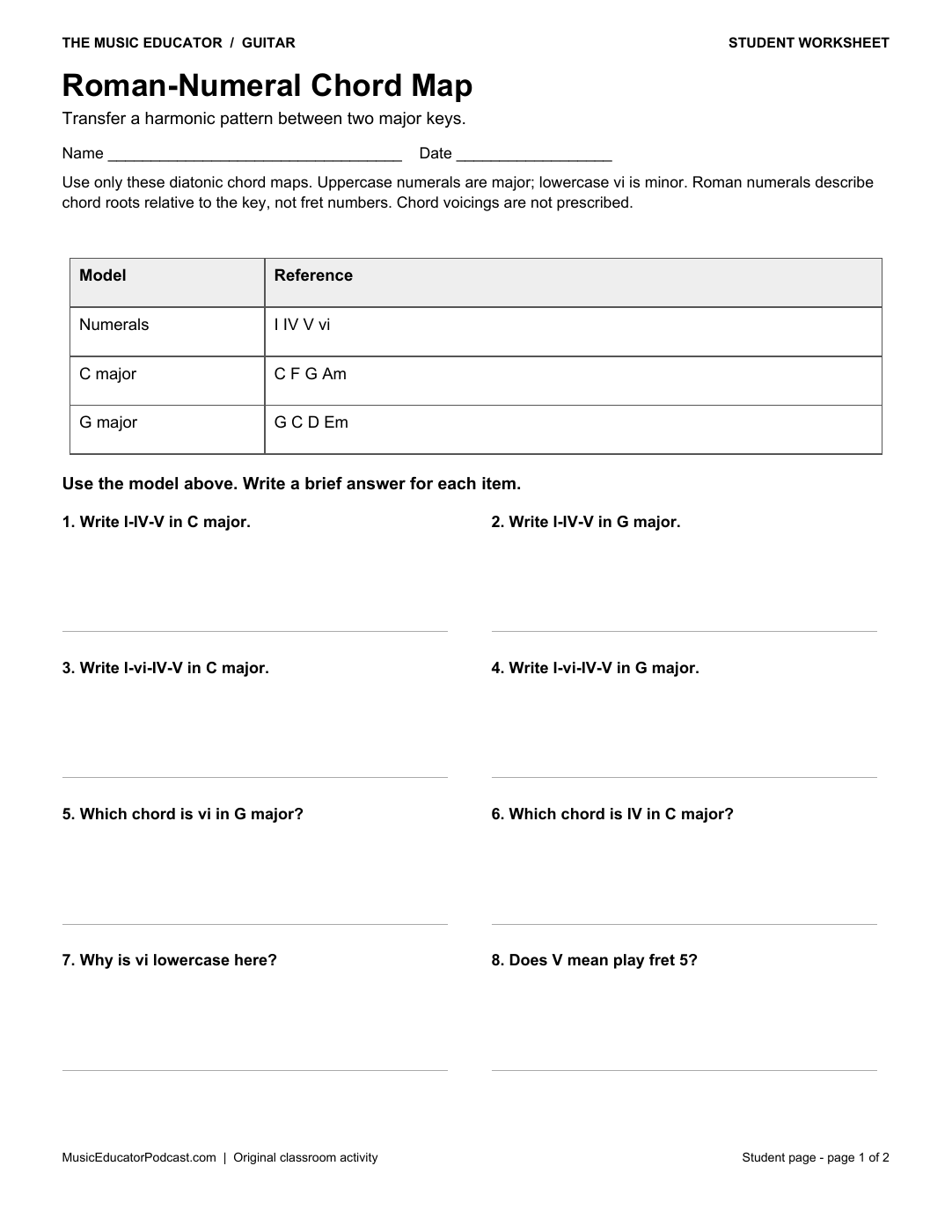
16. Roman-Numeral Chord Map
Transfer a harmonic pattern between two major keys. Use only these diatonic chord maps. Uppercase numerals are major; lowercase vi is minor. Roman numerals describe chord roots relative to the key, not fret numbers. Chord voicings are not prescribed.
Download Roman-Numeral Chord Map (PDF)Student worksheet on page 1; matching answer key on page 2.
Preview the student worksheet
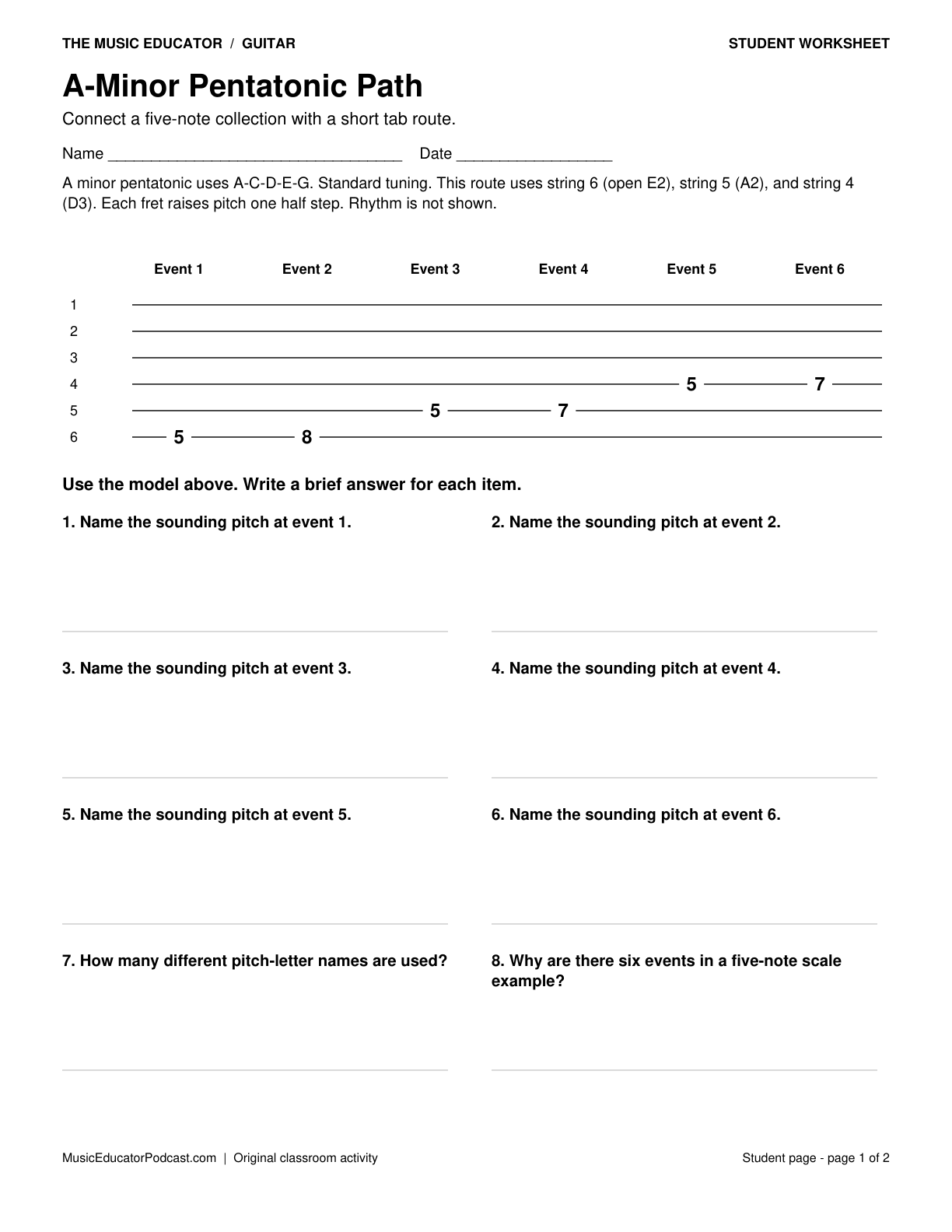
17. A-Minor Pentatonic Path
Connect a five-note collection with a short tab route. A minor pentatonic uses A-C-D-E-G. Standard tuning. This route uses string 6 (open E2), string 5 (A2), and string 4 (D3). Each fret raises pitch one half step. Rhythm is not shown.
Download A-Minor Pentatonic Path (PDF)Student worksheet on page 1; matching answer key on page 2.
Preview the student worksheet
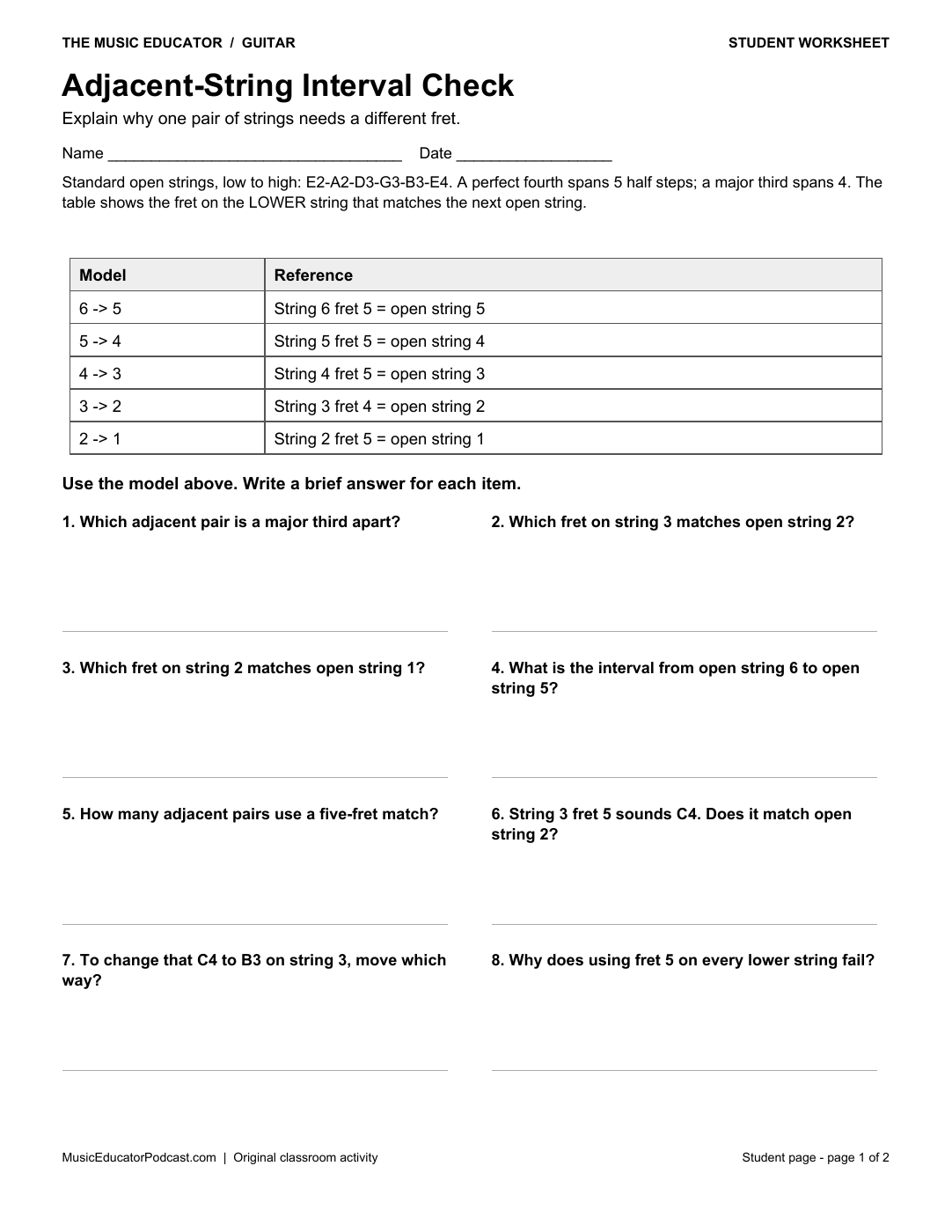
18. Adjacent-String Interval Check
Explain why one pair of strings needs a different fret. Standard open strings, low to high: E2-A2-D3-G3-B3-E4. A perfect fourth spans 5 half steps; a major third spans 4. The table shows the fret on the LOWER string that matches the next open string.
Download Adjacent-String Interval Check (PDF)Student worksheet on page 1; matching answer key on page 2.
Preview the student worksheet
Frequently asked questions
Are answer keys included?
Yes. Each individual PDF contains the student page followed by its key. The full packet groups all 18 student pages before the 18 keys.
Can I print these in black and white?
Yes. The pages use black text, line diagrams and light gray shading. No question depends on color.
Are these complete fingering or performance guides?
No. Chord dots identify fret locations, and tab numbers identify frets. The activities focus on reading and reasoning; choose practical fingerings with your teacher.
Which students are these for?
Use them with students who recognize guitar string numbers and basic fret and chord vocabulary. Each page supplies its own model. Introduce octave numbers, accidentals or Roman numerals first when those ideas are new to the class.